Ask a class of Year 4 children what they know about Greek mythology, and someone will mention a monster. Someone else will mention Hercules. A third child will tell you, with total confidence, something about Zeus that they picked up from a film. Those half-remembered fragments are among the best starting points in the primary curriculum, because Greek mythological stories arrive already loaded with the very thing teachers spend most of their time trying to build: genuine curiosity.
LearningMole is a UK educational platform providing curriculum-aligned teaching resources for primary schools, and Greek myths sit among the topics teachers ask about most often when planning KS2 history and literacy work.
This guide covers what a myth actually is, who the twelve Olympian gods were, and eight Greek mythological stories that children remember years after the topic ends. It also covers the parts most retellings skip: how these myths shaped everyday English words, where the physical evidence of Greek myth survives in British soil, and how the topic maps onto the National Curriculum for Key Stage 2. The stories are the hook. The rest is what turns a lively week of lessons into secure knowledge.
Written for UK primary teachers planning ancient Greece units, parents supporting curious children at home, and home educators building a humanities sequence, this guide keeps the retellings accurate and age-appropriate. Where a myth has a darker version, that is flagged rather than glossed over, because knowing which details to leave out is part of teaching this topic well. If your class is heading towards a broader period, our guide to ancient Greek life for children covers the historical context that accompanies the myths.
What Is a Myth, and What Makes Greek Mythology Different?
A myth is a traditional story that a culture told to explain something it could not otherwise account for: how the world began, why the seasons change, why humans suffer, or why a particular mountain, river or star carries the name it does. Myths were not private entertainment. They were shared, public accounts that carried religious and moral weight, which is what separates a myth from a fairy tale or a fable.
Greek mythology is the body of stories from ancient Greece, told and retold from roughly the eighth century BC onwards in the poems of Homer and Hesiod, then in the plays of Athenian dramatists, and later by Roman writers who inherited and adapted them. Two features make the Greek collection unusual. First, it is enormous and interconnected: the gods, heroes and monsters share family trees, grudges and repeat appearances across hundreds of separate stories. Second, it survived in writing, sculpture, and on painted pottery, so we can read the Greek versions rather than reconstruct them from fragments.
For children, the useful definition is short. A myth is a very old story that explains something, usually involving gods, heroes or monsters, and it was believed rather than simply enjoyed. The Greeks who told these stories were the same people who built the Parthenon, invented the democratic assembly and wrote the first histories, which is exactly why the KS2 curriculum places them where it does.
Is Greek Mythology Real?
No, the gods and monsters were not real, but some of the stories may sit on top of real events. Zeus never threw a lightning bolt from Mount Olympus. The Chimaera never existed. What historians do take seriously is the idea that a handful of myths preserve distorted memories of genuine happenings, a notion scholars call euhemerism.
The clearest example is the Trojan War. Homer describes a ten-year siege of Troy involving gods, prophecies and a hollow wooden horse. Excavations at Hisarlik in modern Turkey have uncovered a real fortified city, destroyed and rebuilt many times, and the Late Bronze Age eastern Mediterranean did see genuine warfare between real powers. Whether any single conflict became the Trojan War of the poems is unresolved. The honest answer for children is that the city was real, the war may have happened in some form, and the gods and the horse belong to the story rather than history.
Mount Olympus is also real. At 2,917 metres, it is the highest mountain in Greece, and the Greeks placed the homes of their gods on its summit precisely because it was so often lost in cloud.
The Twelve Olympians: Who Ruled Mount Olympus?
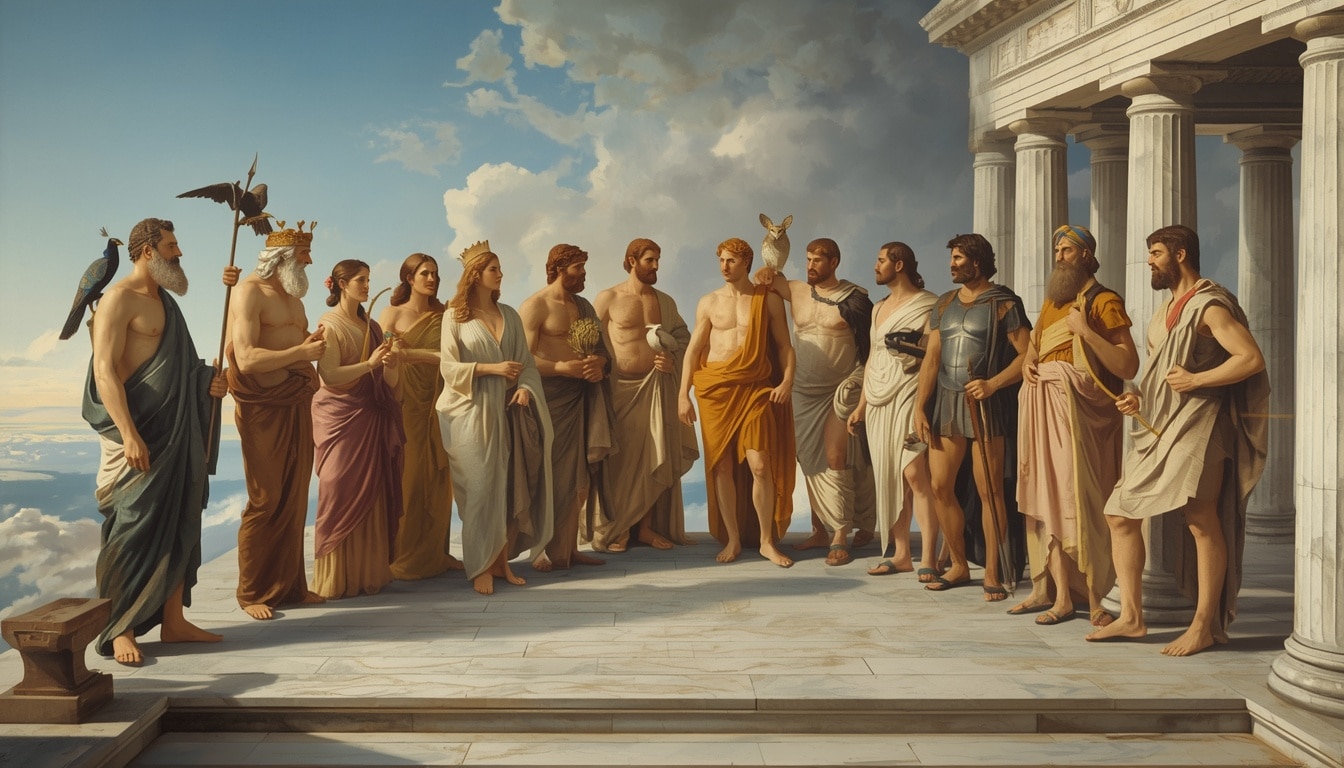
The twelve Olympians were the principal Greek gods, each holding authority over a defined part of human and natural life. They looked and behaved like people, argued constantly, took sides in human quarrels, and could change shape into animals or objects when it suited them. That very human behaviour is part of why the stories work so well with children: the gods are powerful, but they are rarely admirable.
The Greeks did not keep one fixed list, and different cities counted slightly different twelve. The version below is the one primary schools use. Hades is deliberately absent from most lists because he ruled the underworld rather than living on the mountain.
Greek name
Roman name
God or goddess of
Symbol
Zeus
Jupiter
Sky, weather, king of the gods
Lightning bolt, eagle
Hera
Juno
Marriage, childbirth, queen of the gods
Peacock, pomegranate
Poseidon
Neptune
Sea, earthquakes, horses
Trident, dolphin
Demeter
Ceres
Harvest, grain, farming
Wheat sheaf, torch
Athena
Minerva
Wisdom, warfare, crafts, cities
Owl, olive tree
Apollo
Apollo
Music, poetry, prophecy, healing, archery
Lyre, laurel wreath
Artemis
Diana
Hunting, wild animals, the moon
Bow, deer
Ares
Mars
War
Spear, helmet
Aphrodite
Venus
Love and beauty
Dove, rose, shell
Hephaestus
Vulcan
Fire, metalworking, craftsmen
Hammer, anvil
Hermes
Mercury
Travel, trade, messages
Winged sandals, staff
Dionysus
Bacchus
Wine, theatre, celebration
Grapevine, thyrsus
Two details children reliably ask about. Aphrodite’s name is linked to the Greek word aphros, meaning foam, which matches the story of her birth from the sea. Ares was widely feared but thinly worshipped: he had far fewer temples in Greece than his sister Athena, who represented the disciplined, strategic side of war rather than its violence. Our guide to the Greek gods and their roles goes further into each one, and Athena’s myths and legends cover the most curriculum-relevant of the twelve in depth.
Who Were Zeus’s Brothers and Sisters?
Zeus had three sisters, Hestia, Demeter and Hera, and two brothers, Poseidon and Hades. All six were children of the Titans Cronus and Rhea. Cronus, in turn, was the son of Uranus, the sky, and Gaia, the earth, which puts Uranus at the top of the family tree that children are usually asked to draw.
Cronus swallowed each of his children at birth to stop them from overthrowing him. Rhea hid the youngest, Zeus, and gave Cronus a stone wrapped in cloth instead. Zeus grew up, forced his father to release his siblings, and led them in a ten-year war against the Titans. After the victory, the three brothers divided the world by lot: Zeus took the sky, Poseidon the sea, and Hades the underworld.
Zeus later married his sister Hera, and their children included Ares, Hephaestus, Hebe and Eileithyia. Hestia, the eldest sister, gave up her seat among the twelve to Dionysus and took charge of the hearth instead, which is why she appears in some lists and not others.
Greek and Roman Names: Why the Same God Has Two
The Romans adopted most of the Greek gods and matched them to their own deities, keeping the stories and changing the names. Zeus became Jupiter, Athena became Minerva, and Aphrodite became Venus. Apollo kept his name in both.
This matters more than it looks in UK teaching, because almost every physical trace of these gods on British soil bears a Roman name. A class studying Athena will meet her in Bath as Minerva. It also explains a run of English words: the planets, the months of March and January, and volcano from Vulcan all come through the Roman versions rather than the Greek.
Eight Greek Mythology Stories Children Remember
The myths below are the ones that work hardest in a primary classroom. Each one explains something, carries a clear moral question, and can be told in five minutes.
Persephone and Hades: Why the Seasons Change
Persephone, daughter of Zeus and Demeter, was gathering flowers when Hades carried her off to the underworld to be his queen. Demeter, goddess of the harvest, searched the earth for her daughter and let every crop wither. People began to starve.
Zeus ordered Hades to return her. Hades agreed, but Persephone had already eaten pomegranate seeds from the underworld, and anyone who ate there was bound to return. The settlement was a divided year: Persephone spends part of it below ground with Hades, when Demeter grieves, and nothing grows, and the rest above ground with her mother, when the earth turns green again. That is the Greek explanation for winter and summer.
Echo and Narcissus: Where the Word Echo Comes From
Narcissus was a young man so beautiful that everyone who saw him fell in love, and so vain that he cared for nobody. Echo, a nymph, loved him hopelessly. She had already been cursed so that she could not speak first and could only repeat the last words she heard, which left her unable to tell him anything at all.
Narcissus rejected her, then caught sight of his own reflection in a pool and fell in love with it. He could not leave, and he wasted away beside the water. Echo faded too, until only her voice was left, still repeating what others say. Two English words come straight out of this story: echo and narcissism.
Hercules and the Twelve Labours
Hercules, called Heracles in Greek, was the son of Zeus and a mortal woman named Alcmene, which made him a demigod. Hera, Zeus’s wife, hated him from birth and sent two snakes into his cradle. The infant Hercules strangled them.
Her hostility followed him into adulthood. Hera drove him into a madness in which he killed his own wife and children. When he came to his senses, Hercules went to the Oracle at Delphi to ask how he could atone. The Oracle sent him to serve his cousin Eurystheus, king of Mycenae, who set him twelve near-impossible tasks: the Nemean lion, the Hydra, the Erymanthian boar, the Augean stables and nine more. He completed every one, and the phrase a Herculean task has meant an enormous job ever since.
Orpheus and Eurydice: The One Rule He Broke
Orpheus was the finest musician in the world. When his wife Eurydice died, he walked into the underworld and played until Hades himself agreed to release her, on one condition: Orpheus must lead her out without looking back.
He almost managed it. At the last moment, unable to hear her footsteps, he turned to check she was still behind him. She vanished. The story is short, brutal and unusually good for discussion work, because children immediately want to argue about whether the condition was fair.
Pandora’s Jar: The Story of Curiosity
Pandora was the first woman, made by the gods and given a sealed container she was told never to open. Curiosity won. Out came sickness, sorrow and every trouble that afflicts people, and only one thing stayed behind: hope.
The famous phrase is wrong, and that is worth telling children. The Greek word Hesiod used was pithos, a large storage jar. A sixteenth-century translator rendered it as box, and Pandora’s box has been stuck in English ever since.
Icarus and Daedalus: The Danger of Not Listening
Daedalus, an inventor imprisoned on Crete with his son Icarus, built two pairs of wings from feathers and wax so they could escape by air. He gave one instruction: fly neither too low, where the sea spray would soak the feathers, nor too high, where the sun would melt the wax.
Icarus flew higher and higher. The wax melted, the feathers scattered, and he fell into the sea. It is the oldest cautionary tale in the collection and the easiest one for children to map onto their own experience of ignoring a warning.
King Midas: A Lesson in Greed
Midas, a wealthy king, was granted one wish and asked that everything he touched turn to gold. It worked exactly as requested. His furniture, his roses and his food all turned to metal, and in most versions, his daughter did too.
Midas begged to have the gift removed and was told to wash in the river Pactolus, which carried the gold away. The Midas touch now means an ability to make money, which rather misses the point the Greeks were making.
Arachne: The Weaving Contest
Arachne was a mortal weaver who claimed her work was finer than Athena’s. Athena challenged her to a contest. Accounts differ on who wove better, but Arachne’s weaving mocked the gods, and Athena, furious, turned her into a spider condemned to weave forever.
The story explains a name: spiders belong to the class Arachnida. It also raises a question that children find genuinely difficult: whether Arachne was punished for boasting or for being right.
Why Greek Myths Are Still Everywhere in English
Greek mythology never left the language, and pointing that out is the fastest way to convince a sceptical child that this topic matters now. Dozens of everyday English words carry a god, hero or monster inside them, and a word hunt makes an excellent twenty-minute literacy activity.
Word or phrase
Comes from
Meaning today
Achilles’ heel
Achilles, vulnerable only at his heel
A single weak point
Panic
Pan, whose shout terrified travellers
Sudden overwhelming fear
Museum
The Muses, goddesses of the arts
A place of collections
Atlas
The Titan who held up the sky
A book of maps
Titanic
The Titans, giant elder gods
Enormous in scale
Siren
The Sirens, whose singing lured sailors
A warning sound; a tempting danger
Nemesis
Nemesis, goddess of retribution
An unbeatable rival
Tantalise
Tantalus, kept from food just out of reach
To tempt without satisfying
Odyssey
Odysseus’s ten-year journey home
A long, eventful journey
Chaos
Chaos, the void before creation
Total disorder
The same pattern runs through science and space. Planets carry Roman god names, the Olympic Games take their name from Olympia, and arachnid, narcissus and hygiene all trace back to figures in these stories. Modern retellings keep the cycle going, from children’s fiction series built entirely around the Olympians to films that borrow the gods wholesale, which means most children arrive with some prior knowledge already in place. That prior knowledge is usually part right, and part scrambled, and correcting it is half the lesson.
Children also frequently ask whether Thor belongs here. He does not. Thor, Odin and Loki come from Norse mythology, a separate tradition from northern Europe with its own gods and its own end-of-the-world story. Comparing the two makes a strong lesson in itself, and our guide to Norse and Viking mythology sets out the differences, while Celtic mythology covers the tradition closest to home.
Greek Myths in Britain: The Evidence Under Our Feet
Greek myths reached Britain with the Romans, and the physical proof is still here, which gives UK teachers something no general mythology article offers: a local, visitable link to a topic that otherwise feels very far away.
The strongest example is a mosaic floor found in 1963 at Hinton St Mary in Dorset. One of its panels shows the Greek hero Bellerophon riding the winged horse Pegasus and spearing the Chimaera, a monster with a lion’s head, a goat’s head on its back and a serpent for a tail. The mosaic dates to the fourth century AD and is held by the British Museum. A Romano-British landowner in Dorset chose a Greek myth for his floor, roughly a thousand years after the Greeks first told it.
The same scene appears again at Lullingstone Roman Villa in Kent, alongside a second panel showing Europa being carried off by a bull, which is Zeus in disguise. In Bath, the great temple complex was dedicated to Sulis Minerva, a merging of a local British goddess with Minerva, the Roman counterpart of Athena. A class studying Athena can therefore look at a real British site where she was worshipped under another name.
This connects two KS2 units that are usually taught separately. Children study the Roman Empire and its impact on Britain, and they study ancient Greece. The mosaics are where those units physically meet, and asking why a Dorset villa owner wanted a Greek monster on his dining room floor is a proper historical enquiry question with no tidy answer.
Where Greek Mythology Fits the National Curriculum
Ancient Greece is a named study in the Key Stage 2 history programme of study, which asks pupils to examine Greek life and achievements and their influence on the Western world. Myths sit inside that requirement and also carry substantial weight in English, where the curriculum expects pupils to become familiar with myths and legends and to retell them orally.
English: myths and legends; foundation for history
Oral retelling, story structure, character description
Years 5 and 6
History: Ancient Greece study unit
Gods and beliefs, sources, Greek influence on Britain
KS3 transition
Classical civilisation, English literature
Homer, Greek drama, mythological reference in literature
Two curriculum points are worth planning around. The history unit sits in upper KS2 in most schools, but the myths are commonly taught earlier in English, so children often meet Zeus in Year 3 and the Athenian assembly in Year 5. Sequencing those deliberately, rather than by accident, saves a good deal of reteaching. Our Key Stage 2 history resources cover the wider unit, and the Greek alphabet guide supports the language link that many schools use as a bridge activity.
How to Teach Greek Mythology in the Primary Classroom
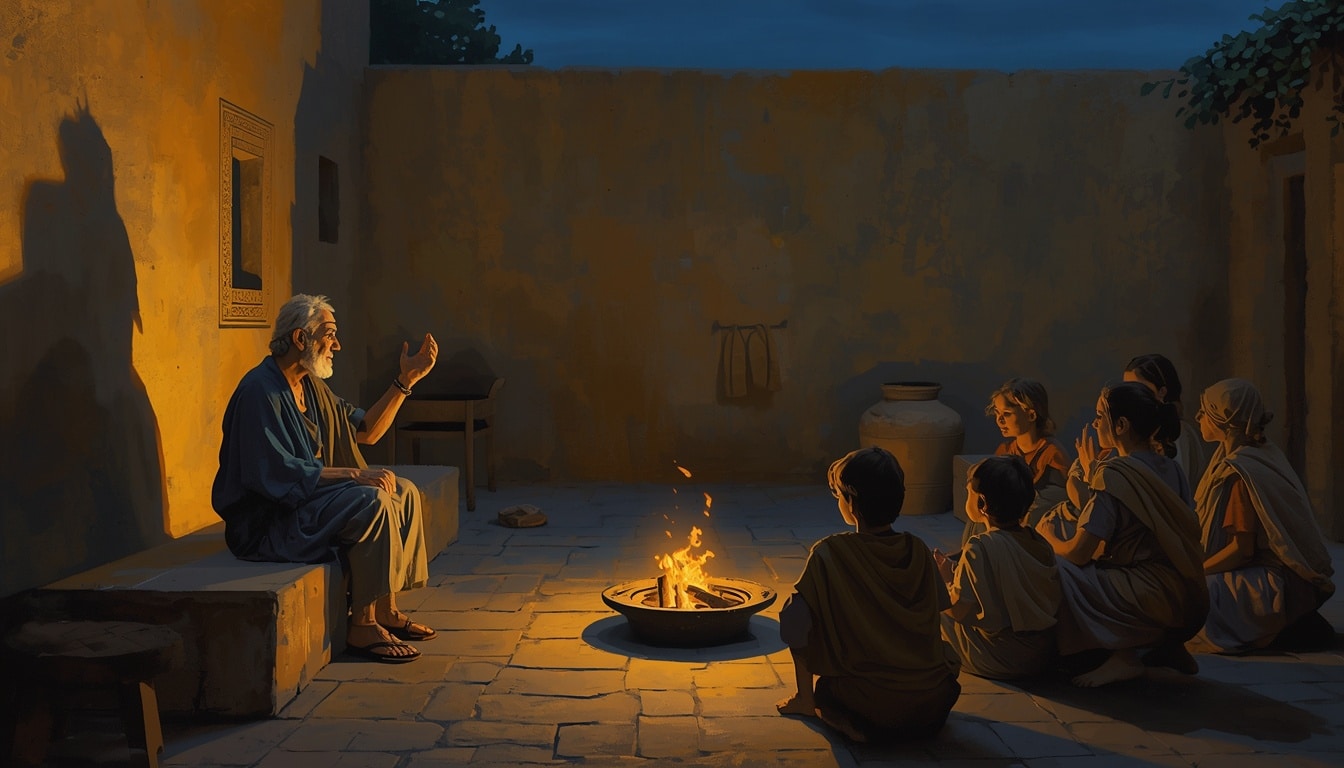
Teach the stories orally first, before any writing. Greek myths were spoken for centuries before they were written down, and children retell them far more confidently when they have heard them told rather than read them from a page. Once the story is secure in their heads, every other activity becomes easier.
“Myths give children permission to ask enormous questions. Why is that fair? What would you have done? A child arguing about whether Athena was right to punish Arachne is doing real historical thinking, and they don’t notice because they think they’re just arguing about a spider.” Michelle Connolly, Founder of LearningMole and former primary school teacher with over 15 years of classroom experience
Creative Writing: Design Your Own Mythical Beast
Greek monsters follow a rule children spot quickly: most are built from parts of real animals. The Chimaera combines a lion, a goat and a snake. Pegasus is a horse with wings. The Minotaur is a bull’s head on a man’s body. Once children have the rule, ask them to design a beast, name it, decide which two or three creatures it borrows from, and write the myth that explains where it came from and who defeated it.
The writing outcome improves noticeably if the design step includes a constraint: the beast must guard something and have one weakness. That mirrors the structure of the real myths and gives the story somewhere to go.
Philosophy for Children: The Morals Inside the Myths
Several of these myths are built around a single arguable decision, which makes them well-suited to Philosophy for Children enquiry. Good starting questions include whether Pandora was to blame for opening the jar, whether Orpheus’s condition was fair, whether Icarus or Daedalus made the bigger mistake, and whether Arachne deserved her punishment.
Run these as genuine enquiries with no correct answer. The value sits in children building reasons, listening to each other and changing their minds, and the myths are short enough that the whole class starts from equal knowledge.
The Word Hunt
Give pairs of children five words from the etymology table above without their origins, and ask them to find the connection using dictionaries. Panic, museum, tantalise, nemesis and atlas work well. It lands the point that these stories are inside the language they use daily, and it doubles as dictionary skills practice.
Handling the Darker Myths
Many Greek myths contain material that needs editing before it reaches a primary classroom, and there is nothing dishonest about doing so. Hercules kills his family. Cronus eats his children. Several myths involve abduction. The standard approach is to use the sanitised retelling for younger children and reintroduce the fuller version later.
For Reception to Year 2, stay with Pegasus, Icarus, Arachne and simple monster stories. From Year 3, Persephone, Hercules and Midas are all manageable with careful wording: Hades takes Persephone away rather than anything more graphic, and Hercules’s madness can be described as a terrible thing Hera made him do. Upper KS2 children can handle the fuller shape of the Hercules story, and they usually want to. If a child asks a direct question about a darker detail, a straight, brief, unembellished answer works better than deflection.
Teaching Resources and Support
LearningMole produces curriculum-aligned video resources and teaching materials for primary schools across the UK, covering history, English, maths and science for children aged 4 to 11. For a Greek mythology unit, the resources that save the most planning time are the ancient Greece materials that sit alongside the myths: the historical context, the gods and beliefs, and the Greek alphabet work that many schools use as an introductory hook.
Teachers planning a KS2 ancient Greece unit can pair the story retellings above with our wider ancient Greek gods resources and mythical creatures collection, which supports the monster design writing task directly. Our Medusa guide covers the myth children ask about most often and works well as an independent reading task.
Parents and home educators can use the same material in different ways. The eight stories above are short enough to read aloud one per evening, and the word hunt needs nothing more than a dictionary. Children who have met the gods through a film or a book series usually enjoy checking what the retelling got wrong, which is a low-effort way to turn screen interest into reading.
Michelle Connolly founded LearningMole to help teachers and parents give children quality educational experiences, and every resource is built by people who have taught in classrooms. Subscription access opens the full video library across all primary subjects, and a substantial collection of free resources is available without one.
Frequently Asked Questions
What is the most famous Greek mythology story?
The Trojan War and the journey home that follows it, as told in Homer’s Iliad and Odyssey, are the most famous and most influential. For primary-aged children, the Twelve Labours of Hercules and the story of Persephone and the seasons are usually the most memorable because both have a clear structure and a satisfying ending. The Odyssey works well as a serialised read-aloud in upper KS2, since each episode stands alone.
Why do we still study Greek myths in UK schools?
Ancient Greece is a required study area in the Key Stage 2 history programme of study, and myths and legends are named in the English curriculum as a genre children should know. Beyond the requirement, the myths carry practical value: they explain a large amount of English vocabulary, they underpin references that children will encounter throughout secondary literature, and they are short enough to use as models for oral storytelling.
Who was the most powerful Greek god?
Zeus, king of the gods and god of the sky, was the most powerful. His brothers, Poseidon and Hades, held comparable authority over the sea and the underworld, respectively, and the three divided the world among themselves after defeating the Titans. Zeus’s power was not absolute, though, since the Fates were held to be beyond even his control, a detail older children find interesting.
Are Greek myths suitable for children under seven?
Some are, with the right choice of story. Pegasus, Icarus, Arachne, and monster stories such as the Minotaur work well for Reception to Year 2 when retold in simplified form. Myths involving violence within families, including the fuller stories of Hercules and Cronus, are better left until Year 3 or later. Choosing a sanitised version for younger children is normal practice rather than a compromise.
Is Greek mythology a religion or just stories?
It was a religion. The ancient Greeks built temples to these gods, left gifts at their altars, consulted oracles and organised festivals and athletic games in their honour, including the original Olympic Games at Olympia. The stories were the shared account of the gods that people genuinely believed in. They became literature much later, once the worship had ended, which is why we can read them now as stories.
What is the difference between Greek and Norse mythology?
They are separate traditions from different parts of Europe. Greek mythology originates in ancient Greece and centres on the twelve Olympians, led by Zeus, who live on Mount Olympus. Norse mythology comes from Scandinavia and centres on gods including Odin, Thor and Loki, with a prophesied end of the world called Ragnarök. Thor is Norse, not Greek, which is the single most common mix-up children bring to the topic.
How can parents help children learn about Greek myths at home?
Read the stories aloud rather than asking children to read them alone, since these myths were meant to be spoken. Follow up with the word hunt, looking up panic, echo, museum and atlas in a dictionary, and let children spot the connection themselves. Museum visits work well too, as Greek and Roman collections in UK museums almost always include mythological scenes on pottery and in mosaics.
Where can I find Greek mythology teaching resources?
LearningMole’s curriculum-aligned video resources and teaching materials cover ancient Greece for KS1 and KS2, including the gods, daily life and the Greek alphabet, with free resources alongside subscription access to the full library. The story retellings and classroom activities in this guide can be used directly, and the mythical creatures collection supports the monster design writing task without further preparation.
Conclusion
Greek mythology stories earn their place in the primary curriculum by doing several jobs at once. They deliver the KS2 history requirement on ancient Greece, they give the English curriculum a genre children actually want to retell, and they hand teachers a set of moral questions short enough to argue about in twenty minutes. Very few topics offer that much in one unit.
The parts most often left out are the ones worth keeping. Children who learn that panic holds a god and a museum holds the Muses stop seeing this as a distant topic. Children who find out that a Dorset farmer put Bellerophon and the Chimaera on his floor in the fourth century start asking why, which is exactly the question historical enquiry is meant to provoke. Both connections take five minutes to teach and change how the whole unit lands.
Start with the stories told aloud, choose versions that suit the age in front of you, and let the questions come. LearningMole’s curriculum-aligned resources cover ancient Greece across Key Stages 1 and 2 for teachers planning the unit and parents following a child’s interest at home. Browse the free ancient Greece materials or open the full video library with subscription access, and the planning work is already done.
Want full access to LearningMole’s library of our videos, quizzes, and printable resources? See our subscription plans to unlock everything KS1 and KS2 teachers need for primary education.
Maths Circus, an innovative platform we've crafted, presents a captivating realm where children learn mathematics through the exciting theme of a circus. The joy of juggling numbers and solving circus...
Asia Facts for Kids: Asia is the largest continent on Earth, covering around 30% of the world's land and home to about 4.8 billion people. It has 47 United Nations...
Feedback with digital portfolios works best in primary schools when teachers keep comments brief and expect every child to act on them. A voice note of about a minute on...
Singers use their voices as musical instruments to perform songs in theatres, recording studios, choirs and at events. Most of their working day, though, is spent practising, learning music and...






Leave a Reply