Mexico is a country shaped by thousands of years of history, most visibly in the way its people celebrate. The country’s Mestizo festivals and culture — a blending of indigenous civilisations and Spanish colonial influence — gave rise to some of the most meaningful and joyful public festivals anywhere in the world. Mexican festivals are not simply parties; they are living history lessons, passed down through generations via music, food, costume, and ritual, each one explaining something about how Mexican society understands time, faith, community, and identity.
For UK primary teachers, that depth is the opportunity. KS2 Geography’s Place Knowledge strand asks children to understand human features of places; few topics deliver that as vividly as Mexican festivals. KS2 Spanish benefits too, since knowing why a culture marks certain dates transforms vocabulary from a list of words into something with genuine meaning.
LearningMole, the UK educational platform founded by former primary teacher Michelle Connolly, produces curriculum-aligned video resources that help teachers bring exactly this kind of global cultural content to life in primary classrooms.
This guide covers seven famous festivals in Mexico, from the internationally recognised Día de los Muertos to the lesser-known but equally fascinating Noche de los Rábanos. It includes a Spanish vocabulary section with phonetic pronunciations, a myth-busting comparison of Cinco de Mayo and Independence Day, and classroom activities aligned to the UK National Curriculum for children aged 7 to 11.
Make This Easier with LearningMole
Teaching cultures from all over the world doesn’t need a stack of worksheets and a search for diagrams that actually match what you’re covering in class. LearningMole’s cultural videos break down all the details into short, visual lessons that are aligned with the KS1 and KS2 curriculum, so you can drop a video into a lesson and know it covers exactly what children need to learn.
Mexican Independence Day, on 16 September, is one of the most important national festivals in Mexico. The celebrations begin the evening before, when the President of Mexico stands on the balcony of the National Palace in Mexico City’s Zócalo (main square) and re-enacts the Grito de Dolores — the Cry of Dolores.
In September 1810, a Mexican priest named Father Miguel Hidalgo rang the bell of his church in Dolores and called on the local people to rise against Spanish colonial rule. That speech sparked Mexico’s eleven-year War of Independence. Every year on the night of 15 September, enormous crowds gather in the Zócalo to hear the Grito, waving Mexican flags and shouting “Viva México!” before fireworks fill the sky. The military parades on 16 September itself draw crowds from across the country.
“Understanding cultural history is the first step in learning a new language,” says Michelle Connolly, Founder of LearningMole and former teacher with over 15 years of classroom experience. “When children know why Mexicans shout ‘Viva México’ on Independence Day, the words become meaningful rather than just sounds to memorise. That’s the difference between language learning and cultural learning working together.”
For UK teachers, Mexican Independence Day makes a natural comparison point when studying colonial history, national identity, or the concept of independence itself. Spain’s influence on Mexican culture is still visible today in the language, religion, and traditions of the country.
2. Día de los Muertos (Day of the Dead)
Día de los Muertos is the most internationally recognised of all Mexican festivals — and one of the most commonly misunderstood. It is not a Mexican equivalent of Halloween. It is a deeply spiritual celebration rooted in pre-Columbian Aztec traditions and later shaped by Catholic All Saints’ and All Souls’ Days, in which families welcome back the spirits of their deceased loved ones for a brief, joyful reunion.
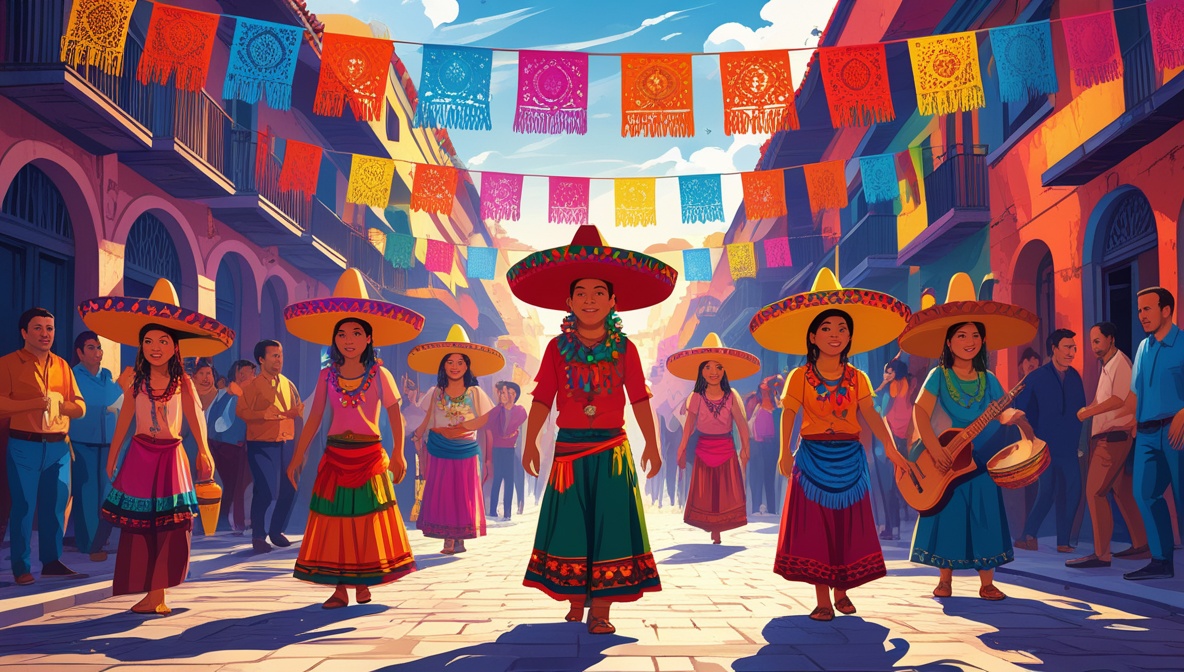
The festival takes place on 1 and 2 November each year. Families build ofrendas (altars) at home and at gravesites, decorated with photographs, the deceased person’s favourite foods and drinks, candles, and marigold flowers (cempasúchil), whose strong scent is believed to guide spirits home. Colourful perforated paper called papel picado hangs overhead, its movement in the breeze representing the presence of the wind.
Altars, Ofrendas, and Marigolds
Each element of a Día de los Muertos ofrenda carries a specific symbolic meaning. Teachers can use this as a discussion framework with KS2 pupils:
Water — to quench the spirit’s thirst after a long journey from the land of the dead
Wind — represented by papel picado; the paper moves in the breeze to show spirits are near
Earth — food, personal objects, and items the deceased person loved during their lifetime
Fire — candles placed to light the path home for returning spirits
The calavera (skull), often painted in elaborate, bright patterns, has become the festival’s most globally recognised symbol. It is not intended as something frightening. It represents a cultural attitude toward death as a natural part of life, one to be acknowledged with ceremony, colour, and even humour rather than avoided.
Classroom activity: Ask children to design a simple ofrenda for an imaginary historical figure from a topic they are studying — an Egyptian pharaoh, a Viking explorer, a significant individual from local history — and choose three items that person would have valued. This connects Día de los Muertos to KS2 History work without requiring any prior knowledge of Mexican culture.
3. Las Posadas
Las Posadas runs for nine consecutive nights, from 16 to 24 December, making it one of the more sustained festivals in the Mexican calendar. The word posada means “inn” in Spanish, and the celebration re-enacts the journey of Mary and Joseph as they searched for shelter before the birth of Jesus.
Each evening, a candlelit procession moves through the neighbourhood. Participants carry small figures of Mary and Joseph, singing traditional call-and-response songs. The procession knocks on doors asking for shelter; householders initially refuse before eventually welcoming the group inside, and the celebration begins with food, music, and the breaking of a star-shaped piñata.
The traditional piñata has seven points, each representing one of the seven deadly sins. Breaking the piñata symbolises resisting temptation, which gives the game a meaning beyond its surface fun. For UK children, Las Posadas sits usefully alongside carol singing and nativity traditions as an example of how different cultures mark the same religious season. It is also celebrated across Latin America and in Mexican communities worldwide.
4. Guelaguetza: Oaxaca’s Festival of Sharing
The Guelaguetza takes place on the two Mondays that follow 16 July each year in the city of Oaxaca, in southern Mexico. It is one of the most significant indigenous festivals in the Americas and one of the Mexican festivals least known outside the country.
The word guelaguetza comes from the Zapotec language, one of Mexico’s many indigenous languages, and means “reciprocal exchange of gifts and services.” The festival celebrates the extraordinary cultural diversity of Oaxaca state, home to 16 distinct indigenous groups, each with its own language, costumes, music, and traditions.
During the Guelaguetza, representatives of each indigenous group perform traditional dances in elaborate handmade costumes and share regional products with the audience: food, crafts, and textiles. The act of giving is central to the festival’s meaning. It is a celebration of generosity and community, not a performance for outsiders.
For KS2 Geography’s Place Knowledge strand, the Guelaguetza is an ideal case study. It challenges the common simplification of “Mexican culture” as a single, uniform thing and shows children that one country can encompass enormous internal diversity, with different languages, belief systems, and traditions coexisting. That is a genuinely valuable lesson for children learning to read the world accurately.
5. Noche de los Rábanos (Night of the Radishes)
Every year on 23 December in Oaxaca, the city’s main square fills with an extraordinary sight: enormous radishes, some weighing up to three kilograms, carved into elaborate scenes from Mexican history, Christmas nativity stories, and indigenous mythology. This is the Noche de los Rábanos, and it is one of the most distinctive and surprising Mexican festivals you will find anywhere.
The tradition dates to the colonial period, when Franciscan priests encouraged local farmers to carve vegetables for market display in the days before Christmas, partly to attract customers and partly to illustrate Bible stories for communities with limited literacy. Over time, the carvings became increasingly ambitious. Today, artisans spend weeks preparing their radish sculptures and compete for prizes judged by local officials, with crowds gathering to view the results before they wilt.
For children, Noche de los Rábanos tends to produce exactly the kind of delighted disbelief that sparks genuine curiosity about a culture. It also opens up a useful classroom discussion: how do traditions begin? What need did this one originally meet? Why does it continue when the original need no longer exists?
6. Día de la Candelaria (Candlemas)
Día de la Candelaria on 2 February is one of the most community-centred Mexican festivals, and it comes with a built-in social obligation that gives it a particular charm.
The chain of events begins on 6 January, Three Kings’ Day, when Mexicans share a ring-shaped sweet bread called the Rosca de Reyes. Hidden inside the bread is a small plastic figure of the baby Jesus. Whoever finds the figure in their slice is obligated to host a tamale party on 2 February, Candlemas Day, and to bring the baby Jesus figure to church to be blessed.
Tamales, parcels of masa (corn dough) filled with meat, cheese, or sweet fillings, wrapped in corn husks or banana leaves and steamed, are the dish of the day. Tamale-making is itself a communal activity, often bringing extended families together for hours of preparation before the celebration. The result is a festival built around obligation, generosity, and shared food in equal measure; a combination that tends to resonate with children when framed as a game with real consequences.
7. Carnival in Mazatlán
Mexico’s Carnival takes place each February in the Pacific port city of Mazatlán, in the days before Lent begins. Mazatlán’s Carnival is one of the oldest in the Americas, with records of celebration dating to 1827, and it ranks among the largest in Latin America.
The celebration runs for five days and includes parades of elaborate floats, live music across multiple stages, fireworks, and traditional dance. One of its most distinctive features is the Quema del Mal Humour, or Burning of Bad Moods, a ceremony in which an effigy representing the troubles of the previous year is set alight as a symbolic fresh start before the Lenten season of reflection begins.
KS2 pupils studying Carnival as a global tradition can compare Mazatlán’s celebrations with those in other countries, the Rio Carnival in Brazil, Trinidad’s Carnival, or the Notting Hill Carnival in London, to show how similar traditions express themselves differently across cultures, climates, and histories.
Myth Busting: Cinco de Mayo vs Mexican Independence Day
This is the most common factual error in classroom discussions of famous Mexican festivals, particularly among UK pupils and teachers who have encountered Cinco de Mayo through American popular culture. The two occasions are entirely separate.
Cinco de Mayo
Mexican Independence Day
Date
5 May
16 September
What it marks
Mexico’s 1862 military victory over French forces at the Battle of Puebla
Father Hidalgo’s 1810 call for independence from Spanish colonial rule
National significance in Mexico
Modest; observed mainly in Puebla state
One of Mexico’s most important national holidays
Where it is most widely celebrated
Mexican-American communities in the United States
Across all of Mexico
Key celebration
Parades and local festivals in Puebla
The presidential Grito in Mexico City’s Zócalo; military parades nationwide
Cinco de Mayo is widely celebrated in the United States but is a relatively minor occasion within Mexico, observed primarily in the state of Puebla, where the 1862 battle took place. Mexican Independence Day, 16 September, is the genuinely national event. Teaching children this distinction builds something valuable beyond knowledge of Mexican culture: it builds the habit of checking what a celebration actually means rather than accepting popular assumptions.
Festival Key Words: Spanish for the Classroom
UK teachers introducing cultural context alongside KS2 Spanish lessons can use this vocabulary as a classroom word wall or starter activity. Practising the pronunciation of festival names — particularly Guelaguetza and cempasúchil — builds phonemic awareness alongside cultural knowledge.
Spanish Word
Pronunciation Guide
Meaning
Ofrenda
oh-FREN-da
Altar/ritual offering
Cempasúchil
sem-pa-SOO-cheel
Marigold, the Day of the Dead flower
Papel picado
pa-PEL pi-KAH-do
Perforated paper used as decoration
Calavera
ka-la-VEH-ra
Skull, also a humorous poem about a living person
Alebrije
a-le-BREE-heh
Brightly painted, fantastical folk art animal
Piñata
pin-YAH-ta
Decorated container filled with sweets, broken by hitting
Tamale
ta-MAH-leh
Filled dough parcel wrapped and steamed in a corn husk
Zócalo
SO-ka-lo
Main public square, especially in Mexico City
Posada
po-SAH-da
Inn or lodging; also the nine-night Christmas procession
Grito
GREE-to
Cry or shout; specifically the presidential Independence Day call
Teaching Mexican Festivals in Your Classroom
Mexican festivals provide UK primary teachers with material that spans multiple curriculum areas — geography, history, religious education, modern foreign languages, and PSHE — without requiring specialist knowledge in any of them.
KS2 Geography (Place Knowledge): Use the Guelaguetza as a case study in cultural diversity. Ask children to research one of Oaxaca’s 16 indigenous groups and create a short fact file. The festival makes it concrete that Mexico contains enormous internal variety — different languages, traditions, and histories coexisting within a single country. That is a key lesson for any geographical study of people and place.
KS2 MFL (Spanish): Use the vocabulary table above as a classroom word wall or pronunciation challenge. Children who can correctly say cempasúchil or Guelaguetza tend to feel a genuine sense of achievement — and the physical challenge of the sounds reinforces phonemic awareness in ways that vocabulary lists alone do not.
RE and PSHE: Día de los Muertos supports a thoughtful classroom discussion about how different cultures approach death, memory, and family. The festival’s emphasis on celebration and remembrance rather than grief offers children a different cultural framework without requiring any culture to be presented as superior to another.
Art: The calavera face-painting tradition and the Noche de los Rábanos sculpture tradition both lend themselves directly to practical projects. The colour symbolism in Mexican folk art, where each colour carries a specific meaning, gives children a structure for creative work that goes beyond decoration.
LearningMole’s curriculum-aligned video resources cover world cultures, human geography, and global traditions, all designed by experienced educators to fit the UK National Curriculum for children aged 4 to 11.
Frequently Asked Questions about Mexican Festivals
What is the most important festival in Mexico?
Mexican Independence Day, celebrated on 16 September, is considered the most significant national festival in Mexico. The Grito de Dolores, re-enacted by the President each year on the evening of 15 September, is a unifying national moment. Día de los Muertos is the most internationally recognised Mexican festival, but Independence Day carries the deepest national significance for Mexican people themselves.
Is Cinco de Mayo the same as Mexican Independence Day?
No — this is one of the most common misconceptions about Mexican festivals. Cinco de Mayo falls on 5 May and marks Mexico’s 1862 military victory over French forces at the Battle of Puebla. Mexican Independence Day falls on 16 September and marks the beginning of Mexico’s War of Independence from Spain in 1810. They are entirely separate events, more than four months apart on the calendar.
What do people eat during Mexican festivals?
Food varies by festival. Tamales are central to Día de la Candelaria and Christmas celebrations. Pan de muerto, a sweet enriched bread flavoured with anise and orange, is made specifically for Día de los Muertos. Pozole, a traditional soup made from hominy corn and meat, appears at Independence Day celebrations. Across many festivals, tacos, enchiladas, and complex sauces like mole, made from dried chillies, chocolate, and spices, feature widely.
How do children celebrate Day of the Dead in Mexico?
Children in Mexico participate alongside their families in building ofrendas, visiting cemeteries to place flowers and food at the graves of loved ones, and in some regions wearing calavera (skull) face paint. Many Mexican primary schools hold their own classroom ofrenda projects in the days before the festival. Día de los Muertos is family-centred and joyful; children are taught to approach it as a time for remembering loved ones with happiness rather than sadness.
Is this content suitable for KS2 pupils aged 7 to 11?
Yes. The seven festivals in this guide are appropriate for children across KS2 (Years 3 to 6). Teachers should handle Día de los Muertos with sensitivity, particularly with younger or more emotionally vulnerable children, but the festival’s emphasis on celebration and memory rather than grief makes it manageable for most primary classes. The vocabulary section and myth-busting content work especially well with Years 5 and 6.
Do children need to speak Spanish to enjoy learning about Mexican festivals?
Not at all. The Spanish vocabulary in this guide is a starting point, not a requirement. Many children find that learning to pronounce a few festival words, particularly the challenge of cempasúchil or Guelaguetza, adds genuine excitement to the topic. Correct pronunciation also builds phonemic awareness, which supports broader language learning alongside the cultural content.
What do the colours of the Mexican flag represent?
The Mexican flag has three vertical stripes: green represents hope and independence; white represents unity; and red represents the blood of national heroes. At the centre sits the national coat of arms, showing an eagle perched on a cactus and holding a serpent — an image drawn from Aztec legend about the founding of Tenochtitlan, the city that became Mexico City.
How does Guelaguetza connect to the KS2 Geography curriculum?
Guelaguetza connects directly to KS2 Geography’s Place Knowledge strand, which asks children to understand human features of places, including culture, traditions, and settlement. The festival illustrates that a country is not culturally uniform: Oaxaca state alone contains 16 distinct indigenous groups with different languages and traditions. This supports the curriculum aim of developing children’s awareness of cultural diversity and their capacity to think geographically about how human societies organise themselves.
What Mexican Festivals Teach Us
Mexico’s festivals are not decorations on top of the culture — they are the culture, carrying forward thousands of years of history in the choices people make about what to celebrate, how to mark it, and what it means. Día de los Muertos tells you how Mexicans think about death and family. The Grito de Dolores tells you how they think about freedom and nationhood. The Guelaguetza tells you how the country holds its internal diversity together through shared ceremony. Each festival is a piece of evidence about a society’s values, and reading them carefully is exactly the kind of geographical thinking the KS2 curriculum is designed to build.
For teachers, the practical advantage of Mexican festivals as a topic is their breadth. A single unit can touch geography, history, RE, MFL, PSHE, and art without feeling forced. The Cinco de Mayo myth-buster alone is worth a lesson: it teaches children to question popular assumptions, check the source of information, and recognise that what one country emphasises about another often says more about the first than the second. Those are transferable critical thinking skills, not just facts about Mexico.
LearningMole provides curriculum-aligned educational resources for UK primary teachers and parents, including video content covering world cultures, human geography, and global traditions. Whether you are planning a KS2 geography unit, looking for Spanish cultural context to support MFL lessons, or simply want to bring Mexican festivals to life for curious children, LearningMole’s library covers the topic with resources built by experienced educators for children aged 4 to 11.
Want full access to LearningMole’s library of Mexican festivals videos, quizzes, and printable resources? See our subscription plans to unlock everything KS1 and KS2 teachers need for primary education.
Maths Circus, an innovative platform we've crafted, presents a captivating realm where children learn mathematics through the exciting theme of a circus. The joy of juggling numbers and solving circus...
Wolfgang Amadeus Mozart (1756 to 1791) was an Austrian Classical-period composer who wrote more than 600 works, including operas, symphonies, and piano concertos, in a life of only 35 years....
Cooks prepare, cook and present food for other people, working in restaurants, schools, hospitals, hotels, care homes and cafés. Their day covers washing and chopping ingredients, cooking dishes at the...
Actors use their voice, their body and their imagination to turn the words of a script into a believable person that an audience can follow, whether that audience is sitting...





Leave a Reply