Aztec pottery holds a significant place in the history of Mesoamerica, providing valuable insights into the culture, society, and artistic expressions of the Aztec civilisation. This ancient art form demonstrates remarkable technical skill and creative expression, with vessels serving both practical and ceremonial purposes in daily life.
The Aztecs, a prominent civilisation in Mesoamerica, are renowned for their pottery traditions. Aztec pottery, often adorned with intricate designs and symbols, reflected the artistic prowess and cultural sophistication of the Aztec people. From cooking vessels to religious offerings, these ceramic creations reveal a complex society with sophisticated artistic traditions.
Understanding Aztec Pottery and Its Historical Context
Aztec pottery was crafted using traditional techniques and materials such as clay, which was shaped by hand or with moulds. Ancient Aztec pottery featured popular designs and styles, including geometric shapes, repeating patterns, animal motifs, and symbols representing their gods and religious beliefs. The production of these vessels required extensive knowledge passed down through generations of skilled artisans.
The Aztecs inhabited the Valley of Mexico from the 14th to 16th centuries, establishing the powerful city of Tenochtitlan as their capital. During this period, pottery production flourished as an essential craft supporting both everyday needs and religious practices. Archaeologists have identified distinct phases in the development of Aztec pottery, each reflecting changes in artistic styles and cultural influences.
Michelle Connolly, founder of LearningMole with 16 years of classroom experience, notes: “Studying ancient pottery helps children understand how practical needs and artistic expression combined in historical cultures, connecting science, art, and social studies in meaningful ways.”
Materials Used in Aztec Pottery
Potters used clay, pigments, and natural dyes to create distinctive pottery. The abundance of clay in the central Mexican region where the Aztec Empire thrived facilitated the production of a wide array of pottery items. Artisans carefully sourced the clay, often mixing different types to achieve the desired consistency and colour.
The foundation of Aztec ceramic excellence lay in the volcanic soil of the Valley of Mexico. Artisans primarily sourced alluvial clay from the lakebeds surrounding their settlements. To prevent the vessels from cracking during firing, they mixed the clay with temper – volcanic ash, sand, or even ground-up fragments of old pottery. This created a resilient body capable of withstanding the thermal shock of open-pit firing.
Different clay sources produced varying colours in the finished pottery. Red and orange clays were particularly common, giving Aztec pottery its distinctive appearance. Black clays from certain regions produced darker vessels, while lighter clays resulted in cream-coloured pottery suitable for painted decoration.
Symbolism and Significance in Aztec Pottery
Pottery was replete with symbolism, often depicting mythological narratives, religious motifs, and representations of deities. The intricate designs and motifs on the pottery vessels conveyed the spiritual beliefs and cosmological concepts central to the Aztec worldview.
Common symbolic elements included:
Animal motifs such as jaguars, eagles, and serpents represent different gods and natural forces.
Geometric patterns symbolising water, mountains, and agricultural cycles.
Solar discs and celestial symbols reflecting astronomical knowledge.
Ritual scenes depicting ceremonies and offerings to deities.
These decorative elements were not merely aesthetic choices. They communicated social status, religious devotion, and cultural identity. High-status individuals possessed elaborately decorated vessels, while commoners used simpler pottery for daily tasks.
Creating Aztec Pottery Without a Potter’s Wheel
The most remarkable aspect of Aztec pottery production was the achievement of symmetrical, durable vessels without ever employing the potter’s wheel. This was not a limitation but a mastery of hand-modelling techniques that remain impressive today. The absence of a wheel allowed Aztec artisans to experiment with non-circular forms, including tripod plates, effigy jars, and complex incense burners.
The Coiling Method
Aztec pottery was born out of skilled hands. The people used unique ways to make it. They would usually roll clay into long coils and stack them to form a pot. This is called the coiling method.
To achieve the thin walls and symmetrical shapes that define Aztec pottery, potters built vessels wall-by-wall with thin coils of clay. They then smoothed the surface with a piece of gourd or a smooth stone until the joints disappeared completely. This technique required considerable skill and patience, with experienced potters able to create perfectly balanced vessels through touch and visual assessment alone.
Young apprentices learned the coiling method by watching master potters and practising with small vessels. The technique allowed for great flexibility in shape and size, from tiny figurines to large storage jars. Potters could adjust wall thickness as they worked, making bases thicker for stability and rims thinner for functionality.
Moulding Techniques
Other times, they would press the clay into a mould made from wood or stone to shape it. For mass-produced items like the legs of tripod vessels or small figurines, potters used two-part ceramic moulds. This allowed for a level of standardised production that fuelled the bustling markets of Tlatelolco.
Moulds enabled the creation of repeated decorative elements with consistent quality. Potters could produce hundreds of identical vessel feet or handles, then attach them to individually coiled bodies. This combination of techniques – moulded components with hand-built vessels – characterised Aztec pottery production.
Surface Finishing and Burnishing
Once shaping is complete, they smooth the surface with a wet stone or a wooden spatula before adding designs. One of the most distinctive features of Aztec pottery is its high-gloss finish. This was not a glaze but a burnish achieved before firing.
Before the pot was fired, the artisan would rub the surface with a highly polished greenstone or a smooth pebble. This compressed the surface molecules, creating a waterproof, glass-like sheen that has survived five centuries of burial. The burnishing process required hours of careful work, with the potter rubbing the entire surface until it achieved the desired lustre.
This technique served practical purposes beyond aesthetics. Burnished surfaces were less porous, making vessels more suitable for holding liquids. The smooth finish also made pottery easier to clean, an important consideration for cooking and serving vessels used daily.
The Firing Process
When making pottery, the firing process is an essential step. After shaping and sculpting the clay into the desired form, it must be fired in a kiln to become durable, long-lasting pottery.
The firing process involves heating the pottery to high temperatures, allowing the clay particles to bond and harden. This process also strengthens the pottery and makes it resistant to water absorption. Aztec potters used open-pit firing methods, carefully managing fires fuelled by wood or dried dung to reach temperatures between 600 and 900 degrees Celsius.
The firing temperature can vary depending on the type of clay used and the desired outcome. Potters controlled fire temperature by adjusting fuel amount and air circulation. They learned to recognise the right colour of the flames and the appearance of the pottery during firing, knowing precisely when vessels had reached the proper temperature.
Firing was often a communal activity, with multiple potters combining their work in a single firing session. This efficient use of fuel and labour reflected the organised nature of Aztec craft production. Once the pottery had been fired, it could be decorated with intricate designs using pigments or left as is for a more natural look.
Popular Designs and Styles in Aztec Pottery
Ancient pottery was known for its popular designs and styles. The Aztecs used geometric shapes and repeating patterns, often with a white background and vibrant red, black, and orange designs. These beautiful designs showcased the artistic skills of the Aztec people.
Decorative Techniques and Patterns
Some popular styles included intricate animal motifs, such as jaguars and eagles, as well as symbols representing their gods and religious beliefs. The attention to detail in these designs was remarkable, reflecting the rich cultural heritage of the Aztec civilisation.
Potters applied decorations using several techniques:
Painting with mineral-based pigments using bird feathers as ultra-fine brushes for detailed linework.
Incising designs into the clay surface before firing.
Adding raised relief elements by applying clay strips or moulded components.
Combining painted and carved decoration for complex visual effects.
The famous “Black-on-Orange” style characterised much Aztec pottery, featuring black painted designs on orange-red clay. This colour combination resulted from the iron-rich clays and manganese-based black pigments available in the Valley of Mexico.
Regional Variations and Stylistic Periods
Aztec pottery manifested diverse styles and variations, influenced by regional cultures and artistic traditions. The distinct regional styles contributed to the rich tapestry of ceramic artistry in the Aztec Empire, showcasing the creativity and innovation of the potters.
Archaeologists have identified four main stylistic periods in Aztec pottery development:
Aztec I (Early Period): Characterised by simpler designs and forms, often showing influence from the Toltec civilisation. Vessels from this period tend to have thicker walls and less refined decoration.
Aztec II (Middle Period): Development of more standardised forms and the emergence of distinctive Aztec decorative motifs. Tripod vessels with cylindrical legs became increasingly common.
Aztec III (Imperial Period): The height of Aztec ceramic artistry, featuring thin-walled vessels with elaborate painted decoration. This period saw the production of the finest examples of Aztec pottery, with complex geometric and symbolic designs.
Aztec IV (Late Period): Continued refinement of earlier styles with some influence from Spanish contact, though traditional forms and techniques remained dominant until the conquest.
Influence of Regional Cultures on Pottery
The exchange of cultural and artistic ideas with neighbouring civilisations such as the Maya, Teotihuacan, and Toltecs left an indelible imprint on Aztec pottery. This cultural exchange enriched the repertoire of pottery styles and techniques, resulting in a vibrant mosaic of ceramic traditions.
Cholula, an important city-state, developed a distinctive polychrome style featuring multiple colours and highly detailed decoration. These vessels were prized throughout the Aztec Empire and often acquired through tribute or trade. The polychrome technique involved applying multiple layers of differently coloured slips and pigments, creating complex multicoloured designs.
Practical Uses of Aztec Pottery in Daily Life
Aztec pottery had various uses in the ancient Aztec civilisation. It was created as art and served practical purposes in everyday life. Pottery vessels were essential tools for food preparation, storage, and serving, making them indispensable in Aztec households.
Utilitarian Vessels and Food Preparation
The Aztecs used pottery vessels for cooking, storing water, and serving food and drinks. These vessels were often decorated with intricate designs and patterns, making them functional and visually appealing.
Common utilitarian pottery included:
Cooking pots (comitl): Large, round-bottomed vessels for preparing stews and boiling maize. These had thick walls to withstand repeated heating and often featured tripod legs to stand over fires.
Water storage jars (apaztle): Large vessels with narrow necks to reduce evaporation and prevent contamination. Some could hold up to 20 litres of water.
Griddles (comal): Flat, circular pottery plates used for cooking tortillas. These remained relatively unchanged in design for centuries due to their perfect functionality.
Serving bowls (caxitl): Smaller vessels in various sizes for individual portions of food. Decorative examples were used during feasts and special occasions.
Pottery was crafted using traditional techniques and materials such as clay, which was shaped by hand or with moulds. The functionality and versatility of pottery made it an essential part of daily life, demonstrating the Aztec people’s craftsmanship and resourcefulness.
Ritual and Religious Significance
Additionally, pottery was also used for religious ceremonies and rituals. The decorative bowls and plates were essential in offering food and beverages to the gods during these rituals. Pottery figurines were also crafted as offerings or talismans in religious practices.
Specific pottery forms were created exclusively for ceremonial use:
Incense burners (tlemaitl): Elaborate vessels with perforated lids for burning copal resin during ceremonies. These often featured the faces or symbols of deities.
Offering vessels: Small bowls and plates specifically made for temple offerings. Many were decorated with religious imagery and symbols.
Ritual drinking cups (tecomate): Specialised vessels for consuming pulque and other ceremonial beverages. Some featured carved or painted scenes of rituals and deities.
Funerary vessels: Pottery specially created to accompany the deceased, often containing food and drink for the afterlife journey.
Beyond its utilitarian functions, pottery was crucial in various religious rites and ceremonies. It was intricately linked to spiritual practices and rituals, with specific pottery items used for offerings, libations, and ceremonial purposes.
Social Status and Pottery Quality
Pottery also served as a marker of social status and wealth. High-ranking nobles and priests possessed elaborately decorated vessels made by the finest artisans. These prestigious pieces featured complex polychrome decoration, intricate carved details, and forms that required exceptional skill to produce.
The craftsmanship and functionality of pottery were integral to the sustenance of Aztec society. Even in common households, multiple vessels were owned for different purposes, with pottery representing a significant portion of household goods. Pottery was also used as a currency in trade and commerce, with standardised vessels serving as units of exchange in markets.
Artistic Evolution and Technical Innovation
Over time, pottery underwent a remarkable artistic evolution, with potters experimenting with new forms, styles, and decorative techniques. The artistry of pottery reflects the dynamic cultural milieu and the evolving aesthetic sensibilities of the Aztec civilisation.
The development of Aztec pottery shows continuous technical refinement. Early vessels were relatively simple and thick-walled, but later examples demonstrate increasingly sophisticated techniques. Potters learned to create thinner walls, more complex forms, and more durable vessels through generations of experimentation and knowledge transmission.
Innovation occurred in both practical and decorative aspects. New vessel shapes emerged to meet changing needs, while decorative techniques became more elaborate. The introduction of new pigments and the refinement of application methods allowed for increasingly detailed painted decoration.
Trade Networks and Pottery Exchange
Aztec pottery played a central role in the vibrant trade networks of Mesoamerica, with pottery items being exchanged for other commodities such as jade, obsidian, and textiles. The exchange of pottery facilitated cultural exchanges and economic transactions across the region.
Markets in major cities featured specialist pottery vendors offering vessels from different regions. Consumers could choose from locally produced everyday wares or more expensive imported pieces from renowned production centres. This trade network helped spread stylistic influences and technical innovations across the empire.
Tributary relationships also involved pottery, with subject cities required to provide specific quantities of vessels to the Aztec capital. These tribute payments included both utilitarian and decorative pottery, supplying the needs of the growing imperial city.
Studying Aztec Pottery: Archaeological Insights
Archaeological studies of pottery have provided valuable insights into the social and cultural practices of the Aztec civilisation. Analysis of pottery shards, motifs, and inscriptions has deepened our understanding of the daily life, religious beliefs, and trade networks of the ancient Aztecs.
Understanding Aztec culture through pottery analysis involves examining multiple aspects of ceramic artefacts. Archaeologists study manufacturing techniques, clay composition, decorative styles, and use-wear patterns to reconstruct ancient lifeways.
Chemical Analysis and Provenance Studies
Modern scientific techniques have transformed our understanding of Aztec pottery. Neutron activation analysis and other methods can identify the specific clay sources used to make vessels, allowing researchers to trace pottery back to particular production sites. This chemical fingerprinting reveals trade patterns and the movement of goods across the empire.
Petrographic analysis examines the mineral composition of pottery temper, providing additional evidence for vessel origins. These scientific approaches complement traditional archaeological methods, creating a more complete picture of Aztec ceramic production and distribution.
Use-Wear Analysis
Examining patterns of wear and residue on pottery surfaces reveals how vessels were actually used. Cooking pots exhibit characteristic burn patterns and food residues, while storage jars show wear from repeated opening and closing. This use-wear analysis helps confirm the functions of different vessel types and sometimes reveals unexpected uses.
Residue analysis can identify specific foods prepared or stored in vessels, providing direct evidence of the Aztec diet and food preparation techniques. These studies have confirmed historical accounts while also revealing previously unknown aspects of Aztec cuisine.
Aztec Pottery in Museum Collections
Preserving Aztec pottery is paramount for archaeologists and institutions dedicated to conserving cultural heritage. Efforts to safeguard and conserve pottery ensure that future generations can still study and appreciate this ancient art form.
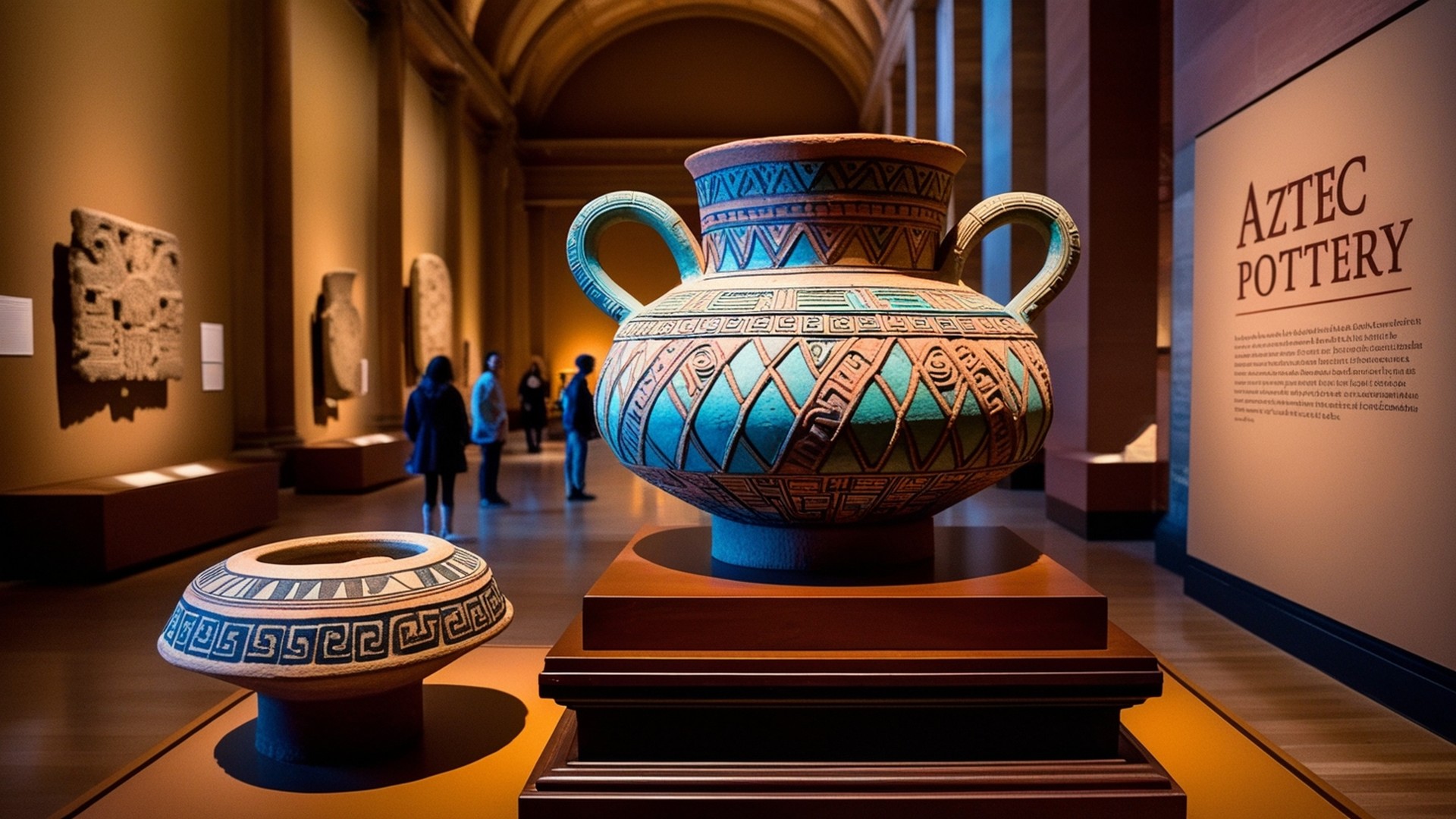
Major museums worldwide house significant collections of Aztec pottery. In the United Kingdom, several institutions offer opportunities to view authentic examples:
The British Museum, London: Houses an extensive Mesoamerican collection, including fine examples of Aztec pottery from different periods and regions.
Pitt Rivers Museum, Oxford: Features Aztec ceramic artefacts within its broader archaeological collections, with detailed documentation of provenance.
World Museum, Liverpool: Contains notable examples of Aztec pottery alongside other Mesoamerican artefacts.
These collections provide valuable resources for education and research. Visiting these museums allows students and enthusiasts to examine authentic Aztec pottery firsthand, observing details of construction and decoration that photographs cannot fully convey.
Contemporary Influence and Legacy
The legacy of Aztec pottery continues to inspire contemporary artists and ceramicists, who draw on its intricate designs and motifs in their work. Modern artwork pays homage to the rich artistic heritage of the Aztec civilisation.
Contemporary artwork inspired by Aztec pottery demonstrates the enduring appeal of these ancient designs. Artists incorporate traditional motifs into modern ceramics, creating pieces that bridge historical and contemporary aesthetics. Some ceramicists study and replicate traditional Aztec techniques, preserving this knowledge for future generations.
Impact on Modern Ceramics
Aztec pottery has left a lasting impression on ceramics, influencing modern techniques, artistic expressions, and decorative styles. The fusion of ancient Aztec motifs with contemporary ceramic artistry demonstrates the enduring influence of Aztec pottery on modern craftsmanship.
Modern potters have adapted burnishing techniques and surface treatments inspired by Aztec methods. The aesthetic of hand-built pottery, emphasising the maker’s touch over mechanical uniformity, reflects values evident in ancient Aztec ceramics.
Revival of Traditional Techniques
Recently, interest in reviving traditional Aztec pottery techniques has resurged. Artisans and craftsmen are reintroducing ancient pottery-making methods, preserving the heritage of Aztec pottery and ensuring the continuity of this ancient craft.
In Mexico, some potters work to reconstruct traditional Aztec techniques using historical and archaeological evidence. These practitioners combine scholarly research with practical experimentation, recreating vessels using only materials and methods available to ancient artisans. Their work contributes to both cultural preservation and educational outreach.
Educational Applications and Cross-Curricular Connections
Studying Aztec pottery offers rich opportunities for cross-curricular learning in educational settings. Teachers can use this topic to connect multiple subject areas while engaging students with hands-on activities and cultural exploration.
Science Connections
The chemistry of clay and firing provides entry points for discussing material properties and chemical changes. Students can explore how heat transforms clay from a soft, water-soluble material into hard, permanent pottery. Investigating different clay types and their properties connects to earth science and geology.
Temperature control during firing introduces concepts of thermal management and combustion. Students can discuss how Aztec potters controlled fire temperature without modern measuring instruments, developing an understanding of observation-based science.
Mathematics and Geometry
Aztec pottery decoration features extensive geometric patterns, offering opportunities for mathematical exploration. Students can analyse repeating patterns, symmetry, and proportion in pottery designs. Creating their own geometric patterns inspired by Aztec examples reinforces understanding of mathematical concepts through artistic application.
The construction of symmetrical vessels without a potter’s wheel involves spatial reasoning and measurement concepts. Students can discuss how ancient potters achieved balance and proportion through estimation and visual assessment rather than precise measurement tools.
History and Geography
Aztec pottery provides material evidence for understanding historical cultures. Students can explore how pottery reveals information about daily life, social structure, trade networks, and religious beliefs. Mapping the extent of the Aztec Empire and pottery distribution patterns connects to geography skills.
Comparing Aztec pottery with ceramic traditions from other cultures and time periods develops comparative historical thinking. Students can consider how environmental factors, available resources, and cultural values influenced pottery production in different societies.
Art and Design Technology
Creating clay vessels using traditional coiling techniques gives students hands-on experience with an ancient art form. This practical work develops fine motor skills while fostering appreciation for the skill required to produce quality pottery.
Students can design their own pottery decoration inspired by Aztec motifs, combining historical research with creative expression. This activity encourages attention to pattern, symbolism, and visual balance while connecting to a specific cultural tradition.
Clay Coiling Project: Students create small vessels using the coiling method, experiencing the technique used by Aztec potters. After construction, they can burnish surfaces with smooth stones and add painted decoration using earth-toned paints.
Design Analysis: Provide images of Aztec pottery for students to examine and sketch. They identify geometric patterns, animal motifs, and symbols, then research their meanings and create their own symbolic designs.
Material Investigation: Students compare different clay types, testing properties like plasticity and water absorption. This hands-on science activity connects to understanding why Aztec potters carefully selected and prepared their clay.
Key Stage 3 Activities:
Archaeological Reconstruction: Students work with pottery shard images to deduce original vessel forms and functions. This activity develops analytical thinking and understanding of archaeological methods.
Cultural Comparison Study: Students research and compare Aztec pottery with ceramic traditions from other ancient civilisations, creating presentations on similarities and differences in techniques, designs, and cultural significance.
Scientific Analysis Project: Students design experiments to test pottery properties, such as water absorption and thermal conductivity, in line with the practical requirements of Aztec vessel use.
Supporting Resources from LearningMole
LearningMole offers educational videos and resources supporting the study of ancient civilisations and art history. These materials provide engaging visual content that brings Aztec culture to life for learners of all ages.
Our subscription services include comprehensive teaching resources aligned with the UK National Curriculum, offering ready-to-use lesson plans and activities for exploring Aztec pottery and other aspects of Mesoamerican history. These resources save teachers valuable planning time while ensuring high-quality educational content.
Interactive learning materials help students develop cross-curricular skills as they explore fascinating historical topics. From science-based investigations of materials and processes to creative art projects inspired by ancient designs, LearningMole resources support diverse learning approaches.
Conclusion
Aztec pottery offers a fascinating glimpse into the rich history and artistic traditions of the Aztec civilisation. The techniques used to create these intricate designs, along with the beautiful styles and uses of this pottery, highlight the skill and creativity of the Aztec people.
Even today, pottery remains a significant part of cultural heritage and continues to be appreciated for its historical and artistic value. Exploring this ancient art form allows us to appreciate their craftsmanship and gain insight into their vibrant culture. The legacy of Aztec ceramics endures in museum collections, contemporary art, and educational studies, ensuring that this remarkable artistic tradition continues to inform and inspire future generations.
Through hands-on exploration, scientific investigation, and cultural study, learners of all ages can connect with the remarkable achievements of Aztec artisans. Whether examining authentic artefacts in museums or creating their own coiled vessels in the classroom, students discover how practical needs and artistic expression combined to produce one of the ancient world’s most distinctive ceramic traditions.
Maths Circus, an innovative platform we've crafted, presents a captivating realm where children learn mathematics through the exciting theme of a circus. The joy of juggling numbers and solving circus...
Article Summary What this article covers: How to calculate minutes and hours in primary maths, including reading analogue and digital clocks, converting between the 12-hour and 24-hour clock, working out...
Article Summary What this article covers: Facts about forces and motion for primary children, including Newton's three laws, friction, gravity, air and water resistance, measuring forces and simple machines, with...
Article Summary What this article covers: Fun monkeys facts for kids, explained for UK primary pupils, with links to the National Curriculum for science at Key Stage 1 and Key...






Leave a Reply