Eclipses Facts for Kids: Have you ever seen the sky suddenly darken in the middle of the day, or watched the full Moon turn a mysterious blood-red colour? These spectacular events are called eclipses, and they’re among the most dramatic and exciting astronomical phenomena visible from Earth. An eclipse occurs when one celestial object passes into the shadow of another, temporarily blocking light and creating a rare alignment that has fascinated humans for thousands of years.
There are two main types of eclipses that we can see from Earth: solar eclipses, which happen when the Moon passes between Earth and the Sun, blocking the Sun’s light; and lunar eclipses, which occur when Earth passes between the Sun and the Moon, casting Earth’s shadow onto the Moon. Both types have amazed, frightened, and inspired people throughout human history.
In this article, we’ll explore five exciting facts about eclipses. You’ll discover an incredible cosmic coincidence that makes solar eclipses possible, learn what amazing things you can see during a total solar eclipse, understand how lunar eclipses differ from solar eclipses, find out how eclipses helped prove Einstein’s famous theory and led to other scientific discoveries, and hear fascinating stories about how ancient cultures around the world explained these mysterious events.
Whether you’re a future astronomer or simply someone who loves learning about space, eclipses offer some of the most spectacular shows the universe has to offer. Let’s begin our journey into the shadow!
Fact 1: Solar Eclipses Happen Because of an Amazing Cosmic Coincidence
Solar eclipses are among the most spectacular sights in nature, and they exist because of one of the most remarkable coincidences in our solar system—a cosmic accident so unlikely that it probably doesn’t happen anywhere else in the known universe.
What Is a Solar Eclipse?
A solar eclipse occurs when the Moon passes directly between Earth and the Sun, blocking the Sun’s light and casting the Moon’s shadow onto Earth. From our perspective on Earth’s surface, we see the Moon appear to cover the Sun, either partially or completely. This alignment of Sun, Moon, and Earth must be nearly perfect for an eclipse to occur, which is why they’re relatively rare from any given location.
The Incredible Coincidence
Here’s the amazing part: The Sun is approximately 400 times larger in diameter than the Moon. That’s an enormous difference—you could fit about 64 million Moons inside the Sun! However, the Sun is also approximately 400 times farther away from Earth than the Moon is. These two numbers—both around 400—create a spectacular coincidence.
Because of this perfect ratio, the Sun and Moon appear almost exactly the same size when viewed from Earth. If you hold up your thumb at arm’s length, both the Sun and Moon would be covered by your thumb—they occupy roughly the same angular size in our sky, about half a degree across.
This size match is what makes total solar eclipses possible. The Moon is just barely large enough to cover the Sun’s bright disk completely, blocking its overwhelming light and allowing us to see the Sun’s faint outer atmosphere, called the corona. If the Moon were slightly smaller or slightly farther away, it couldn’t completely cover the Sun. If it were slightly larger or closer, it would cover the Sun and the beautiful corona.
This coincidence is unique to Earth. While other planets in our solar system have moons, none of them experience eclipses quite like ours because none of their moons appear the same size as the Sun from that planet’s surface. Mars’s moons are too small, Jupiter’s moons are sometimes too large—only Earth has this perfect match. As far as we know, Earth might be the only place in the entire universe where intelligent observers can witness perfect total solar eclipses!
This Won’t Last Forever
The Moon is slowly moving away from Earth at a rate of about 1.5 inches (3.8 centimetres) per year. This happens because of tidal interactions between Earth and Moon. While this seems incredibly slow, over millions of years, it adds up. Eventually, the Moon will be too far away and will appear too small in our sky to completely cover the Sun.
In about 600 million years, total solar eclipses from Earth’s surface will no longer be possible. The Moon will still pass in front of the Sun during alignments, but it will appear smaller than the Sun, creating only annular eclipses (more on those in a moment). This means we live during a very special time in Earth’s 4.5-billion-year history—when total solar eclipses are possible!
Types of Solar Eclipses
Not all solar eclipses are the same. There are several types:
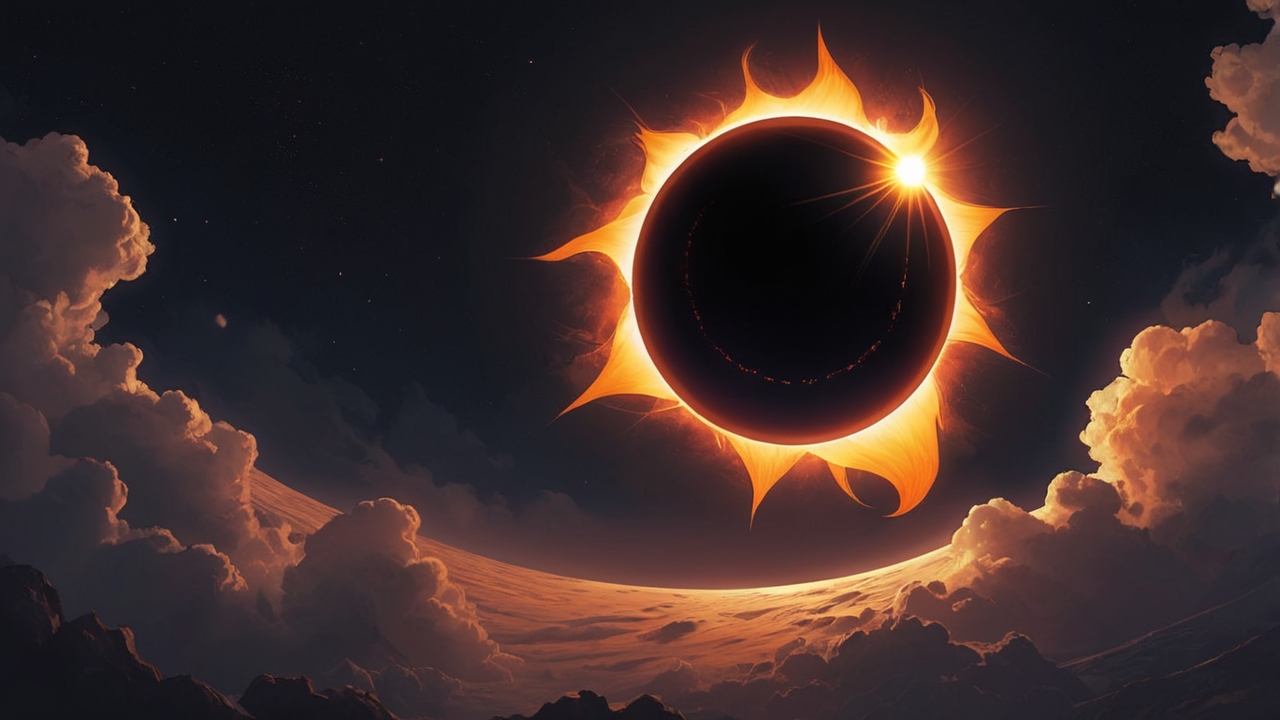
Total Solar Eclipse is the most spectacular type. The Moon completely covers the Sun’s bright disk, and the sky becomes dark like twilight or early night. This only happens along a narrow path on Earth’s surface called the “path of totality,” typically 60-100 miles wide. The Moon’s shadow races across Earth’s surface at over 1,000 miles per hour, and totality—when the Sun is completely covered—lasts only a few minutes at any given location, though it can last up to about 7.5 minutes at maximum.
Partial Solar Eclipse occurs when the Moon covers only part of the Sun. This happens in regions outside the path of totality during a total eclipse, or when the Moon passes slightly above or below perfect alignment. The Sun appears as a crescent, with a dark circular “bite” taken out of it. The sky dims somewhat, but doesn’t become dark like it does during totality.
An Annular Eclipse happens when the Moon is at a point in its elliptical orbit where it’s farther from Earth and thus appears slightly smaller than the Sun. When it passes in front of the Sun, it doesn’t quite cover the entire disk, leaving a bright ring or “annulus” of sunlight visible around the dark Moon. This creates the spectacular “ring of fire” effect. The sky dims but doesn’t become dark because that bright ring remains visible.
Hybrid Eclipse is the rarest type. Due to Earth’s curved surface, an eclipse might appear total from some locations and annular from others along its path. These are quite rare and represent a transitional state between total and annular eclipses.
How Often Do Solar Eclipses Occur?
Solar eclipses happen somewhere on Earth about every 18 months on average—more often than many people realise. However, because each eclipse is visible only from a narrow path on Earth’s surface, any specific location will see a total solar eclipse very rarely. On average, any given point on Earth experiences a total solar eclipse only once every 375 years!
This is why eclipse enthusiasts travel around the world to witness these events. Rather than waiting centuries for one to come to them, they go to wherever the path of totality crosses. Some people have seen dozens of total solar eclipses by travelling to different continents to be in the right place at the right time.
This cosmic coincidence—the perfect size match between Sun and Moon—makes Earth a special place in the universe and gives us one of nature’s most awe-inspiring shows. But this show requires perfect timing and precise alignment, which brings us to what happens during those precious few minutes of totality.
Fact 2: You Can Safely See Stars and Planets During the Day (During a Total Solar Eclipse!)
The few minutes of totality during a total solar eclipse provide one of the most surreal and spectacular experiences in nature. It’s like someone flipped a switch and turned day into night, revealing sights that are normally impossible to see.
What Happens During Totality
As the Moon’s shadow sweeps across the landscape and totality begins, the transformation is dramatic and sudden. Within seconds, the bright daylight fades to a deep twilight or darkness comparable to nighttime. The experience is eerie and awe-inspiring—it’s the middle of the day, yet the sky is dark!
The temperature drops noticeably—often by 10-15°F (5-8°C) or more within just a few minutes. You might feel a sudden chill. Birds may stop singing or return to their roosts, confused by the sudden darkness. Nocturnal animals like crickets might begin their evening songs, and some flowers may close as if night has arrived. These reactions show how deeply connected life on Earth is to the Sun’s presence.
One of the most unusual effects is the 360-degree “sunset” visible on the horizon in all directions. Because totality only occurs in a narrow path, the sky outside this path remains partially lit. Looking toward any horizon, you see a glowing orange-red ring all around you—like watching a sunset in every direction simultaneously!
Stars and Planets Become Visible
Perhaps the most mind-blowing aspect of totality is that stars become visible in the middle of the day! Normally, the Sun’s overwhelming brightness scatters light through Earth’s atmosphere, creating the blue sky that makes stars invisible during daylight hours. But when the Moon blocks the Sun’s bright disk during totality, that scattered light disappears and the sky darkens enough for stars to appear.
The brightest stars become visible, and planets are particularly prominent. Venus, the brightest planet, appears as a brilliant “star” near the eclipsed Sun. Depending on their positions, Jupiter, Mars, and Mercury may also be visible. It’s an extraordinary feeling to see planets and stars in what should be a daytime sky—something that’s normally impossible without travelling to space!
Ancient peoples who witnessed eclipses without understanding what was happening must have been absolutely terrified to see stars appear when the Sun vanished. Many cultures believed this meant the end of the world was coming.
The Spectacular Solar Corona
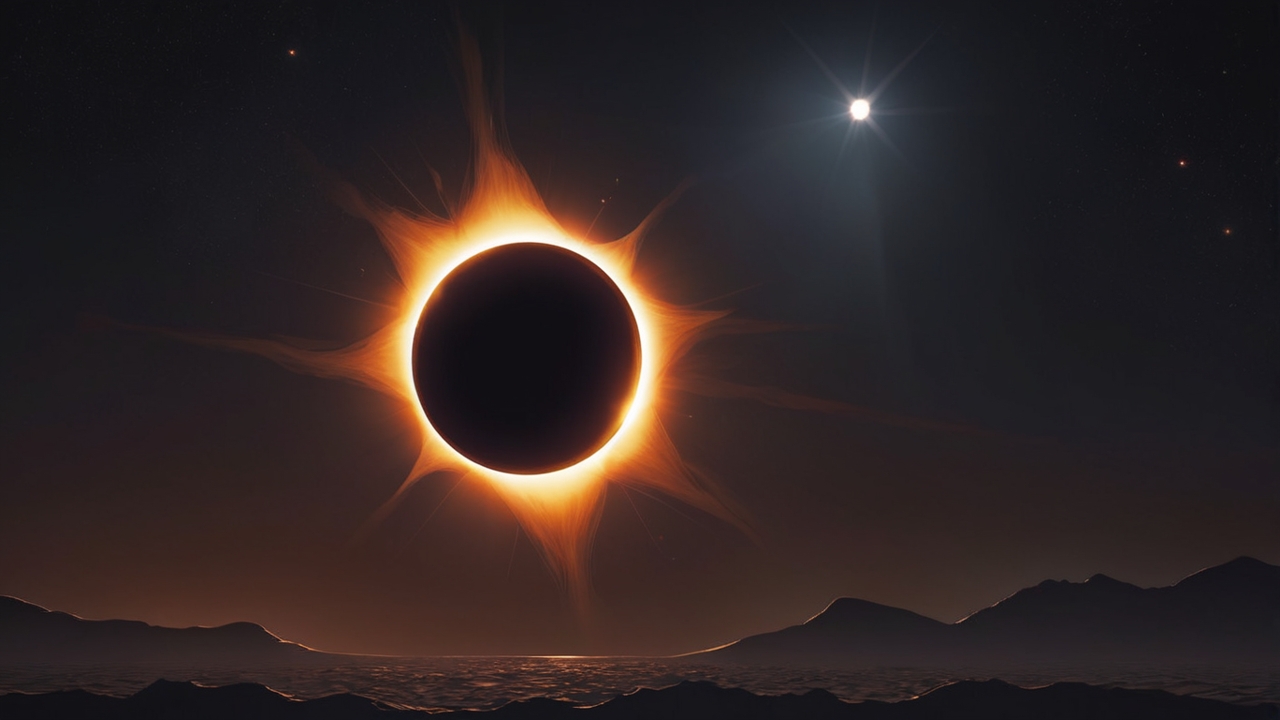
The most beautiful sight during totality is the Sun’s corona—its outer atmosphere. The corona is always there, surrounding the Sun, but normally we can’t see it because the Sun’s bright surface (the photosphere) overwhelms it completely. The corona is millions of times fainter than the Sun’s disk, so it’s like trying to see a candle flame next to a searchlight.
But during totality, with the Moon blocking the bright disk, the corona becomes visible as an ethereal, pearly-white glow extending millions of miles into space. It appears as delicate wisps, streamers, and loops of glowing plasma following the Sun’s magnetic field lines. The corona’s appearance changes based on the Sun’s 11-year activity cycle—sometimes it appears relatively symmetrical, other times it has long streamers extending far into space.
The corona is even more mysterious because it’s incredibly hot—millions of degrees Fahrenheit, much hotter than the Sun’s surface, which is “only” about 10,000°F. Why the corona is so much hotter than the surface remains one of the biggest unsolved mysteries in solar physics, called the “coronal heating problem.” Scientists use solar eclipses (and specialised space-based instruments) to study the corona and try to solve this puzzle.
The Diamond Ring Effect
Just before totality begins and just after it ends, observers see one of the most photographed eclipse phenomena: the “diamond ring effect.” This occurs during the last few seconds before totality when only a tiny sliver of the Sun’s bright surface remains visible through a valley on the Moon’s edge, while the faint corona is already visible around the rest of the Moon. This creates the appearance of a brilliant diamond on a ring—the faint corona forming the ring and the last bit of bright Sun forming the diamond.
The diamond ring signals that totality is about to begin (or has just ended), and it’s the signal for observers to remove (or replace) their eclipse glasses. During totality itself, it’s safe to look at the eclipsed Sun without protection, but once that diamond appears, the Sun’s bright surface is visible again and eye protection is required.
Baily’s Beads
Related to the diamond ring effect are “Baily’s beads,” named after British astronomer Francis Baily, who explained them in 1836. These appear as a string of bright points of light around the Moon’s edge just before and after totality. They’re caused by the last bits of sunlight shining through the valleys and between the mountains on the Moon’s rugged edge.
Because the Moon’s edge isn’t smooth but rough with mountains and craters, sunlight can shine through in some places while being blocked in others. This creates a broken ring of light that looks like a string of glowing beads around the Moon’s silhouette. Baily’s beads last only seconds but provide a spectacular sight that marks the transition into and out of totality.
Shadow Bands
Another subtle but fascinating phenomenon happens in the moments just before and after totality. If you look at a light-colored surface like a white sheet spread on the ground, you might see rippling shadow bands—wavy lines of darkness moving rapidly across the surface, like the patterns you see on the bottom of a swimming pool.
Shadow bands are caused by turbulence in Earth’s atmosphere refracting the Sun’s light when the Sun is reduced to a thin crescent just before or after totality. They’re quite faint and difficult to photograph, but once you see them, they’re mesmerising. Not every eclipse produces visible shadow bands—their appearance depends on atmospheric conditions.
A Brief but Unforgettable Experience
Totality is brief—lasting from less than a minute to a maximum of about 7.5 minutes depending on the specific eclipse and your location—but those who’ve experienced it describe it as life-changing. The sudden darkness, the appearance of stars and planets, the ethereal beauty of the corona, the temperature drop, and the strange behaviour of animals all combine to create an experience unlike anything else in nature.
Many people who’ve seen one total solar eclipse become “eclipse chasers,” travelling the world to witness totality again and again. Each eclipse is unique, with different corona appearances, planets visible, weather, and viewing locations. The experience never gets old because the cosmic coincidence that makes it possible is so rare and so perfect.
Fact 3: Lunar Eclipses Are Different from Solar Eclipses (And Safer to Watch!)
While solar eclipses occur when the Moon blocks the Sun, lunar eclipses happen when Earth blocks sunlight from reaching the Moon. These two types of eclipses are quite different in several important ways.
What Is a Lunar Eclipse?
A lunar eclipse occurs when the Sun, Earth, and Moon align so that Earth passes directly between the Sun and Moon. Earth casts a shadow into space, and when the Moon moves through this shadow, it darkens—sometimes turning a dramatic reddish or copper colour. Unlike a solar eclipse, where you’re standing in the Moon’s shadow, you’re watching the Moon pass through Earth’s shadow during a lunar eclipse.
Key Differences from Solar Eclipses
Visibility: This is the biggest practical difference. A solar eclipse is visible only from a narrow path on Earth’s surface where the Moon’s small shadow falls—perhaps 100 miles wide and a few thousand miles long. Most of Earth doesn’t see any eclipse at all. But during a lunar eclipse, anyone on the entire night side of Earth—half the planet—can see the eclipse at the same time! This means far more people can witness each lunar eclipse without travelling.
Duration: Lunar eclipses last much longer than solar eclipses. A total lunar eclipse can last over an hour (the maximum is about 1 hour and 47 minutes), while a total solar eclipse lasts only minutes. The entire sequence from the Moon first entering Earth’s shadow to fully exiting can take several hours. This gives everyone plenty of time to notice the eclipse, get outside, and watch the entire event unfold.
Safety: This is crucial—lunar eclipses are completely safe to watch with your naked eyes! The eclipsed Moon is simply a Moon lit by dimmer, reddish light rather than bright sunlight. You can look at it as long as you want without any danger to your eyes. You can use binoculars or a telescope to get a better view. In contrast, solar eclipses require special eye protection (eclipse glasses or solar filters) for all phases except totality.
Frequency: While solar eclipses happen slightly more often overall, lunar eclipses are much easier to see from any given location because of their visibility from entire hemispheres. Most people will see multiple lunar eclipses during their lifetimes without travelling, while they might never see a total solar eclipse without specifically planning for it.
Why the Moon Turns Red: The “Blood Moon”
During a total lunar eclipse, the Moon doesn’t go completely dark. Instead, it typically turns a deep red, orange, or copper colour—sometimes called a “Blood Moon.” This happens for the same reason sunsets are red.
When sunlight passes through Earth’s atmosphere on its way to the Moon, the atmosphere acts as a filter and a lens. Blue light (which has shorter wavelengths) gets scattered in all directions by air molecules—this is what makes our sky blue during the day. Red light (with longer wavelengths) is scattered less and can pass through the atmosphere more easily.
During a lunar eclipse, sunlight passes through Earth’s atmosphere all around the edges of Earth, through the atmosphere at every sunrise and sunset happening on Earth at that moment. This light is filtered and bent (refracted) by the atmosphere, with the blue light scattered away and the red light bent into Earth’s shadow, where it illuminates the Moon.
The exact colour of the eclipsed Moon varies from eclipse to eclipse. It depends on Earth’s atmospheric conditions—the amount of dust, pollution, clouds, and volcanic ash in the atmosphere. After large volcanic eruptions that inject ash high into the atmosphere, lunar eclipses can be particularly dark because even the red light is blocked. Conversely, during times with clear atmospheres, the Moon might appear bright orange or copper-colored.
Types of Lunar Eclipses
A Total Lunar Eclipse occurs when the Moon passes completely through Earth’s darkest shadow, called the umbra. The entire Moon enters the shadow and typically turns red. This is the most dramatic type and what people usually think of when they hear about a lunar eclipse.
A Partial Lunar Eclipse occurs when only part of the Moon enters the umbra. It looks like a dark, curved shadow is taking a “bite” out of the Moon. The part in shadow appears dark reddish-brown, while the part outside the shadow remains its normal bright gray-white colour.
Penumbral Eclipses occur when the Moon passes through Earth’s outer, lighter shadow called the penumbra. This is the least dramatic type of lunar eclipse. The Moon darkens only slightly, and the effect is so subtle that many people don’t notice it without being told an eclipse is occurring. Only careful observers watching throughout the event will see the dimming.
How Often Do Lunar Eclipses Occur?
There are typically 2-4 lunar eclipses per year (counting all types—total, partial, and penumbral). Not all are total eclipses—in fact, penumbral eclipses are the most common but also the least noticeable. From any given location, you can see several lunar eclipses per decade, making them much more accessible than solar eclipses.
Observing Lunar Eclipses
One of the best things about lunar eclipses is how accessible they are. You need no special equipment—just your eyes! The eclipse is safe to watch during all phases. However, binoculars or a small telescope will enhance the view, showing surface detail on the Moon even during the eclipse.
The best place to watch is anywhere with a clear view of the Moon, away from bright lights if possible. The entire eclipse sequence unfolds over several hours, so you can watch the Moon gradually enter Earth’s shadow, turn red during totality, and then gradually exit the shadow and return to its normal brightness.
Historical Significance
Lunar eclipses played an important role in ancient astronomy. Greek philosophers observed that Earth’s shadow on the Moon is always curved, evidence that Earth is spherical, not flat. Watching Earth’s shadow cross the Moon’s surface provided clear proof of our planet’s shape.
Ancient Greek astronomers also used lunar eclipses to estimate the Earth-Moon distance, achieving reasonably accurate results using geometry and careful observations. This showed that careful observation of natural phenomena could reveal fundamental truths about the universe.
One famous historical story involves Christopher Columbus. In 1504, stranded in Jamaica with dwindling supplies and increasingly uncooperative natives, Columbus consulted his astronomical tables and realised a total lunar eclipse was approaching. He told the native leaders he would make the Moon disappear. When the eclipse occurred exactly as he predicted, the frightened natives agreed to provide supplies, and Columbus’s knowledge of astronomy literally saved his expedition.
Lunar eclipses offer a safe, accessible, and beautiful way to witness the cosmic clockwork of our solar system. They remind us that we live on a planet that orbits the Sun, part of a dynamic system where precise alignments create spectacular events visible across entire hemispheres.
Fact 4: Eclipses Helped Prove Einstein Was Right (And Made Other Scientific Discoveries)
Eclipses aren’t just beautiful—they’ve been crucial for scientific progress. These brief astronomical events have provided unique opportunities for observations that led to major discoveries and confirmed revolutionary theories about the nature of our universe.
The 1919 Eclipse That Made Einstein Famous
Perhaps the most famous scientific use of an eclipse occurred on 29 May 1919, when a total solar eclipse provided the first experimental confirmation of Albert Einstein’s General Theory of Relativity.
In 1915, Einstein published his revolutionary theory proposing that gravity isn’t a force pulling objects together (as Newton had described), but rather a warping of space-time itself caused by massive objects. Imagine space as a stretched rubber sheet—placing a heavy ball on it creates a depression, and smaller objects roll toward the depression not because the ball pulls them, but because the sheet is curved.
Einstein’s theory predicted that this warping would affect light. When light passes near a massive object like the Sun, it should follow the curved space-time, bending its path. Stars that appear near the Sun in the sky should appear slightly shifted from their normal positions because the Sun’s gravity bends their light on its way to Earth.
The problem was obvious: you can’t see stars near the Sun during the day—the Sun’s overwhelming brightness makes them invisible. But during a total solar eclipse, with the Sun’s bright disk blocked by the Moon, stars near the Sun become visible.
British astronomer Arthur Eddington organised two expeditions to observe the 29 May 1919, total solar eclipse—one to Sobral, Brazil, and one to the island of Príncipe off the west coast of Africa. Both teams photographed stars visible near the eclipsed Sun and measured their positions carefully.
They then compared these positions to photographs of the same star field taken at night months earlier when the Sun was nowhere near these stars. If Einstein was right, the stars should appear shifted when photographed during the eclipse compared to their normal nighttime positions.
The results, announced in November 1919, confirmed Einstein’s prediction! The stars were indeed shifted by almost exactly the amount Einstein’s equations predicted—about 1.75 arcseconds (a tiny angle, but measurable). This discovery made international headlines and turned Einstein into a worldwide celebrity overnight. More importantly, it confirmed a revolutionary new understanding of gravity and space-time that changed physics forever.
The Discovery of Helium
Another major discovery made during a solar eclipse was the element helium. During the total solar eclipse of 18 August 1868, French astronomer Pierre Janssen observed the Sun’s corona and noticed a bright yellow spectral line that didn’t match any known element. Every element produces a unique “spectral fingerprint” of light wavelengths when heated, and this yellow line didn’t correspond to any element known at the time.
British astronomer Norman Lockyer confirmed the observation and suggested it came from a previously unknown element. He named it “helium” after Helios, the Greek sun god. This was the first time an element was discovered in space before being found on Earth!
For nearly 30 years, helium was known only from the Sun. It wasn’t until 1895 that helium was discovered on Earth (trapped in uranium ore). Today, we know helium is the second-most abundant element in the universe (after hydrogen), making up about 24% of the universe’s mass. It’s used in balloons, medical equipment, scientific instruments, and many other applications—all stemming from an observation made during a solar eclipse.
Understanding the Sun’s Corona
The solar corona—visible only during total solar eclipses or with specialised space-based instruments—has been crucial for understanding the Sun. Scientists studying the corona during eclipses discovered that it’s incredibly hot, reaching temperatures of millions of degrees Fahrenheit (compared to the Sun’s surface temperature of about 10,000°F).
This discovery created a major puzzle: Why is the corona so much hotter than the surface below it? This “coronal heating problem” remains one of the biggest mysteries in solar physics. Various theories have been proposed, but the question isn’t fully resolved. Each total solar eclipse provides a few minutes for scientists to study the corona’s structure and behaviour, gathering clues to solve this mystery.
The corona’s structure also reveals information about the Sun’s magnetic field, which drives solar storms and space weather that can affect Earth. Understanding these magnetic fields helps scientists predict solar activity that can disrupt satellites, power grids, and communications.
Testing Physics and Einstein’s Theories
The 1919 eclipse wasn’t the only time eclipses were used to test General Relativity. Subsequent eclipses allowed scientists to measure light bending with increasing precision, further confirming Einstein’s theory. Modern eclipse expeditions continue to make measurements, though today we also have space-based observations that can observe similar phenomena.
Eclipses have been used to test other predictions of physics and to make observations impossible under normal conditions. The brief minutes of totality provide a unique viewing geometry and environmental conditions that scientists exploit for various experiments.
Ancient Astronomy and Eclipse Prediction
The scientific value of eclipses extends back to ancient times. Ancient astronomers carefully recorded eclipses and, over generations, discovered patterns that allowed them to predict future eclipses. The Babylonians discovered the Saros cycle—a period of approximately 18 years, 11 days, and 8 hours after which eclipses repeat in similar patterns. This allowed eclipse prediction without understanding the underlying astronomy.
Greek astronomers used eclipse observations to calculate the Earth-Moon distance and to prove that the Earth is spherical. Chinese astronomers kept detailed eclipse records for thousands of years—records that help modern astronomers precisely calculate historical astronomical events.
Modern Eclipse Science
Despite satellites, space telescopes, and sophisticated instruments, eclipses remain valuable for science. They provide unique opportunities that space-based observations can’t replicate. During solar eclipses, scientists study changes in Earth’s ionosphere (the charged layer of our upper atmosphere), observe how the sudden darkness affects weather patterns and atmospheric circulation, and test new instruments.
Citizen scientists also contribute to eclipse research. Projects like Eclipse Soundscapes encourage people to record animal and environmental reactions during eclipses, documenting how life responds to sudden darkness. Thousands of amateur astronomers photograph eclipses, providing data about the corona’s structure from multiple locations simultaneously.
Eclipses demonstrate that science is about careful observation, testing predictions against reality, and using rare opportunities to learn things impossible to discover any other way. From proving Einstein right to discovering new elements, eclipses have advanced human knowledge in profound ways.
Fact 5: Ancient Cultures Had Amazing (and Sometimes Scary) Stories About Eclipses
For most of human history, people didn’t understand what caused eclipses. Without scientific knowledge, these events were terrifying—the Sun, source of all light and life, suddenly disappearing; the Moon turning blood-red for no apparent reason. Cultures around the world created stories to explain eclipses, and many of these tales reveal how people tried to make sense of frightening celestial events.
Why Eclipses Terrified Ancient Peoples
Imagine living thousands of years ago without any knowledge of astronomy. Your life depends entirely on the Sun—it provides light, warmth, and makes crops grow. Then one day, in the middle of the afternoon, the Sun starts disappearing. The sky darkens, stars appear, animals act strangely, and the temperature drops. Within minutes, the day has turned to night. If you didn’t know this was temporary, you might think the world was ending!
For people without scientific understanding, eclipses seemed like supernatural events—signs of divine anger, cosmic battles, or omens of disaster. The unpredictability made them even more frightening. Some cultures eventually learned to predict eclipses, which gave priests and astronomers tremendous power.
Stories from Around the World
China: Ancient Chinese believed a celestial dragon was eating the Sun (or Moon) during an eclipse. People would bang drums, ring bells, and shoot arrows into the sky to scare the dragon away and save the Sun. This “worked” every time because, of course, the eclipse always ended eventually! Chinese emperors employed court astronomers whose job was to predict eclipses accurately. Failure to predict an eclipse could result in execution because it suggested the astronomers weren’t fulfilling their cosmic duty.
Ancient Chinese eclipse records, some dating back over 3,000 years, are so detailed and accurate that modern astronomers use them to study historical astronomical events and even to understand changes in Earth’s rotation over millennia.
Vikings and Norse Mythology: Norse legends told of two wolves, Sköll and Hati, that eternally chased the Sun and Moon across the sky. During an eclipse, people believed that one of the wolves had finally caught its prey. People would make loud noises to frighten the wolf into releasing the Sun or Moon. Eventually, the wolf would let go (when the eclipse ended), and the chase would resume.
Ancient Egypt: Egyptians saw eclipses as a battle between the sun god Ra and the serpent Apep (also called Apophis). Apep was the embodiment of chaos and evil, living in the underworld and trying to prevent Ra’s daily journey across the sky. An eclipse meant Apep was temporarily winning. People performed protective rituals and recited spells to help Ra defeat the serpent and restore light to the world.
India: Hindu mythology tells of a demon named Rahu who disguised himself as a god to drink the nectar of immortality. The Sun and Moon recognised the deception and alerted the gods, who cut off Rahu’s head. However, Rahu had already consumed the nectar, immortalising his severed head. In revenge, Rahu’s head eternally chases the Sun and Moon across the sky. When he catches one, he swallows it (causing an eclipse), but because he has no body, the Sun or Moon falls out the bottom and escapes. This story beautifully explains why eclipses are temporary!
Korea: Korean legends tell of fire dogs living in the sky that try to steal the Sun or Moon. During an eclipse, people believe a fire dog has succeeded in catching the bright orb. People beat drums and made noise to frighten the fire dog into dropping its prize.
Inca Empire: The Inca saw lunar eclipses as a jaguar attacking and eating the Moon. The reddish colour of the eclipsed Moon was interpreted as the Moon’s blood. People feared that after eating the Moon, the jaguar might come to Earth and attack people, so they would make noise, shake spears, and make their dogs bark to scare the jaguar away.
Ancient Greece: While early Greeks saw eclipses as signs of divine anger or omens requiring interpretation, Greek philosophers eventually began proposing natural explanations. By the 5th century BCE, some Greek thinkers correctly explained eclipses as shadows. This gradual shift from supernatural to natural explanation represents the beginning of scientific thinking about celestial phenomena.
Various African Cultures: Many African traditions interpreted eclipses as the Sun and Moon fighting or having conflict. During an eclipse, communities saw it as a reminder to resolve their own conflicts. It was considered a time for reconciliation, peacemaking, and settling disputes—a beautiful transformation of a frightening event into an opportunity for social healing.
Eclipses Facts Conclusion
From the remarkable cosmic coincidence that makes total solar eclipses possible to the surreal experience of seeing stars during daytime totality, from understanding the differences between solar and lunar eclipses to discovering how eclipses helped prove Einstein’s theory of relativity, and from ancient myths of dragons and jaguars to modern scientific understanding—eclipses reveal both the wonder of the universe and the progress of human knowledge.
These spectacular alignments of Sun, Earth, and Moon connect us to the cosmos and to history, showing us that the universe follows predictable patterns we can understand and anticipate. Whether watching safely through eclipse glasses or viewing a blood-red Moon with naked eyes, eclipses remind us to keep looking up and wondering about our magnificent universe. The next eclipse visible from your location could be just months or years away—will you be ready to witness it?
We hope you enjoyed learning more things about eclipses as much as we loved teaching you about them. Now that you know how majestic these space probes are, you can move on to learn about our Space like: Space Stations, Sun, and Asteroids.
Why not subscribe to our LearningMole Library for as little as £1.99 per month to access over 3400 fun educational videos.
Maths Circus, an innovative platform we've crafted, presents a captivating realm where children learn mathematics through the exciting theme of a circus. The joy of juggling numbers and solving circus...
Singers use their voices as musical instruments to perform songs in theatres, recording studios, choirs and at events. Most of their working day, though, is spent practising, learning music and...
Article summary What this article covers: How primary teachers can use online assessment tools such as live quizzes, polling, digital exit tickets and digital portfolios to check understanding, give faster...
Article summary What this article covers: The role of AI in education for primary-aged children in the UK, including what artificial intelligence is, how schools in England use it, the...








Leave a Reply