Teachers use quality curriculum materials for core subjects to deliver engaging lessons and meet curriculum standards. These resources offer interactive activities, structured lesson plans, and assessment tools that support learning across all key subject areas.
English Language Arts (ELA)
English Language Arts resources help your pupils develop reading, writing, speaking, and listening skills. Phonics programmes and guided reading materials lay the foundation for effective literacy instruction in primary classrooms.
Reading Resources:
Levelled reading books that match pupils’ abilities
Comprehension question sets for various text types
Peer editing checklists for collaborative learning
ELA resources offer differentiated materials to support struggling readers and challenge advanced pupils. Choose materials that include assessment rubrics and progress tracking tools.
Michelle Connolly, founder of LearningMole with 16 years of classroom experience, says: “Effective literacy resources must balance structured phonics instruction with engaging texts that spark children’s imagination and curiosity about reading.”
Mathematics
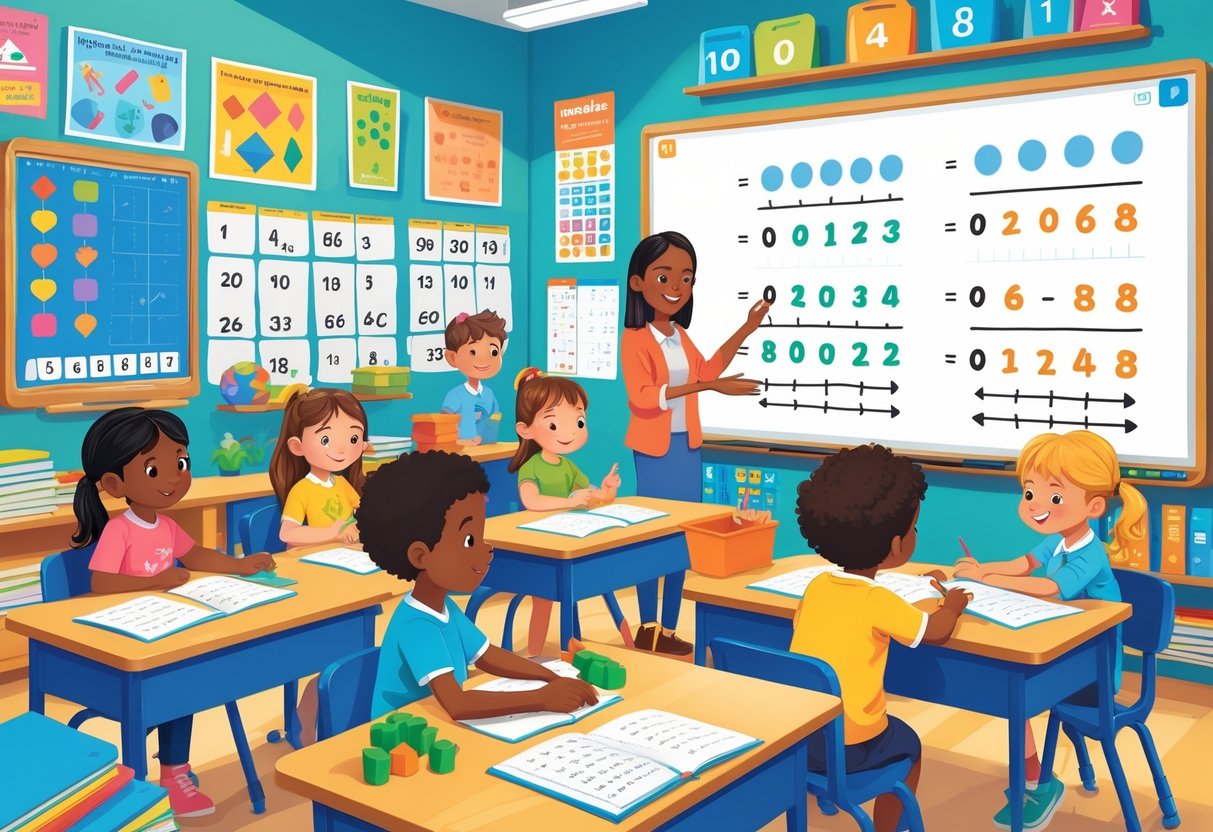
Teachers need mathematics resources that align with curriculum progression to build understanding and skills. Standards-aligned math lessons help teachers deliver consistent, high-quality instruction in all mathematical domains.
Number and Place Value Materials:
Manipulatives and visual representations
Number line activities for different ranges
Place value charts and digit cards
Mental arithmetic practice sheets
Geometry and Measurement Tools:
2D and 3D shape identification resources
Measuring activities with standard units
Angle and symmetry investigation sheets
Problem-solving challenges in real-world contexts
Maths resources include teacher guides that highlight common misconceptions and suggest interventions. Materials progress in small steps and provide opportunities for deeper mathematical thinking.
Teachers use science resources to encourage hands-on investigation and build scientific vocabulary. Quality materials include experiment instructions, observation sheets, and explanation frameworks for inquiry-based learning.
Investigation Materials:
Step-by-step experiment guides with safety notes
Observation recording templates
Hypothesis formation worksheets
Results analysis question prompts
Topic-Based Resources:
Life cycles diagrams and sorting activities
Forces and motion demonstration ideas
Materials properties testing sheets
Weather monitoring charts and tools
Science resources connect to pupils’ everyday experiences and encourage collaborative investigation. Select materials that offer vocabulary support and cross-curricular links to literacy and mathematics.
Assessment Tools:
Scientific drawing templates
Concept mapping activities
Practical skills checklists
Investigation planning frameworks
Social Studies
Social Studies resources help pupils understand their community, country, and world through historical and geographical content. These materials include maps, timelines, and cultural exploration activities to develop citizenship skills.
History Resources:
Timeline templates for different periods
Artefact investigation worksheets
Role-play scenarios from past eras
Cause and effect analysis frameworks
Geography Materials:
Local area study worksheets
Map skills progression activities
Climate and weather comparison charts
Cultural celebration information sheets
Social Studies resources promote critical thinking about past and present events while building pupils’ sense of identity and belonging. Use materials that represent diverse perspectives and experiences.
Citizenship Activities:
Community helper interview templates
Rights and responsibilities sorting games
Democratic decision-making scenarios
Environmental action planning sheets
Literacy Development
Strong literacy foundations require targeted materials that address reading skills step by step. Teachers use specific tools for comprehension, phonics, and fluency building to support every learner.
Reading Comprehension Materials
Reading comprehension grows through well-chosen texts and structured questioning. Use a mix of fiction and non-fiction materials that match students’ reading levels and challenge their thinking.
CommonLit delivers high-quality materials for students in grades 3-12 with built-in comprehension activities. Their texts cover diverse topics that engage reluctant readers and build critical thinking skills.
ReadWorks provides curated articles with vocabulary lessons and assessments. This platform offers teacher guidance to save planning time and ensure systematic skill development.
Michelle Connolly, founder of LearningMole with 16 years of classroom experience, says: “Comprehension improves dramatically when children connect texts to their own experiences through structured discussion and reflection activities.”
Phonics and Vocabulary Tools
Phonics instruction uses systematic approaches that build from simple to complex sound patterns. Teachers need materials that present phonetic rules clearly and offer plenty of practice.
Vocabulary grows through repeated exposure in meaningful contexts. Use word walls, semantic maps, and vocabulary journals to reinforce new terms across subjects.
Fluency and Decoding Activities
Reading fluency combines accuracy, speed, and expression to support comprehension. Students need regular practice with texts at their reading level to build automatic word recognition.
Reading Rockets shares strategies for struggling readers to build phonemic awareness and fluency through structured activities. Their classroom videos show effective techniques.
Effective fluency activities include:
Paired reading with partners
Repeated readings of familiar texts
Echo reading for expression practice
Timed reading passages for rate building
Set up fluency stations where children practise different aspects independently. Use audio recordings so students can hear proper phrasing and expression while following along in texts.
Teach decoding skills by showing word attack strategies. Show children how to break unfamiliar words into syllables, recognise prefixes and suffixes, and use context clues for meaning.
Writing and Grammar Instruction
Strong writing and grammar foundations grow through structured practice and systematic instruction. Teachers need ready-to-use materials that target specific skills and keep students motivated to improve their communication.
Writing Prompts and Templates
Writing prompts spark creativity and give students clear starting points for their work. Themed prompts work well—seasonal topics, character scenarios, and “what if” questions capture young imaginations.
Monthly prompt collections help you plan ahead and keep lessons fresh. Use prompts that connect to your current topics in class. Science-based writing prompts can reinforce learning about animals or weather.
Templates give struggling writers the support they need. Sentence starters like “First, I noticed…” or “The most important reason is…” help students organise their ideas. Sentence and paragraph framing is very helpful for children with additional learning needs.
Story planning sheets break writing into simple steps:
Character description boxes
Setting sketches
Beginning, middle, end sections
Problem and solution spaces
Michelle Connolly, founder of LearningMole with 16 years of classroom experience, says: “Templates aren’t crutches—they’re stepping stones that build confidence. Once children master the structure, they naturally begin creating their own frameworks.”
Create class-specific templates based on your students’ interests. Football match reports or pet care guides often generate more enthusiasm than generic topics.
Grammar Practice Sheets
Choose grammar worksheets that make practice meaningful, not tedious. Activities should embed grammar within real contexts instead of isolated drills.
Sentence building activities work well. Students combine word cards to create different sentence types, learning about subjects, predicates, and modifiers through hands-on play.
Interactive grammar worksheets with games and puzzles keep students engaged while reinforcing key concepts. Crosswords using vocabulary words or grammar terms serve dual purposes.
Try these effective worksheet types:
Error correction passages—students find and fix mistakes
Sentence expansion exercises—adding adjectives, adverbs, or clauses
Grammar sorts—categorising words by type or function
Mad libs style activities—reinforcing parts of speech through silly stories
Use progressive difficulty levels so all learners can join in. Start with simple noun-verb identification before moving to complex sentences.
Daily grammar warm-ups work well as starter activities. Five-minute exercises focusing on one concept help consolidate learning.
Handwriting Resources
Effective handwriting instruction uses systematic practice and clear letter formation guidance. Many children struggle with writing stamina if they have not learned efficient letter patterns.
Letter formation charts should be visible in your classroom. Arrows showing stroke direction and starting points help prevent bad habits. Regularly demonstrate proper pencil grip to avoid writing difficulties.
Lined paper supports different developmental stages:
Wide lines with dotted centres for beginners
Standard ruled paper for developing writers
Narrow lines for advanced students
Multisensory approaches help kinesthetic learners. Sand trays, finger painting letters, or writing in the air reinforce correct formation. These methods support children with dysgraphia or fine motor difficulties.
Handwriting practice books should connect to your phonics program. Practising letters with their sounds reinforces both skills.
Use speed building exercises. Timed copying activities help students develop fluency while keeping their writing clear. Start with familiar words before moving to longer passages.
Punctuation Activities
Teach punctuation through practical application, not just abstract rules. Students need to see how punctuation changes meaning and helps readers understand.
Punctuation detective games engage students in finding and correcting errors in text passages. Use familiar stories or student writing samples for meaningful corrections.
Create punctuation sorts using sentence strips:
Questions vs. statements
Exclamations vs. calm observations
Sentences needing commas for lists
Dialogue requiring speech marks
Drama activities show children how punctuation affects expression. Students read sentences with different punctuation marks and adjust their voice and tone. This hands-on approach makes punctuation clear.
Grammar instruction works best when it connects to reading and writing activities. Link punctuation lessons to texts you read together.
Punctuation progression charts help you plan lessons:
Year Group
Focus Areas
Year 1-2
Full stops, capital letters, question marks
Year 3-4
Commas in lists, apostrophes, speech marks
Year 5-6
Colons, semicolons, advanced apostrophe use
Practice activities should mirror real writing situations. Editing partnerships let students apply punctuation knowledge to authentic texts and build collaborative skills.
Mathematics Skill Builders
Mathematics skill builders offer structured activities that help pupils develop number skills, spatial reasoning, and data analysis. These resources combine hands-on learning with practice to build mathematical confidence in all primary years.
Number Sense and Operations
Strong number sense forms the foundation of all mathematical learning.
You can use manipulatives like counting cubes and number lines to help pupils visualise mathematical concepts. These tools support pupils before they move to abstract thinking.
Skill builder workbooks offer systematic practice for different year groups.
Start with counting activities for Reception pupils. Progress through addition and subtraction for Years 1-2.
Michelle Connolly, founder of LearningMole with 16 years of classroom experience, says: “Children need to see numbers as friendly tools rather than abstract symbols. Skill builders help bridge that gap beautifully.”
Try these approaches:
Skip counting games using number learning kits with 50 cubes
One-to-one correspondence activities with physical objects
Encourage mental maths practice through daily warm-up sessions.
For pupils with additional needs, specialised curricula use real-world scenarios to teach problem-solving skills. These resources align with Common Core standards and support both elementary and secondary students.
Geometry Activities
Geometry skill builders help pupils understand shapes, space, and spatial relationships through interactive experiences.
Hands-on activities work better than worksheets for developing geometric thinking.
Start with 2D shape recognition in Reception and Year 1. Use shape sorting games and pattern blocks to build familiarity.
Progress to 3D shapes by Year 2. Let pupils handle cubes, spheres, and pyramids.
Try these geometry builders:
Shape hunts around the classroom and playground
Pattern creation using geometric tiles
Add symmetry activities with mirrors and folding. Explore angles through body movements.
Interactive mathematics software like GeoGebra gives pupils digital geometry tools. Pupils can manipulate shapes, measure angles, and explore transformations on screen.
Year 3-6 pupils benefit from coordinate activities and transformation exercises. Use grid paper for plotting points and creating geometric art.
This builds understanding of position and movement in math.
Measurement and Data Resources
Measurement skills connect mathematics to daily life through practical applications.
Make these concepts concrete by using real objects and authentic measuring tasks throughout your classroom routine.
Begin with non-standard units in Early Years. Pupils might measure tables using paperclips or compare heights using building blocks.
This builds understanding before introducing centimetres and metres.
Try these measurement activities:
Length comparisons using rulers and tape measures
Weight investigations with balance scales
Add capacity experiments using water and containers. Link time activities to daily schedules.
Start data handling with simple sorting and classifying in Reception. Pupils can group objects by colour, size, or shape.
Progress to creating pictographs and bar charts using favourite foods or pets data.
Kindergarten math skill builders often include counting and basic measurement activities. These workbooks provide structured practice alongside hands-on exploration.
For older pupils, introduce probability concepts through coin flips and dice games.
Use surveys to collect class data, then create graphs to display results. This builds statistical thinking skills.
Science Exploration Resources
Science exploration resources help you create an active learning environment where pupils discover concepts through hands-on investigation.
Plant and animal studies form the core of life science exploration.
You can set up classroom terrariums using clear containers to observe plant growth cycles. Bean seeds in transparent cups show germination stages, while butterfly gardens demonstrate metamorphosis.
“Children grasp life science concepts best when they can observe real changes happening over time,” says Michelle Connolly, founder of LearningMole with 16 years of classroom experience.
Essential life science materials include:
Magnifying glasses for detailed observation
Collection containers for specimens
Use growth charts for tracking changes. Digital microscopes allow cellular exploration.
Habitat investigations help pupils understand ecosystems.
Create mini-habitats in shoeboxes representing different environments. Pupils can research which animals live in each habitat and explain their adaptations.
Try pond dipping activities if you have access to outdoor spaces. Pupils collect water samples and identify microorganisms using identification sheets.
Physical Science
Physical science resources explore matter, energy, and forces through practical experiments.
These hands-on science activities help pupils understand concepts like states of matter, motion, and simple machines.
Matter and materials investigations use everyday items to explore physical properties.
Set up stations where pupils test materials for magnetic attraction, transparency, and flexibility. Ice cube experiments show state changes as pupils observe melting and freezing.
Forces and motion activities require minimal equipment but deliver maximum impact.
Ramps with toy cars show how surface texture affects friction. Pendulum experiments using string and washers demonstrate predictable patterns in physics.
Equipment
Investigation
Concept
Magnets
Material testing
Magnetic properties
Ramps
Car races
Friction and motion
Scales
Object comparison
Mass and weight
Torches
Shadow play
Light and dark
Simple machines exploration helps pupils understand levers, pulleys, and wheels.
Build bottle cap spinners to show wheel mechanics. Use rulers and pencils to create levers for lifting objects.
Light and sound experiments captivate young learners.
Prism activities split white light into colours. Musical instruments made from recycling demonstrate sound vibration.
Earth and Space Science
Earth and space science resources help pupils explore our planet and beyond through observation and modelling activities.
Weather and climate studies begin with daily observations using simple weather stations.
Pupils record temperature, rainfall, and wind direction while learning about weather patterns. Rain gauges made from plastic bottles measure precipitation accurately.
Geology investigations use rock and mineral samples for hands-on classification activities.
Pupils test hardness using the scratch test and observe crystal structures with magnifying glasses. Sediment layers in clear containers show how rocks form over time.
Solar system activities help pupils understand scale and distance through creative modelling.
Use different sized balls to represent planets and measure distances in the playground. Moon phase observations using biscuits show lunar cycles clearly.
Seasonal changes provide ongoing investigation opportunities throughout the school year.
Pupils photograph the same tree monthly to document changes. Shadow stick measurements show how sun position changes with seasons.
Try creating earthquake models using jelly and toy buildings. This demonstrates tectonic plate movement in a safe, engaging way.
Art Education Materials
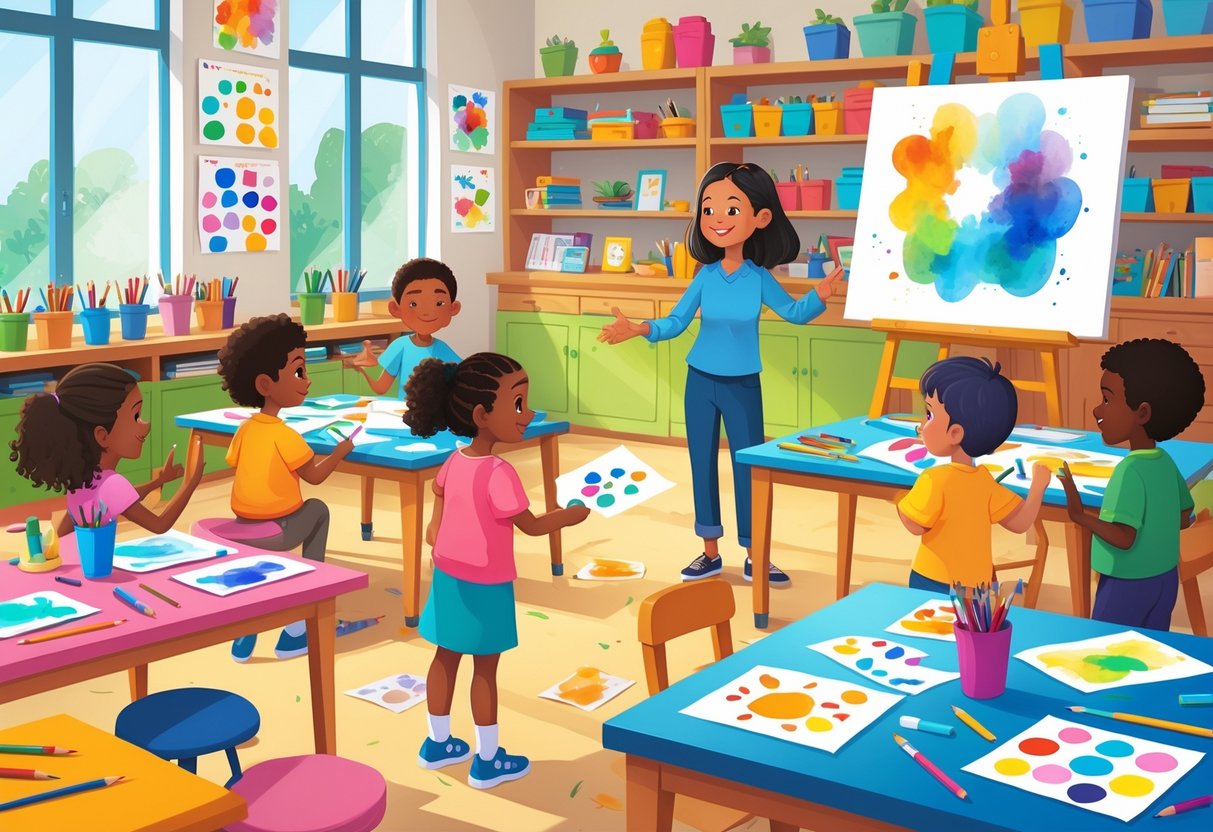
Art education materials support classroom creativity through hands-on visual projects and practical craft activities.
Basic supplies include crayons, watercolours, coloured pencils, and various paper types.
Drawing projects help students practise observation skills.
Start with simple contour drawings of classroom objects. Move to self-portraits using mirrors.
Still life arrangements teach proportion and shading techniques.
Painting activities build colour theory knowledge.
Primary colour mixing experiments show how secondary colours form. Watercolour resist techniques using crayons create interesting textures.
Tempera paints work well for younger children due to easy cleanup.
“Drawing from her background in educational technology, Michelle Connolly says, ‘Art projects help children express ideas they cannot yet put into words whilst developing essential fine motor skills.'”
Many include downloadable templates and instruction guides for immediate classroom use.
Flashcards and Games
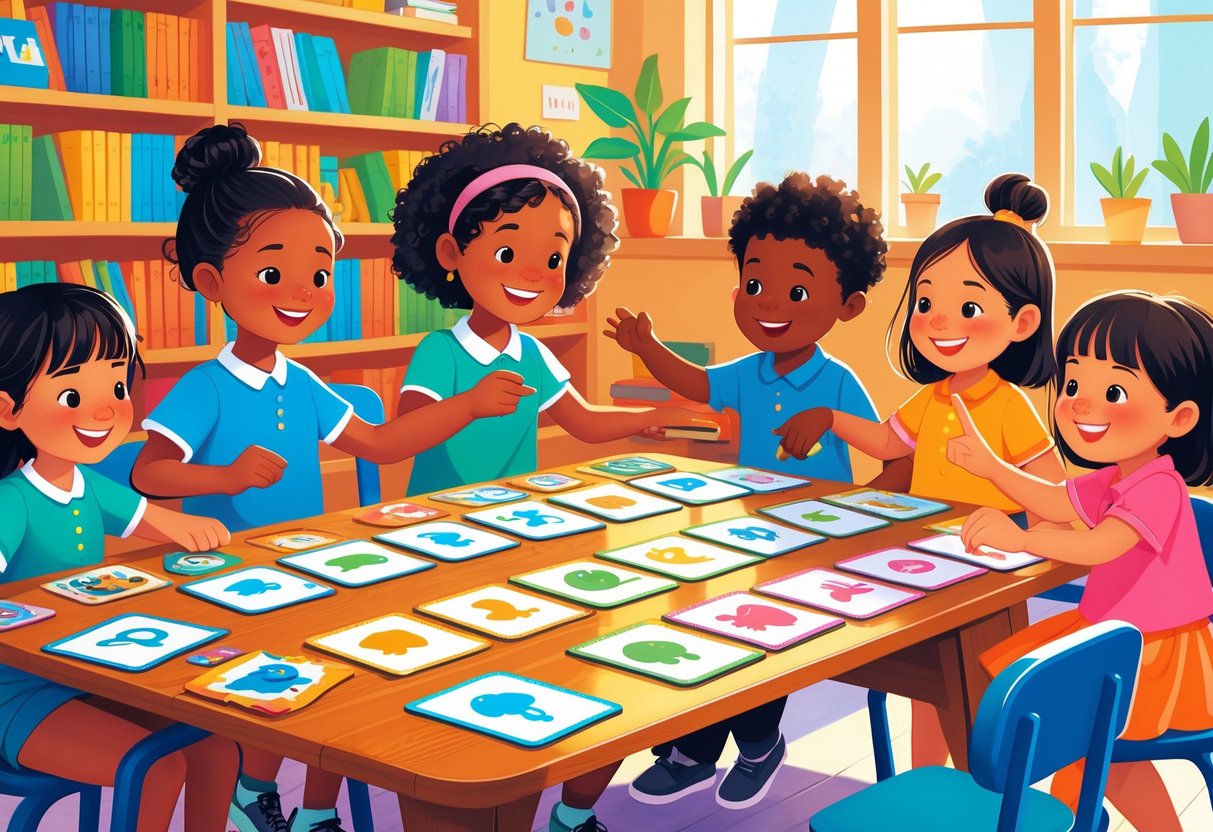
Flashcards offer quick vocabulary practice.
Card-based games make learning maths and science concepts memorable.
Interactive classroom activities keep students engaged and build essential skills through movement and competition.
Vocabulary Flashcards
Traditional flashcards remain one of the most effective tools for building vocabulary across all subjects.
You can create themed sets covering everything from phonics and sight words to subject-specific terminology.
Digital flashcard platforms like Quizlet let you build custom sets that students can access at home.
Print versions work well for younger learners who need tactile engagement.
“Flashcards work because they activate multiple learning pathways simultaneously,” says Michelle Connolly, founder of LearningMole with 16 years of classroom experience.
“Students see, say, and often write the words, creating stronger memory connections.”
Try different flashcard formats:
Picture-to-word matching for visual learners
Definition cards for older students
Add sentence completion cards for context practice.
Quick tip: Start with 10-15 cards per session. Master these before adding new vocabulary.
Math and Science Card Games
Turn abstract concepts into engaging games using number cards and visual aids.
Place value games work well with digit cards where students build the largest or smallest numbers possible.
Science vocabulary cards help students connect terms to real-world applications.
Try matching games where students pair scientific terms with their definitions or examples.
English Language Arts worksheets include grammar and spelling activities. They also offer vocabulary building exercises, reading comprehension passages, and creative writing prompts.
Mathematics resources provide arithmetic practice sheets and algebra and geometry problems. Students also use logic puzzles, reasoning activities, and visual maths concepts.
Michelle Connolly, founder of LearningMole with 16 years of classroom experience, advises: “Select worksheets that encourage critical thinking, not just rote practice.” She adds, “The best resources challenge students and build confidence.”
Science worksheets and activities encourage hands-on learning. These resources cover the scientific method and promote problem-solving skills for Key Stages 1-4.
Cross-Curricular Resources
Seasonal and holiday worksheets connect learning across subjects. These themed resources combine vocabulary, reading, writing, and maths in familiar contexts.
These tools are especially helpful for SEN students who benefit from visual learning.
Customisable Activity Packs
Educational printable worksheets from teacher-developed lessons offer flexibility for different learning needs. You can adapt these resources for your class.
Activity pack features include:
Differentiated levels within single topics
Extension activities for advanced learners
Support materials for struggling students
Assessment rubrics for tracking progress
Study skills and strategies worksheets help students build independent learning habits. These include checklists, self-quizzes, and time management templates.
Key customisation options:
Adjust difficulty levels
Add visual supports for SEN learners
Include challenge questions for gifted pupils
Create subject-specific versions of generic templates
You can combine different worksheet types to build comprehensive learning packs. This works well for homework or cover lessons.
Professional Development for Teachers
Quality professional development helps you grow as a teacher and stay current with teaching methods. Online training modules let you learn at your own pace, while specialised workshops provide practical skills for classroom management and subject teaching.
Annenberg Learner – Video workshops and libraries for K-12 teachers
Friday Institute – Self-paced courses from NC State University
National Geographic – Courses on scientific storytelling and global challenges
Many platforms offer both free and paid options. You usually pay only if you need official certificates.
Michelle Connolly, founder of LearningMole, explains: “Online modules let teachers focus on areas where they need the most support.”
Popular Paid Platforms:
Coursera – University-level courses with expert instructors
ed2go – Six-week to year-long programmes starting at £45
SimpleK12 – Teacher-created content for £24 monthly
Check your district’s requirements before enrolling. Some areas accept certain programmes, while others do not.
Classroom Management Strategies
Effective classroom management training helps you create positive learning environments. These courses focus on practical techniques you can use right away.
Key Training Areas:
Behaviour intervention strategies
Positive reinforcement systems
De-escalation techniques
Creating classroom routines
Professional development workshops often include role-playing and peer discussions. You will practice handling situations like disruptions or conflicts between pupils.
Recommended Approaches:
Restorative practices – Repair harm instead of punishing
Trauma-informed strategies – Support pupils in difficult situations
Differentiated management – Adapt for various learning needs
Cultural responsiveness – Respect diverse backgrounds
Many courses provide templates for behaviour charts and communication logs. You save time by using these ready-made resources.
Training often includes video examples of successful classroom management. Watching these helps you picture how to use the strategies in your own classroom.
Subject-Specific Workshops
Subject-focused workshops help you teach content more effectively and engage pupils in specific areas. These sessions provide ready-to-use resources and lesson plan templates.
Popular Workshop Topics:
Subject Area
Key Focus
Typical Duration
Maths
Concrete-pictorial-abstract approach
1-2 days
English
Phonics and reading comprehension
Half-day sessions
Science
Hands-on investigations
Full day
Computing
Coding and digital literacy
2-3 hours
Modern Classrooms Project offers free courses on mastery-based learning. You can learn to pace instruction based on individual pupil needs.
Benefits of Subject-Specific Training:
Updated curriculum knowledge – Stay current with national expectations
Assessment strategies – Learn effective marking and feedback
Differentiation methods – Support pupils at various levels
Workshops often include time for collaborative planning. You can work with other teachers to create lessons and share ideas.
Many programmes offer follow-up support through online communities or mentoring. This ongoing connection helps you use new techniques in your classroom.
Integrating Technology in Elementary Classrooms
Technology integration changes how young learners engage with the curriculum and build digital skills. Modern classrooms use digital platforms and educational tools to support different learning styles and develop technological literacy.
Digital Learning Platforms
Learning Management Systems help organise classrooms and improve communication. Google Classroom acts as a hub where you can distribute assignments, share resources, and track progress.
Integrating technology in elementary education means using platforms that suit young learners. Seesaw lets children document their learning using photos, videos, and voice recordings. You can share student work with families and maintain digital portfolios.
Interactive whiteboards transform whole-class instruction. Tools like SMART Boards enable collaborative learning, letting multiple students contribute at once. You can save lessons for review and adapt content in real-time.
Virtual field trips expand classroom experiences. Google Expeditions brings historical sites, science, and geography directly to pupils, offering rich learning opportunities at no cost.
Michelle Connolly says: “Digital platforms work best when they enhance human connection—technology should amplify your teaching, not overshadow it.”
Educational Apps and Tools
Adaptive learning apps personalise instruction for each student. Khan Academy Kids adjusts difficulty levels automatically, helping children face the right challenges and build confidence.
Gamification tools boost engagement through competition. Kahoot turns assessment into interactive quiz games, encouraging participation from all students.
Creative applications support cross-curricular learning. Scratch Junior introduces coding through storytelling, and Book Creator lets pupils design digital books with text, images, and audio.
Assessment apps give instant feedback. Plickers uses printable cards and a mobile device for quick polls and quizzes, helping you spot misconceptions and adjust teaching on the spot.
Assessment and Progress Tracking Tools
Teachers need reliable ways to measure student learning and track growth. Using ongoing assessment methods and progress monitoring systems helps you make informed teaching decisions.
Formative Assessment Resources
Formative assessment checks student understanding during lessons. These quick checks help you adjust your teaching before introducing new concepts.
Formative assessment tools like Kahoot, Padlet, and Mentimeter make checking understanding interactive. Students respond using tablets or computers, giving you instant feedback.
Exit tickets work well at the end of lessons. Ask students to write one thing they learned and one question they have. This method quickly shows gaps in understanding.
Michelle Connolly notes: “Quick formative checks save hours of reteaching. When you catch misconceptions early, you can address them before they become embedded.”
Traditional Assessment Methods
Method
Best For
Time Needed
Thumbs up/down
Quick comprehension check
30 seconds
Mini whiteboards
Maths problems
2-3 minutes
Think-pair-share
Discussion topics
5-10 minutes
Observation checklists help you track skills during group work or independent tasks. Create simple tick boxes for key objectives and move around the classroom with your clipboard.
Many schools use platforms like Target Tracker or Pupil Asset to monitor progress across subjects. These systems link to National Curriculum objectives and create visual reports for parents and school leaders.
Spreadsheet templates also work well for small-scale tracking. Create columns for assessment dates and rows for student names, then colour-code cells to show progress levels.
Physical Progress Displays
Classroom progress charts motivate students and keep goals visible. Use traffic light systems so students can move their names from red (struggling) to green (secure).
Individual progress folders help students track their own learning. Include target sheets, completed work, and reflection prompts so students can see their improvement.
Reading assessment tools are especially important because reading forms the foundation for all learning. Regular reading level checks using running records or digital assessments help you group students and select the right texts.
Enrichment and Extension Resources
Quality enrichment and extension resources challenge advanced learners and keep all students engaged.
These materials include hands-on STEM projects, cultural studies content, and extra-curricular activities that extend learning beyond the standard curriculum.
STEM Challenges
STEM challenges present students with real-world problems.
Students use science, technology, engineering, and maths skills to solve these problems.
You can find ready-made activities that require little preparation but engage students fully.
Popular STEM Challenge Types:
Bridge building with limited materials
Robot coding projects using simple programming languages
Water filtration system designs
Solar oven construction challenges
Michelle Connolly, an expert in educational technology, explains that STEM challenges work best when students see immediate results from their efforts.
These activities help students discover new talents and develop social skills.
You can start with one or two activities and expand as interest grows.
Planning Considerations:
Survey students for their interests.
Identify staff and parent volunteers.
Secure spaces and materials.
Create clear schedules and expectations.
Plan events to showcase student achievements.
Frequently Asked Questions
Teachers often use online platforms and educational websites to find teaching materials, printable resources, and technology tools for primary school classrooms.
Where can I find engaging and free lesson plans for primary school?
Storage solutions, labelling systems, and display materials make classroom management easier.
Seasonal decorations and themed displays help keep pupils interested throughout the school year.
These materials create engaging classroom atmospheres that support learning.
How can I integrate technology effectively with my teaching resources?
Start with simple technology integration instead of using complex systems. Digital presentations enhance traditional lessons and help teachers and pupils.
Combine interactive whiteboards with physical resources. Let pupils explore concepts through hands-on activities after you demonstrate them with technology.
Use educational apps and websites to provide extra practice opportunities. Pick platforms that match your curriculum.
Recording devices capture pupil discussions and presentations for later review. This approach supports assessment and helps pupils reflect on their progress.
Online collaboration tools let pupils work together on projects outside classroom hours. These platforms extend learning time.
“Technology should enhance your teaching rather than complicate it,” says Michelle Connolly, educational consultant. “Choose tools that save time and improve learning outcomes.”
Check your school’s technical capabilities before using new digital resources. Reliable internet and updated devices make technology integration easier.
Maths Circus, an innovative platform we've crafted, presents a captivating realm where children learn mathematics through the exciting theme of a circus. The joy of juggling numbers and solving circus...
Asia Facts for Kids: Asia is the largest continent on Earth, covering around 30% of the world's land and home to about 4.8 billion people. It has 47 United Nations...
Feedback with digital portfolios works best in primary schools when teachers keep comments brief and expect every child to act on them. A voice note of about a minute on...
Singers use their voices as musical instruments to perform songs in theatres, recording studios, choirs and at events. Most of their working day, though, is spent practising, learning music and...






Leave a Reply