Dinosaur Facts: Dazzling Jurassic Park and Beyond for Kids

Avatar of Shaimaa Olwan
Updated on: Educator Review By: Michelle Connolly

Dinosaur Facts: Every child who has watched a T. rex thunder across a cinema screen carries a mental image of dinosaurs that scientists would politely but firmly correct. The Jurassic Park films have done more than any textbook to ignite children’s fascination with prehistoric life, yet they were made when palaeontology looked quite different from what it looks like today. What we know about dinosaurs in 2024 is more astonishing, and in many ways more beautiful, than anything Hollywood has managed to depict.

This article is for primary teachers covering KS2 Science and History, and for parents who want to give children something more substantial than a list of names and sizes. It draws on modern palaeontological research to correct the biggest misconceptions, highlight the UK’s remarkable dinosaur heritage, and connect what children learn in the classroom to the living science happening in museums and field sites. LearningMole’s curriculum-aligned resources on prehistoric life are designed with exactly this kind of depth in mind.

Understanding dinosaurs properly matters beyond the topic itself. When children grapple with how we know what we know about creatures that died 65 million years ago, they are learning to think scientifically. They are encountering evidence, inference, revision, and uncertainty. These are the habits of mind the UK National Curriculum calls “working scientifically,” and dinosaurs, with their mix of solid fossil evidence and genuine ongoing debate, are one of the best vehicles for building them.

Hollywood Myth-Busting: What the Films Got Wrong

The good news is that the films got a lot right. The bad news is that what they got wrong is exactly what children remember most vividly.

The T. rex: A Cretaceous King, Not a Jurassic One

The most famous factual error in Jurassic Park is built into the film’s title. Tyrannosaurus rex lived during the Late Cretaceous period, roughly 68 to 66 million years ago, not the Jurassic period, which ended about 145 million years ago. There is a gap of nearly 80 million years between the last Jurassic dinosaurs and the first T. rex. To put that in perspective, the gap between T. rex and us (66 million years) is smaller than the gap between T. rex and the Stegosaurus (80 million years). T. rex and Stegosaurus never shared the earth.

The films also depicted T. rex as unable to see stationary prey. This detail came from a single scene in Michael Crichton’s original 1990 novel and has no palaeontological basis. Studies of T. rex skull fossils suggest its vision was excellent, better than that of a modern hawk, with forward-facing eyes that provided strong depth perception. For a predator hunting large prey, the ability to judge distance accurately would have been genuinely useful.

Film VersionScientific Reality
T. rex could not see stationary objectsT. rex had forward-facing eyes and likely excellent binocular vision
T-Rex could not see stationary objectsT. rex lived in the Jurassic period
Velociraptors were human-sizedReal Velociraptors were roughly turkey-sized
Velociraptors had scaly skinFossil evidence strongly suggests they had feathers
Dilophosaurus had a neck frill and spat venomNo fossil evidence exists for either feature; it was up to 6 metres long
Brachiosaurus stood on its hind legs to reach treesIts body structure made this biomechanically implausible

Velociraptors: Small, Smart, and Feathered

The Velociraptors in Jurassic Park were modelled on a different dinosaur entirely: Deinonychus, a much larger North American species. Real Velociraptors, discovered primarily in Mongolia, stood roughly 50 to 60 centimetres tall at the hip, about the size of a large turkey. They were undoubtedly clever and agile predators, but a child could have outrun one.

More importantly, Velociraptors were feathered. Fossil specimens discovered since the mid-1990s show clear quill knobs on the forearm bones, the same attachment points for flight feathers seen in modern birds. Velociraptors could not fly, but they were covered in feathers, likely used for display, insulation, or helping to pin down struggling prey. The image of a scaly, lizard-like creature sprinting through a kitchen is giving way to something stranger and more beautiful: a large, feathered predator with a sickle claw and a beak-like snout.

The Dazzling Truth: Dinosaurs Were Not All Grey and Green

dinosaur facts

For most of the twentieth century, palaeontologists assumed dinosaurs were dull-coloured, like modern reptiles. That assumption has collapsed almost entirely over the past two decades.

The breakthrough came from analysing melanosomes: tiny pigment-producing structures preserved in exceptional fossil feathers. In 2010, researchers studying a 125-million-year-old specimen of Sinosauropteryx, a small feathered dinosaur from China, identified the chemical signature of reddish-brown pigment in its tail feathers. The animal had ginger and white banding on its tail, like a striped cat. Subsequent analysis of Microraptor, a four-winged gliding dinosaur, found evidence of iridescent black plumage, similar to that of a modern crow or starling.

These are not reconstructions based on guesswork. They are direct chemical analyses of fossil tissue. The science is still developing, and colour reconstruction has real limitations, but the picture that emerges is of a dinosaur world far more vivid than anything depicted in the films.

For classroom purposes, this is a genuinely powerful teaching moment. Children who draw dinosaurs green and grey are not wrong based on what was known in 1993. Telling them that science has moved on and explaining how it has done so through technology applied to fossils rather than new animal discoveries teaches something more valuable than any individual fact.

Beyond the Famous Names: Weird Dinosaurs You Won’t See in Films

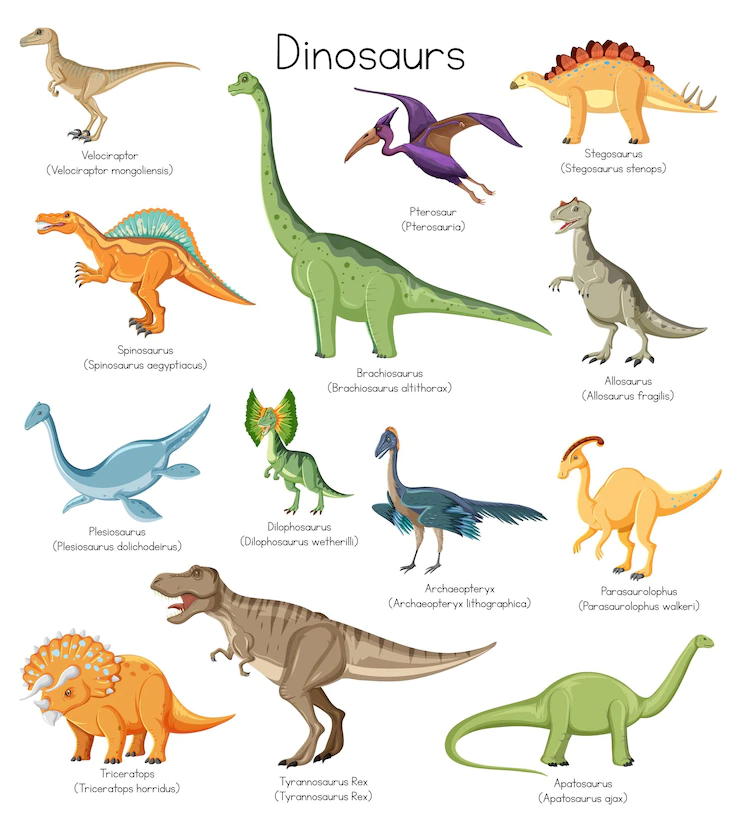
The dinosaurs most children can name, T. rex, Triceratops, Brachiosaurus, Velociraptor, represent a tiny fraction of the roughly 1,000 species currently identified by palaeontologists. Some of the most recent discoveries challenge almost everything films have taught children to expect.

Yi qi (pronounced “ee chee”) was a small, sparrow-sized dinosaur from Jurassic China that had bat-like wings made of a membrane stretched between elongated fingers and a bony rod. It could glide, possibly even flap. It is the only known dinosaur with this wing structure, and it would look completely alien to anyone raised on Jurassic Park.

Spinosaurus makes a brief appearance in the third Jurassic Park film as an enormous predator. The real Spinosaurus, as reconstructed from fossils discovered in the 2010s, was even stranger. It was the largest predatory dinosaur known, reaching perhaps 14 metres in length, but its legs were relatively short, and its body was adapted for swimming. Spinosaurus was a river predator that hunted fish in what is now North Africa. Its nostrils were positioned high on its skull, like a crocodile’s, so it could breathe while mostly submerged.

Pachycephalosaurus had a dome of solid bone up to 25 centimetres thick on the top of its skull. For decades, palaeontologists assumed it used this dome in head-butting contests, like modern bighorn sheep. More recent research suggests the dome may have been used for display rather than combat. The debate is ongoing, and that ongoing debate is itself worth sharing with children as an example of how science works.

Britain’s Own Prehistoric Story: The Jurassic Coast

Children searching for the term “Jurassic” in connection with the UK will find something far more significant than a film franchise. The Jurassic Coast in Dorset and East Devon is a UNESCO World Heritage Site and one of the most important palaeontological locations in the world. Its cliffs expose 185 million years of geological history in a single stretch of coastline.

The scientist most associated with the Jurassic Coast is Mary Anning, who was born in Lyme Regis in 1799. Working largely without formal scientific training and operating in a period when women were excluded from scientific societies, she discovered the first complete Ichthyosaur skeleton (at age 12), the first two Plesiosaur specimens ever found, and numerous other creatures that redefined understanding of prehistoric life. Anning’s story is directly relevant to the KS2 History curriculum’s focus on significant historical figures and to the Science curriculum’s emphasis on how scientific knowledge develops.

LocationNotable Finds
Lyme Regis, DorsetIchthyosaurs, Plesiosaurs (Mary Anning’s key discoveries)
Charmouth, DorsetAmmonites, Ichthyosaur fragments; now a protected fossil site
Kimmeridge Bay, DorsetMarine reptiles, fish, and Kimmeridgian mudstones
Portland, DorsetSauropod footprints discovered in 1997
Isle of WightMost dinosaur species found anywhere in the UK, including Baryonyx

Britain has also produced land-based dinosaur finds. Baryonyx, a large fish-eating theropod with crocodile-like jaws, was discovered in Surrey in 1983. Iguanodon remains, one of the first dinosaurs ever formally described, have been found in multiple locations, including the Isle of Wight. And Megalosaurus, found in Oxfordshire, became the first dinosaur to be formally named and described anywhere in the world, in 1824.

How We Know What We Know: Fossil Science Explained Simply

Dinosaur facts

Understanding how fossils form is part of the KS2 Science curriculum, and it provides children with a mental model for why our knowledge of dinosaurs is always partial and always improving.

A fossil begins with death. For fossilisation to occur, an animal’s remains need to be buried quickly under sediment before they can decay or be scattered. This is more likely in certain environments, particularly river floodplains, deltas, and shallow seas, which is why the fossil record is heavily biased towards animals that lived near water. The vast majority of animals that ever lived left no fossil trace at all.

Over millions of years, sediment compresses into rock, and minerals in the groundwater gradually replace the original bone material, molecule by molecule, with harder minerals. What remains is chemically different from the original bone but preserves the structure in remarkable detail. CT scanning, the same technology used in hospital scanners, now allows scientists to examine the internal structure of fossils without cutting them open, revealing brain cavities, inner ear structures, and blood vessel patterns that were invisible to earlier researchers.

“Children often assume that fossils are rare and simple. In fact, the process of discovering what fossils can tell us is incredibly active and technical. When you explain that the same scanner used in hospitals is being used to look inside dinosaur bones, you see children’s understanding of science shift in real time.” Michelle Connolly, Founder of LearningMole and former teacher with over 15 years of classroom experience

Teaching Resources and Support

What is Phonics?

For teachers covering fossils and rocks in Year 3 Science, or prehistoric life as part of KS2 History and topic work, LearningMole provides curriculum-aligned video resources and educational materials designed to give children genuine depth rather than surface-level facts.

LearningMole’s educational resources connect directly to UK National Curriculum objectives for working scientifically: asking questions, using evidence, comparing explanations, and understanding that scientific knowledge changes over time. The dinosaur topic is an ideal vehicle for all four, and our video content is designed to give teachers material they can use directly in lessons or assign for supported home learning.

For parents exploring this topic at home, the Kitchen Cabinet Fossil Hunt is a simple activity worth trying: bury chicken bones or shells in salt dough (equal parts salt, flour, and water), allow it to harden, then give children tools to excavate their “fossils.” The experience of careful, methodical extraction connects the activity to what real palaeontologists do and gives children a tactile understanding of why fossil work is slow and precise.

Frequently Asked Questions

Dinosaurs for Kids

Which dinosaur in Jurassic Park was the most scientifically accurate?

Brachiosaurus is often cited as one of the more accurate depictions, at least in terms of basic body shape and scale. The main inaccuracy is the scene where it rears onto its hind legs; its body structure makes this biomechanically implausible. The franchise’s least accurate depictions are Dilophosaurus (shown with a neck frill and the ability to spit venom, with no fossil evidence for either) and Velociraptors, which were modelled on the larger Deinonychus and shown without feathers.

Are birds actually dinosaurs?

Yes. By the most widely accepted scientific classification, birds are dinosaurs, specifically, they are avian theropods that evolved from within the group that includes Velociraptor and T. rex. The transition from feathered non-flying dinosaurs to flying birds happened gradually, and the earliest known bird, Archaeopteryx (discovered in Bavaria in 1861), looks strikingly similar to small feathered dinosaurs from the same period. This means that pigeons, sparrows, and every other bird alive today are living dinosaurs. This is the current scientific consensus, not a loose metaphor.

Were there dinosaurs in Britain?

Yes, more than 100 species of dinosaur have been discovered in the UK. Significant finds include Baryonyx (a large fish-eating theropod found in Surrey in 1983), multiple Iguanodon specimens from the Isle of Wight and Sussex, and the original Megalosaurus material from Oxfordshire, which in 1824 became the first dinosaur to be formally named anywhere in the world. The Isle of Wight has yielded more dinosaur species than any other location in Britain, and fossils continue to be found there regularly.

What was the Mesozoic Era, and why does it matter?

The Mesozoic Era spans approximately 252 to 66 million years ago and is divided into three periods: the Triassic (when the first dinosaurs appeared around 230 million years ago), the Jurassic, and the Cretaceous. Dinosaurs dominated land ecosystems for roughly 165 million years. One useful comparison for children: the time between the Stegosaurus and T. rex (about 80 million years) is longer than the time between T. rex and us (about 66 million years). Understanding the Mesozoic gives children a sense of deep time, one of the foundational concepts in both earth science and biology.

How do we know what colour dinosaurs were?

For most of the twentieth century, we did not know. That changed in 2010 when researchers analysing feathered fossils from China identified preserved melanosomes, the tiny structures inside feather cells that produce pigment. By comparing the shape and arrangement of melanosomes in fossils with those in living birds, scientists can infer colour with reasonable confidence. Sinosauropteryx is now reconstructed with ginger and white striped tail feathers; Microraptor had iridescent black plumage. This technique only works for fossils that preserve soft tissue in exceptional detail, so it applies to a small fraction of known species, but it demonstrates a broader principle: what we can learn from fossils continues to grow as scientific methods improve.

What age is the dinosaur topic suitable for in the UK curriculum?

Dinosaurs and fossils appear most formally in the KS2 Science curriculum under “Rocks” (Year 3), where children are expected to describe how fossils form when organisms that lived are trapped within rock. The topic also appears in topic work and history, with Mary Anning’s story used by many schools as a History case study in Years 4-6. For home educators, the topic is genuinely accessible from age 5 upwards, with depth added as children develop.

Where can parents and teachers find curriculum-aligned dinosaur resources?

LearningMole provides video resources and educational materials covering prehistoric life, fossils, and related science topics, all aligned to UK National Curriculum objectives for KS1 and KS2. Resources are designed to support both classroom teaching and home learning, with content that connects the topic to working scientifically skills as well as factual knowledge. Visit learningmole.com to explore the full range across science and history topics.

Why did the dinosaurs become extinct?

The most widely accepted explanation is that a large asteroid, roughly 10 to 15 kilometres in diameter, struck what is now the Yucatán Peninsula in Mexico approximately 66 million years ago. The impact triggered wildfires and a “nuclear winter” effect in which dust and debris blocked sunlight for months or years, killing plants and disrupting food chains. This coincided with intense volcanic activity in what is now India (the Deccan Traps), and both factors likely contributed to the extinction. Importantly for children: not all dinosaurs died. The avian dinosaurs (birds) survived. What ended was the age of non-avian dinosaurs.

Conclusion

Dinosaurs facts

The story of dinosaurs is, at its heart, a story about what science can do with fragmentary evidence and improving tools. A palaeontologist working today has access to CT scanners, chemical analysis, biomechanical modelling, and an international network of discoveries that would have seemed impossible to the scientists who first described Megalosaurus in 1824. What we know now is not a final picture; it is a snapshot of an ongoing investigation, and the next discovery could change it again.

For children, that is not a reason for uncertainty. It is a reason for excitement. The T. rex in the museum is not a finished exhibit; it is an argument waiting to be updated. Teaching children to see science that way, as something that moves and changes rather than something to be memorised, is one of the most valuable things any educator can do, and the dinosaur topic, properly taught, gives teachers exactly that opportunity.

LearningMole’s curriculum-aligned resources on prehistoric life are designed to support exactly this kind of teaching: content that connects what children see on screen to what is actually known, resources that give teachers the depth they need for confident classroom delivery, and video materials that bring the science to life in ways that work for primary-aged learners. Explore the full range at learningmole.com.

Leave a Reply

Your email address will not be published. Required fields are marked *