Counting with Toys and Play Doh: Brilliant Ideas for KS1, KS2, ESL & EFL
Table of Contents
Counting with Toys and Play-Doh: Children make sense of numbers through their hands before they can make sense of them on paper. Rolling a ball of Play-Doh, lining up toy animals in order, cutting a soft disc into equal parts: these are not diversions from maths learning. They are learning maths.
The Concrete-Pictorial-Abstract (CPA) method, used by primary schools across the UK as part of the National Curriculum mastery approach, places physical handling of objects at the very start of every new concept. Without that grounding, abstract numbers remain meaningless symbols for many children.
At LearningMole, the UK educational platform founded by Michelle Connolly, a former primary school teacher with over 15 years of classroom experience, we see the impact of tactile maths learning across every key stage.
Play-Doh and everyday toys are not just for Reception classes. With the right activities, they support fractions in Year 5, ratios in Year 6, and vocabulary building for EAL learners at any age. This article gives teachers and parents a practical toolkit spanning EYFS through KS2, including a dedicated section for ESL and EFL learners, where physical objects provide exactly the ‘comprehensible input’ that language-learning theory recommends.
Whether you are a Year 1 teacher planning a number bonds lesson, a parent supporting homework on fractions, or a specialist supporting newly arrived EAL pupils, the activities here are ready to use in the classroom or at home. Every activity maps to specific UK National Curriculum objectives so that teachers have the planning evidence they need, and every section follows the CPA sequence: start with the concrete, move to a visual representation, then introduce the number.
Why Tactile Maths Works: The CPA Method
Hands-on learning accelerates understanding because it gives children a physical memory of a concept, not just a verbal one. The CPA method, developed by educational psychologist Jerome Bruner and embedded in the UK’s mastery maths approach, describes three stages that move from the physical to the abstract.
- Concrete: children handle real objects — Play-Doh, toy figures, blocks — to experience the mathematical concept directly.
- Pictorial: children draw or sketch what they built, creating a visual bridge between the physical and the symbolic.
- Abstract: Children work with numbers and mathematical notation, now anchored to a real experience they can recall.
Jumping straight to abstract notation — numbers on a whiteboard — is why many children struggle, especially with concepts such as fractions and ratios. Play-Doh and toys are not childish shortcuts; they are the first step in a rigorous learning sequence that the National Curriculum endorses.
“When a child cuts a piece of Play-Doh into two equal parts and holds one half in each hand, fractions stop being confusing symbols and become something they have physically experienced. That physical memory carries them all the way through to Year 6 and beyond.” Michelle Connolly, Founder of LearningMole and former teacher with over 15 years of classroom experience
KS1: Building Number Sense with Play-Doh and Toy Figures
For children in Year 1 and Year 2, the concrete stage is everything. National Curriculum objectives for Number and Place Value at KS1 require children to count reliably, identify one more and one less, and begin working with number bonds to 10 and 20. Play-Doh and small toys make all of these visible and touchable.
1-to-1 Correspondence (Year 1)
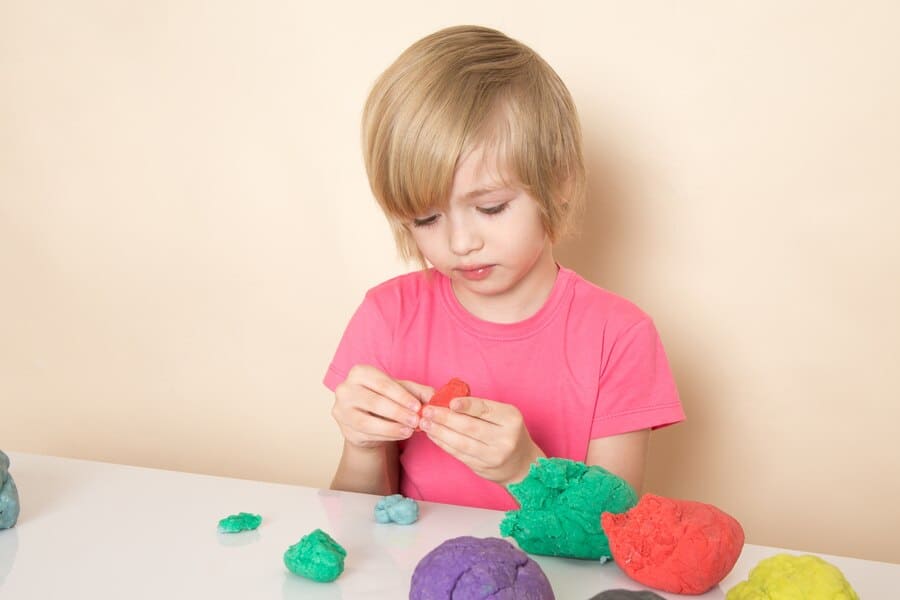
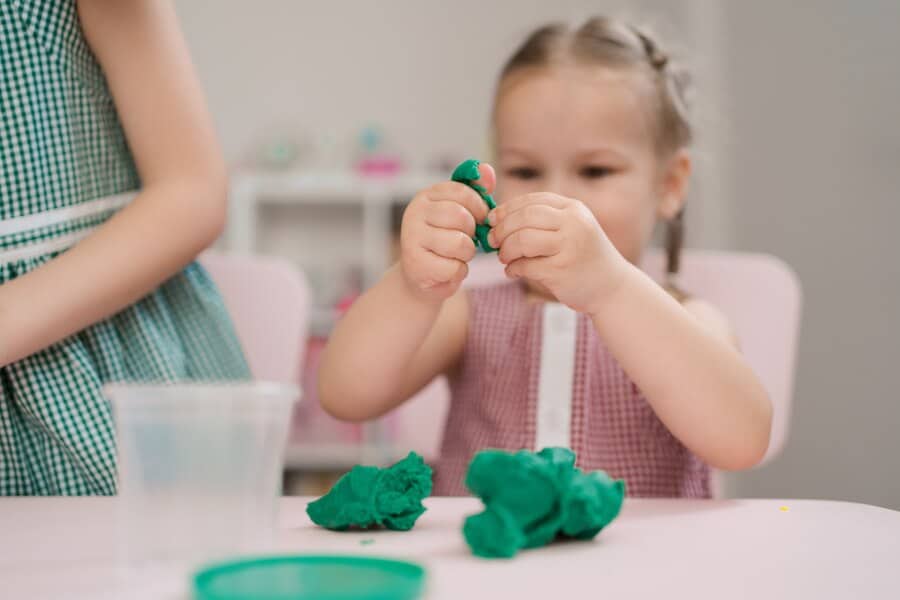
One of the most common early miscounting errors is skipping or double-counting objects. Physical objects fix this because children can move each item as they say its number. Ask children to roll five Play-Doh balls and line them up while counting aloud. Then remove one ball and ask how many remain. The physical act of removing an object makes subtraction concrete before the minus sign appears.
Number Bonds to 10 and 20 (Year 1 and Year 2)
Give children ten toy figures and a Play-Doh ‘fence’ dividing a table into two fields. Ask them to place some figures on each side, then count both groups and confirm the total is ten. Children quickly discover that there are multiple ways to split ten into two groups, which is exactly the number bond fluency the curriculum requires. Extend to 20 by adding more figures or using two colours of Play-Doh to represent different values.
Place Value: Tens and Units (Year 2)
Unifix cubes snapped into towers of ten alongside loose Play-Doh units give children a physical model of place value. Ask them to build the number 34: three towers of ten and four single cubes. Then ask them to flatten the towers to show that thirty is three groups of ten. This bridges the concrete model directly to the place value chart they will encounter in written work.
Curriculum reference: Year 1 and Year 2 Number and Place Value statutory requirements, UK National Curriculum for Mathematics.
KS2: Elevating Play for Fractions, Decimals and Ratios

Play-Doh is not ‘babyish’ at KS2. It is one of the most effective tools available for making fractions and ratios tangible, two areas where abstract notation confuses children because they cannot picture what the numbers mean. The activities below map to Year 3 through Year 6 objectives in the Fractions (including decimals and percentages) and Ratio and Proportion strands of the National Curriculum.
Fractions: The Play-Doh Pizzeria (Year 3 and Year 4)
Roll a ball of Play-Doh into a flat disc approximately the size of a small plate. Ask children to cut it into two equal halves: this is 1/2. Cut another disc into four equal quarters: this is 1/4. Ask children to show you 3/4 by arranging three pieces together. The physical act of cutting and recombining makes the relationship between numerator and denominator visible in a way that diagrams alone rarely achieve.
Extend the activity: use two differently coloured balls of Play-Doh, one white and one red. Roll them together and then cut: each cut piece now contains both colours in the same proportion, which introduces equivalent fractions without any notation at all. Children who have done this activity almost always find the notation straightforward when it arrives.
Decimals: Tenths and Hundredths (Year 4 and Year 5)
Roll a Play-Doh bar and place it alongside a ruler. Ask children to divide it into exactly ten equal sections using a plastic knife. Each section is one-tenth, or 0.1. Ask them to take three sections: that is 0.3, or three tenths. For hundredths, divide each tenth into ten more pieces. This physical experience of dividing and subdividing is the foundation for column value in decimal notation.
Ratio and Proportion: The Animal Parade (Year 5 and Year 6)
Give children a bag of mixed toy animals in two colours or types, with a total of 12 animals. Ask them to arrange them so that for every 2 red animals, there are 3 blue ones. How many groups can they make? How many of each colour do they need for 10 animals? 15? This is the ratio strand of the Year 6 curriculum expressed as a sorting and patterning game. Children who work through the physical arrangement before encountering ratio notation are significantly more confident when writing the formal 2:3 relationship.
Curriculum reference: Year 3–6 Fractions strand and Year 6 Ratio and Proportion strand, UK National Curriculum for Mathematics.
Activity Map: Key Stage, Concept, Tool and Activity
| Key Stage | Maths Concept | Tool / Material | Suggested Activity |
|---|---|---|---|
| EYFS / Reception | Counting 1–10 | Play-Doh + objects | Roll and count: roll 5 balls, count aloud |
| KS1 Year 1 | Number bonds to 10 | Play-Doh + toy figures | Split 10 figures into two groups; model with Play-Doh |
| KS1 Year 2 | Place value (tens/units) | Unifix cubes + Play-Doh | Build towers of 10; squash flat to show units |
| KS2 Year 3–4 | Fractions (halves, quarters) | Play-Doh discs | Cut ‘pizza’ discs into equal parts; label each piece |
| KS2 Year 4–5 | Decimals and percentages | Play-Doh bars + ruler | Divide a bar into 10 equal slices; each = 0.1 or 10% |
| KS2 Year 5–6 | Ratio and proportion | Plastic animals / toy cars | For every 2 cars, place 3 animals; extend the pattern |
| ESL/EFL Beginner | Number vocabulary 1–20 | Play-Doh + number mats | Roll, count, say: physical action locks in vocabulary |
| ESL/EFL Intermediate | Action verbs for maths | Any manipulatives | Plastic animals/toy cars |
ESL and EFL: The Language of Maths Through Sensory Play

For children learning English as an additional language, maths lessons present a double challenge: they must understand the mathematical concept and the language used to describe it simultaneously. Physical objects resolve the language barrier because they make meaning visible without translation. Educational linguist Stephen Krashen’s theory of ‘comprehensible input’ describes exactly this: when the meaning is conveyed through context and action, learners acquire language alongside the concept rather than after it.
The Total Physical Response (TPR) approach, developed for language learning by James Asher, pairs physical actions with vocabulary, making words memorable through muscle memory. Play-Doh is ideal for TPR in a maths context because it supports a rich vocabulary of physical actions, each of which corresponds directly to a mathematical operation.
Action Verbs for Maths: The EAL Language Bank
The table below lists the physical actions children can perform with Play-Doh or toys alongside the mathematical verb and a sentence the teacher or parent can model. The sequence is: the teacher demonstrates the action while saying the sentence, the children copy the action, the children say the sentence, and the children perform the action independently when asked.
| Physical Action | Maths Verb | Example Maths Sentence |
|---|---|---|
| Rolling a ball | Subtract/take away | “Roll 3 balls. Roll 2 more. How many altogether?” |
| Squashing flat | Divide/share | “I have 5. I squash 2. How many are left?” |
| Cutting a disc | Divide / share | “Cut the circle in half. Each half is one out of two equal parts.” |
| Splitting into groups | Multiply/times | “Put 3 groups of 2. How many in total?” |
| Stretching a strip | Double/twice as much | “Stretch it to twice the length. That is doubling.” |
| Breaking off a piece | Fraction | “Break off one quarter. That is 1 out of 4 equal parts.” |
| Counting toy animals | Ratio/for every | “For every 1 red animal, put 2 blue ones. That is 1:2.” |
| Count/add | Ordinal numbers | “The first toy is a bear. The third is a car.” |
Ordinal Numbers: The Animal Parade (ESL Beginner to Intermediate)
Line up five toy animals in a row. Point to each in turn and say ‘the first animal is a bear, the second is a rabbit’ and so on. Ask children to copy: ‘Which animal is third?’ Children can rearrange the parade and describe the new order. Ordinal vocabulary (first, second, third, fourth, fifth) is a consistent stumbling block for EAL learners in KS1 and KS2 because ordinals are irregular and do not follow predictable patterns in English. Physical objects give each ordinal a fixed referent that children can point to.
Number Words and Numerals: Matching and Counting
Roll Play-Doh into numbered balls (press a numeral into the surface with a pencil or press a number stamp). Create a set of cards with number words written on them: ‘five’, ‘twelve’, ‘twenty’. Ask children to match each ball to its word card, then order the balls from smallest to largest. This activity builds the connection between the numeral, the spoken word and the written word that EAL learners often need more practice with than native speakers.
Five Brilliant Activity Recipes for Home and School

Each activity below follows a recipe format with clear objectives, materials and steps. All are suitable for home or classroom use.
1. Roll and Count (EYFS and Year 1)
Objective: Count reliably to 10 with 1-to-1 correspondence.
Materials: Play-Doh, a flat surface, and a number line 1–10.
Instructions:
- Ask the child to roll 10 small balls of Play-Doh.
- Point to each ball in turn and count aloud together.
- Remove 3 balls. Ask: how many are left? Count to check.
- Place each remaining ball on the matching number on the number line.
- Extend: ask the child to make the number 7 without counting from 1.
2. The Play-Doh Pizzeria (Year 3 and Year 4 Fractions)
Objective: Understand unit fractions and equivalent fractions through practical cutting.
Materials: Play-Doh (two colours), a plastic knife, fraction wall for reference.
Instructions:
- Roll each colour into a flat disc the same size.
- Cut the first disc into 2 equal halves. Label each piece 1/2.
- Cut the second disc into 4 equal quarters. Label each piece 1/4.
- Ask: how many 1/4 pieces equal one 1/2? Check physically by placing them together.
- Extend: roll a combined-colour disc, cut into eighths, and compare with the halves disc.
3. The Decimal Bar (Year 4 and Year 5)
Objective: Understand tenths and hundredths in decimal notation.
Materials: Play-Doh, ruler, plastic knife, and small sticky labels.
Instructions:
- Roll a Play-Doh bar 10 cm long.
- Use a ruler to divide it into 10 equal sections. Label each section 0.1.
- Ask: What is 0.3? Have the child identify and remove 3 sections.
- Extend: subdivide one section into 10 tiny pieces. Each is 0.01.
- Pose: What is 0.35? Child selects 3 sections and 5 tiny pieces.
4. The Ratio Sort (Year 5 and Year 6)
Objective: Set up and extend ratio relationships with concrete objects.
Materials: Toy animals or coloured counters in two sets.
Instructions:
- Set the ratio: for every 1 red counter, place 2 blue counters.
- Ask: how many of each colour do you need for 9 counters total?
- Build the pattern physically, checking that each group matches the ratio.
- Extend: change the ratio to 2:3 and repeat.
- Write the formal ratio notation only after the physical pattern is secure.
5. The TPR Number Game (ESL and EFL, any age)
Objective: Acquire maths action vocabulary through physical response.
Materials: Play-Doh, a ball of any size, toy figures.
Instructions:
- The teacher says ‘roll’ and demonstrates rolling Play-Doh. Children copy and repeat the word.
- The teacher says ‘squash’ and demonstrates. Children copy and say ‘squash.’
- Combine with numbers: ‘roll 3 balls.’ ‘Squash 2.’ ‘How many are left?’
- Progress to full sentences: ‘Roll 4 balls, squash 1, count what remains.’
- Use the EAL Language Bank table above as a reference for extending vocabulary.
Teaching Resources and Support

LearningMole provides curriculum-aligned educational videos and teaching resources for primary schools covering maths, English, science and more. Our video library includes resources on early numeracy, counting, place value and fractions, all designed by experienced educators and aligned with UK National Curriculum objectives.
For teachers, LearningMole’s resources reduce planning time while keeping lessons engaging and purposeful. For parents supporting home learning, our videos explain concepts clearly and at the right pace for primary-aged children. Resources cover EYFS through KS2, with content suitable for mixed-ability classrooms and for children who need extra support, including those learning English as an additional language.
In LearningMole, Michelle Connolly works through counting and matching activities using Play-Doh, demonstrating exactly the concrete stage of the CPA sequence described in this article. Explore LearningMole’s primary maths resources at learningmole.com, or subscribe for full access to over 1,400 educational videos covering every area of the UK primary curriculum.
Frequently Asked Questions

How do you use Play-Doh to teach maths to older children in KS2?
Play-Doh is genuinely useful at KS2 because it can be cut, divided and reshaped to model fractions, decimals and 3D shapes in ways that worksheets cannot. A Year 5 child cutting a Play-Doh bar into tenths has a physical experience of decimal division that stays with them. For ratio, children use Play-Doh alongside counters or toy figures to build concrete ratio relationships before writing them in formal notation. The key is maintaining a clear link between the physical model and the abstract representation that follows.
What is the CPA method, and how does it apply to primary maths?
CPA stands for Concrete-Pictorial-Abstract, a three-stage sequence for teaching maths developed by Jerome Bruner and widely adopted in UK primary schools as part of the mastery approach. In the Concrete stage, children handle real objects (Play-Doh, toys, blocks) to experience the concept physically. In the Pictorial stage, they draw or sketch the objects they handled. In the Abstract stage, they work with numbers and symbols, now anchored to a physical memory. The CPA method is referenced in the National Curriculum guidance for mathematics and in Ofsted’s mathematics subject review.
How can toys help ESL and EFL students learn number vocabulary?
Physical objects provide what language-learning theorists call ‘comprehensible input’ — meaning conveyed through context and action rather than translation. When a child rolls three balls of Play-Doh while saying ‘three’, the word acquires meaning through the physical experience rather than through a dictionary lookup. The Total Physical Response approach pairs teacher-modelled actions with vocabulary, so children hear, say and do simultaneously. This multi-sensory encoding is particularly effective for number words, ordinals and maths operation vocabulary, all of which are challenging for EAL learners because they require both language and abstract numerical understanding.
Is play-based learning appropriate for Year 5 and Year 6?
Yes. Play-based learning does not mean unstructured or unchallenging learning; it means using physical materials as the concrete foundation for a mathematical concept before introducing formal notation. For Year 5 and Year 6 pupils, activities with Play-Doh and manipulatives are particularly useful for consolidating fractions, decimals, ratio and 3D geometry, areas where many children reach KS2 tests with procedural knowledge but limited understanding. The National Centre for Excellence in the Teaching of Mathematics (NCETM) supports concrete manipulative use at all primary stages.
Which toys and materials work best for teaching counting and early numbers?
Unifix cubes, Lego bricks, plastic animals and toy cars are all excellent for early counting because they are uniform in size, easy to grip, and can be arranged and rearranged quickly. Play-Doh adds a tactile dimension because it can be shaped to represent quantities (rolling a specific number of balls) and physically divided to represent fractions or sharing. Interlocking cubes are particularly useful for place value because towers of ten can be built and then taken apart to show units. For children with sensory sensitivities, wooden blocks or foam counters are good alternatives to Play-Doh.
Do I need special Play-Doh mats or number mats?
Number mats can be helpful for Foundation Stage and KS1 learners because they provide a visual structure (numbered spaces for placing objects) that supports accurate counting. Printable counting mats are widely available from educational publishers and from LearningMole’s resource library. However, they are not essential: a piece of paper with numbers written in circles works just as well. The physical objects, the Play-Doh, the toys, are what matter most. The mat simply provides a scaffold that children do not need once counting is secure.
What if my pupils have sensory processing difficulties?
Some children find the texture of Play-Doh uncomfortable or distracting. Alternatives that maintain the concrete stage of learning include wooden blocks, foam counters, magnetic tiles, dry pasta shapes or smooth pebbles. The key is that children can handle and move the objects, not the specific material. For children who find any tactile material difficult, virtual manipulatives, interactive digital tools that simulate physical objects on screen, are a reasonable alternative, though they are a step removed from the full concrete experience. Always observe and adapt based on individual children’s responses.
How does this connect to what children learn in school?
Every activity in this article maps to specific objectives in the UK National Curriculum for Mathematics. Counting and number bonds link to the KS1 Number and Place Value strand. Fractions, decimals and percentages link to the KS2 Fractions strand. Ratio and proportion activities map to Year 6 statutory requirements. For EAL learners, the language activities support the vocabulary dimension of maths learning referenced in Ofsted’s mathematics review and in EAL best practice guidance. Teachers using these activities at home with families can note that they align directly with classroom learning across every primary year group.
Conclusion

Maths fluency begins with physical experience, not with numbers on a page. When children have held, shaped, cut and counted real objects, the abstract symbols that follow carry genuine meaning rather than remaining arbitrary marks. Play-Doh and everyday toys make the concrete stage of the CPA sequence accessible to every teacher and every parent, at home or in school, without specialist equipment or significant preparation time.
The activities in this article span every primary year group and every ability level, from rolling balls to count to ten in Reception through to building ratio relationships in Year 6. They are also designed to serve EAL learners who need the language of maths to be grounded in physical experience before it becomes abstract. LearningMole’s video resources extend each of these activity types with visual demonstrations that children can watch, and teachers can use as lesson starters or homework support.
If you have tried any of these activities with your class or your child, the results speak for themselves: children who count on their fingers and cut their fractions by hand are children who understand what they are calculating, not just how to calculate it. That understanding is what the UK National Curriculum is asking for, and it starts here, on a table, with a ball of Play-Doh.
Have you found this interesting? Come and check our series about teaching using Play-Doh: Teaching with Play-Doh, Counting with Play-Doh, Matching Games, Numeracy and Pattern Making, Multiplication Story Problems and Play-Doh Games.


Leave a Reply