6 Counting Rhymes for Kids: Boosting Early Numeracy
Counting rhymes for kids offer a perfect blend of fun and learning that helps children develop essential early maths skills. These catchy verses have stood the test of time because they work so well at making number concepts stick in young minds. From the classic “Ten in a Bed” to “Five Little Ducks,” these rhythmic counting activities create an engaging foundation for early numeracy development.
In today’s educational landscape, combining traditional teaching methods like counting rhymes with modern digital approaches creates powerful learning experiences. Educational providers and digital specialists work together to transform classic teaching tools into engaging digital resources that maintain the core educational benefits while expanding reach and accessibility.
Table of Contents
Why Counting Rhymes Work for Early Learning

Counting rhymes help children learn numbers in a natural, enjoyable way. They offer several key benefits that make them an essential tool in early years education.
Building Number Foundations
When children recite rhymes like “Ten in a Bed” or “Five Little Ducks,” they’re doing much more than memorising words. They’re:
- Learning number sequence (counting up and down)
- Understanding one-to-one correspondence (matching numbers to objects)
- Grasping basic subtraction concepts (as ducks disappear or teddy bears fall)
- Recognising number patterns through repetition
- Developing a sense of ordinality (understanding the order of numbers)
- Building confidence with mathematical language
These foundational skills form the bedrock of mathematical understanding. Research has consistently shown that children who develop strong number sense in the early years are better prepared for more formal maths education later. Counting rhymes provide this foundation through play and repetition.
For example, when a child counts down from ten to one in “Ten in the Bed,” they’re not just memorising a sequence—they’re internalising the concept that each number is one less than the previous number. This fundamental understanding of decrementation is a key mathematical concept that will serve them throughout their education.
Supporting Language Development
Beyond maths skills, counting rhymes boost language development by:
- Introducing new vocabulary in context
- Building phonological awareness through rhyming patterns
- Improving memory and recall through repetition
- Encouraging active listening skills
- Developing rhythm and timing awareness
- Fostering verbal expression and confidence
The musical, rhythmic nature of counting rhymes makes them particularly effective for language acquisition. The combination of rhythm, rhyme, and repetition creates multiple memory pathways in the brain, helping children retain both the numerical concepts and the language structures.
Take the rhyme “One, Two, Buckle My Shoe,” for instance. Beyond the counting element, children learn action words (buckle, knock, pick up) and positional language (straight, open, shut). This enriches their vocabulary in a context that feels like play rather than formal learning.
Creating Multisensory Learning Experiences
Effective counting rhymes engage multiple senses simultaneously:
- Auditory: Hearing the rhythm and numbers
- Visual: Seeing fingers held up or props used
- Kinesthetic: Performing actions that accompany the rhymes
- Tactile: Manipulating objects to represent numbers
This multisensory approach caters to different learning styles and creates stronger neural connections. Educational research has long supported the effectiveness of multisensory learning for concept retention and understanding, particularly in early years education.
Building Social and Emotional Skills
Counting rhymes often incorporate social elements that help develop:
- Turn-taking skills when reciting lines in a group
- Cooperative play through shared activities
- Confidence in speaking and participating
- Positive associations with mathematical concepts
- Group cohesion and shared experiences
- Joy in learning through play
These social-emotional benefits are particularly valuable in early childhood settings, where developing positive attitudes toward learning is just as important as the content itself.
Ten in a Bed: A Classic Counting Rhyme
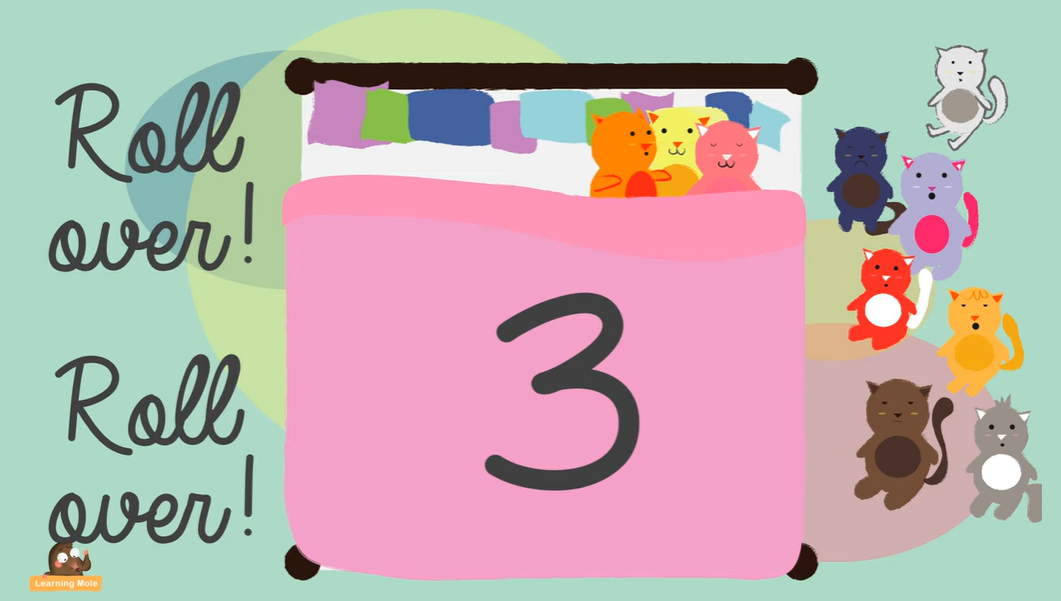
“Ten in a Bed” remains one of the most popular counting rhymes for teaching numbers from 1 to 10. It follows a simple pattern of counting backwards as each character falls out of bed, making it perfect for learning subtraction concepts.
How the Rhyme Works
The rhyme tells the story of ten bears (or sometimes people) sleeping in the same bed. As they run out of space, one asks the others to “roll over,” causing one to fall out each time. This continues until only one bear remains.
The lyrics typically follow this pattern:
“There were ten in the bed and the little one said, ‘Roll over, roll over!’ So they all rolled over and one fell out. There were nine in the bed and the little one said, ‘Roll over, roll over!’ So they all rolled over and one fell out…”
This continues until there’s just one left, who typically says something like “Good night!” or “Alone at last!”
The repetitive structure makes it easy for children to join in, predict what comes next, and understand the concept of counting backwards from ten to one.
Mathematical Concepts in Ten in a Bed
This simple rhyme introduces several important mathematical ideas:
- Ordinal counting: Counting backwards from 10 to 1
- Cardinal values: Understanding that each number represents a quantity of bears
- Subtraction: Each verse involves taking one away from the total
- Zero concept: Implicitly understanding what happens when everyone falls out
- Pattern recognition: Identifying the repeating structure of the rhyme
Using Ten in a Bed for Teaching
When you choose to teach counting using rhymes like “Ten in a Bed,” try these approaches that experienced educators have found effective:
- Sing along with emphasis: Sing together with children and emphasise the numbers
- Use props: Employ teddy bears or soft toys to physically demonstrate the counting
- Create a visual number line: Show the backwards counting sequence visually
- Pause and predict: Stop before each new verse and ask children to predict the next number
- Act it out: Have children role-play the rhyme, taking turns to be the bears
- Extend learning: Ask questions like “How many bears fell out altogether?” to extend the mathematical thinking
For younger children (ages 2-3), focus on the enjoyment and repetition of the rhyme. For older preschoolers (ages 4-5), you can use the rhyme to explore more complex concepts like “how many bears have fallen out so far?” or “how many are left in the bed?
Digital Enhancements for Ten in a Bed
Modern digital approaches can enhance this classic rhyme:
- Animated videos that visually show the bears falling one by one
- Interactive applications where children can tap to make each bear fall
- Digital counting boards that display the changing numbers
- Recording features that allow children to create their own versions
These digital elements can make the rhyme more engaging while reinforcing the core mathematical learning.
More Great Counting Rhymes for Children

While “Ten in a Bed” focuses on counting backwards from 10 to 1, there are many other rhymes that teach different counting concepts. Each offers unique learning opportunities and can be adapted for various age groups and learning objectives.
Five Little Ducks
This popular rhyme teaches subtraction as ducks disappear one by one, then return at the end:
“Five little ducks went swimming one day, Over the hills and far away. Mother duck said, ‘Quack, quack, quack, quack,’ But only four little ducks came back.”
The pattern continues until no ducks return, then all five come back when mother duck calls one final time.
The rhyme teaches:
- Counting backwards from 5 to 0
- Basic subtraction concepts
- The concept of zero (when no ducks remain)
- Pattern recognition and prediction
This rhyme works particularly well with puppets or finger plays. Children can hold up the correct number of fingers for each verse, providing a tactile reinforcement of the counting.
One, Two, Buckle My Shoe
This traditional rhyme teaches counting from 1 to 10 in pairs:
“One, two, buckle my shoe, Three, four, knock at the door, Five, six, pick up sticks, Seven, eight, lay them straight, Nine, ten, a big fat hen.”
It’s particularly good for younger children who are just beginning to count. The rhyme teaches:
- Number sequence from 1 to 10
- Pairing numbers (introducing the concept of even numbers)
- Associating numbers with actions
- Rhyming patterns
Adding actions to each part of the rhyme enhances engagement. For “buckle my shoe,” children can pretend to buckle shoes; for “knock at the door,” they can make knocking motions.
Five Little Monkeys
This energetic rhyme teaches counting backwards while incorporating a gentle lesson about safety:
“Five little monkeys jumping on the bed, One fell off and bumped his head. Mama called the doctor and the doctor said, ‘No more monkeys jumping on the bed!'”
The rhyme continues with four, three, two, and finally one monkey, each falling off in turn. It teaches:
- Counting backwards from 5 to 0
- Subtraction concepts
- Cause and effect
- Safety awareness
This rhyme naturally lends itself to movement activities, with children acting out the jumping and falling (safely onto soft surfaces, of course). It’s a great way to combine physical activity with mathematical learning.
Five Current Buns
This rhyme incorporates money concepts alongside counting:
“Five current buns in a baker’s shop, Round and fat with sugar on the top. Along came a boy with a penny one day, Bought a current bun and took it away.”
The rhyme continues with four, three, two, and one bun remaining. It teaches:
- Counting backwards from 5 to 0
- Basic subtraction
- Simple money concepts
- Exchange (buying and selling)
This rhyme can be enhanced with prop buns and pennies for a hands-on shopping experience, introducing early financial literacy alongside counting.
Counting-Up Rhymes
While many popular counting rhymes focus on counting backwards, it’s also important to include rhymes that count upwards:
This Old Man
“This old man, he played one, He played knick-knack on my thumb. With a knick-knack, paddy-whack, give a dog a bone, This old man came rolling home.”
The rhyme continues through numbers 1-10, with each number associated with a different body part. It teaches:
- Forward counting from 1 to 10
- Body part identification
- Rhythm and rhyme patterns
1, 2, 3, 4, 5, Once I Caught a Fish Alive
“1, 2, 3, 4, 5, once I caught a fish alive. 6, 7, 8, 9, 10, then I let it go again. Why did you let it go? Because it bit my finger so. Which finger did it bite? This little finger on the right.”
This rhyme teaches forward counting to 10 while incorporating finger play.
Using Different Rhymes for Different Skills
It’s valuable to use a variety of counting rhymes to develop a well-rounded understanding of numbers:
- Use backward counting rhymes like “Ten in a Bed” and “Five Little Ducks” to develop subtraction concepts
- Use forward counting rhymes like “This Old Man” to reinforce number sequence
- Use rhymes with pauses like “Alice the Camel” to develop prediction skills
- Use action rhymes like “Five Little Monkeys” to engage kinesthetic learners
- Use rhymes with money concepts like “Five Current Buns” to introduce financial awareness
The key is to match the rhyme to the specific learning objective while keeping the experience enjoyable for the children.
Digital Approaches to Teaching with Counting Rhymes
As a digital agency specialising in educational content, we’ve developed several approaches to enhance counting rhymes with technology:
Video-Enhanced Learning
Our video production team creates educational videos that bring counting rhymes to life:
- Animated characters that children can count along with
- Visual number displays that reinforce the spoken count
- Engaging storylines that maintain interest
- Clear, child-friendly narration that emphasises numbers
We’ve found that educational videos using counting rhymes typically receive higher engagement rates than standard instructional content.
Interactive Web Applications
Our web development team builds interactive counting tools that:
- Allow children to click on objects as they count
- Provide immediate feedback on counting accuracy
- Adapt difficulty based on the child’s progress
- Combine audio, visual and interactive elements
Social Media Content Strategies
For early years providers, counting rhymes make excellent social media content:
- Short video clips featuring one rhyme per post
- Downloadable printables that accompany digital content
- Weekly counting challenges for parents to try at home
- Behind-the-scenes looks at how educational content is created
Creating Your Own Counting Rhymes

While traditional rhymes have stood the test of time, creating custom counting rhymes can address specific learning needs. Our content writing team often develops bespoke counting rhymes that:
- Feature specific themes relevant to a child’s interests
- Target particular number ranges or concepts
- Include cultural references appropriate to the audience
- Address specific curriculum requirements
Simple Formula for Creating Counting Rhymes
Follow this basic structure to create your own counting rhyme:
- Choose a subject children can relate to (animals, toys, food)
- Decide on an action (jumping, sleeping, eating)
- Create a simple repeating pattern
- Add a resolution at the end (all come back, wake up, etc.)
Measuring Success with Analytics
For educational providers using digital counting rhyme content, our digital marketing team helps track effectiveness through:
- Video completion rates for counting rhyme videos
- Time spent on interactive counting applications
- Engagement metrics on social media posts about counting
- Parental feedback through surveys and comments
This data-driven approach ensures that digital counting content continues to evolve based on what actually works for young learners.
Conclusion
Counting rhymes have established themselves as invaluable tools in early childhood education, offering children a joyful introduction to maths concepts through rhythm, repetition and play. Classics like “Ten in a Bed” and “Five Little Ducks” endure precisely because they transform abstract numerical concepts into engaging experiences that young children naturally respond to and remember.
These versatile learning resources simultaneously develop multiple skills—mathematical understanding, language development, physical coordination and social interaction—making them remarkably efficient teaching tools. For practitioners working within the EYFS framework, counting rhymes provide excellent opportunities to address several learning areas whilst documenting observable progress in children’s development.
Whether used in nurseries, reception classrooms or home environments, counting rhymes remain relevant in our digital age. Traditional oral recitation works brilliantly on its own, whilst thoughtful digital adaptations can extend the learning experience through visual reinforcement and interactive elements. By fostering positive attitudes toward maths from the earliest ages, these seemingly simple verses help children see themselves as capable mathematical thinkers—a foundation that serves them throughout their educational journey.


Leave a Reply