Bronze Age Facts for Kids: The Bronze Age was one of the most critical periods in human history, marking a time when people learned to create bronze, a revolutionary metal that transformed civilisation. This era, which lasted from roughly 3300 BCE to 1200 BCE in different parts of the world, bridges the gap between the primitive Stone Age and the more advanced Iron Age that followed.
The Bronze Age didn’t happen at the same time everywhere. Different regions discovered bronze-making at different times, with the earliest bronze appearing in the Middle East around 3300 BCE, spreading to Egypt and the Mediterranean, reaching Europe later, and arriving in China around 2000 BCE. This period is defined by humanity’s ability to create and use bronze, an alloy made by mixing copper and tin metals together to create something stronger than either metal alone.
This technological breakthrough wasn’t just about making better tools – it fundamentally changed how people lived, worked, and organised their societies. Bronze enabled the construction of magnificent monuments, the creation of powerful armies, the establishment of complex governments, and the development of international trade networks spanning thousands of miles. Understanding the Bronze Age helps us appreciate how a single technological innovation can transform entire civilisations and shape the course of human history.
Let’s explore five brilliant facts about the Bronze Age that reveal why this period was so crucial to human development!
Fact 1: Bronze Changed Everything – It Was the “Plastic” of the Ancient World
Bronze was the wonder material of the ancient world, as revolutionary for its time as plastic would be in the modern era. But what exactly is bronze? It’s an alloy – a mixture of two or more metals – specifically combining approximately 90% copper with 10% tin. This might seem like a simple combination, but creating it was a monumental discovery that changed everything.
Before bronze, people had been working with pure copper for centuries. Copper was an improvement over stone tools, but it had a major weakness: it was soft and bent easily. A copper axe blade would dull quickly and bend after hitting a tree a few times. Copper weapons were unreliable in battle. But when ancient metalworkers accidentally or experimentally mixed tin with copper, they created something remarkable. Bronze was significantly harder, more durable, and held a sharp edge much longer than pure copper. It was also more resistant to corrosion and could be melted, poured into molds, and shaped into almost any form imaginable.
The importance of bronze manifested in three major areas. First, it created vastly superior tools for everyday work. Bronze axes, chisels, saws, and plows revolutionized farming, woodworking, and construction. Farmers could clear land faster, build better plows, and produce more food. Carpenters could shape wood more precisely. Builders could cut and shape stone for monuments and structures. These better tools meant people could work more efficiently, producing surplus food and goods that supported larger populations and more complex societies.
Third, bronze enabled the creation of beautiful and intricate objects. Because bronze could be melted and poured into detailed molds, artisans could create elaborate jewelry, decorative vessels, mirrors, and sculptures that would have been impossible in stone. These luxury items became status symbols for the wealthy and powerful, driving demand for bronze and the skilled craftspeople who could work with it.
Creating bronze was a complex process requiring considerable skill and knowledge. First, copper ore and tin ore had to be mined – and these two metals were rarely found in the same location. The ores had to be smelted, a process of heating them to extremely high temperatures (around 1,000°C) to extract the pure metals. Then the metals had to be mixed in the correct proportions and heated again until molten. The liquid bronze could then be poured into molds carved from stone or formed from clay to create the desired object. Skilled bronze smiths were highly valued members of society, their knowledge passed down through generations.
The need for both copper and tin created one of the Bronze Age’s most important features: long-distance trade. Copper was relatively common, found in many regions, but tin was rare. To make bronze, civilisations had to establish trade networks stretching hundreds or even thousands of miles. This necessity created the first truly international trade systems, connecting distant cultures and spreading ideas, technologies, and goods across vast distances. The Bronze Age was perhaps the first era of globalisation, with economies becoming interdependent across entire continents.
Fact 2: The Bronze Age Saw the Rise of the First Great Civilisations
The Bronze Age witnessed the emergence of humanity’s first great civilisations – complex societies with cities, governments, specialised professions, monumental architecture, and sophisticated cultures. Bronze technology provided the tools and surplus wealth that made these civilisations possible.
Ancient Egypt flourished during the Bronze Age, constructing the iconic pyramids that still stand today. The bronze tools available to Egyptian workers made it possible to cut and shape the massive stone blocks used in pyramid construction. Egyptian civilisation developed a complex government ruled by pharaohs considered living gods, a sophisticated writing system using hieroglyphics, advanced mathematics and astronomy, and magnificent art and architecture. Bronze weapons equipped Egyptian armies that expanded the kingdom’s borders, while bronze tools helped build temples and monuments along the Nile River.
In Mesopotamia, the region between the Tigris and Euphrates rivers in modern-day Iraq, several civilisations rose to prominence. The Sumerians developed one of the world’s first writing systems called cuneiform, pressing wedge-shaped marks into clay tablets to record everything from business transactions to epic poems. They built impressive cities featuring massive ziggurat temples that towered over the landscape. Later, the Babylonian Empire arose, famous for King Hammurabi’s Code – one of the earliest written legal systems, inscribed on stone steles for all to see. These Mesopotamian civilisations created literature, including the Epic of Gilgamesh, one of humanity’s oldest surviving stories.
The Indus Valley Civilisation in what is now Pakistan and northwestern India built remarkably planned cities like Mohenjo-daro and Harappa. These urban centres featured straight streets arranged in grid patterns, sophisticated drainage systems, standardised brick sizes, and public baths. The level of urban planning demonstrated by these cities wouldn’t be matched in many parts of the world for thousands of years.
In China, the Shang Dynasty represented the Bronze Age’s peak, creating extraordinarily beautiful bronze vessels and bells used in religious ceremonies. These bronzes displayed incredible craftsmanship with intricate designs and perfect casting. The Shang also developed an early form of Chinese writing found on oracle bones – pieces of bone or turtle shell used for divination and fortune-telling. These inscriptions represent the origins of the Chinese writing system still used today.
The Minoan civilisation on the island of Crete built elaborate palaces, most famously at Knossos, featuring advanced architecture with multiple stories, sophisticated ventilation systems, and stunning frescoes depicting dolphins, bulls, and religious ceremonies. The Minoans were skilled seafarers who traded throughout the Mediterranean, spreading their culture and artistic styles.
The Mycenaean civilisation in mainland Greece built massive fortified palaces with enormous stone walls, developing the legends that would later inspire Homer’s tales of the Trojan War. They used an early form of Greek writing called Linear B, found on clay tablets that recorded palace inventories and administrative records.
These civilisations could exist because bronze tools increased agricultural productivity, creating food surpluses. When not everyone needed to farm, people could specialise in other professions – becoming smiths, priests, soldiers, merchants, scribes, or artisans. This specialisation allowed societies to become more complex and sophisticated, with organised governments, religious institutions, military forces, and trade networks. The Bronze Age marked humanity’s transition from simple agricultural villages to complex urban civilisations with all the features we associate with advanced societies.
Fact 3: Bronze Age People Created Amazing Art and Invented Writing
The Bronze Age wasn’t just about practical tools and weapons – it was also an era of remarkable artistic achievement and the revolutionary invention of writing systems that would preserve knowledge for all future generations.
Bronze itself became an artistic medium. Craftspeople created weapons that were functional but also beautiful works of art. Swords featured intricate engraved patterns, ceremonial daggers displayed elaborate decorative elements, and shields bore embossed designs depicting gods, animals, or battle scenes. These weren’t merely utilitarian objects but expressions of wealth, status, and artistic skill.
Chinese bronze vessels from the Shang and later Zhou dynasties represent some of the most sophisticated bronze artwork ever created. These ritual vessels used in religious ceremonies featured complex shapes and designs, often decorated with stylised animal motifs and geometric patterns.
Creating these vessels required advanced casting techniques including piece-mold casting, where multiple clay mold sections were carefully fitted together to create intricate three-dimensional designs. Some vessels were enormous, weighing hundreds of pounds, demonstrating both the metalworkers’ technical skill and the society’s ability to organise large-scale production.
Bronze jewelry became prized possessions throughout the Bronze Age world. Craftspeople created intricate bracelets, necklaces, rings, and pins, often combining bronze with gold, silver, and semi-precious stones. These luxury items served as status symbols, with the wealthy adorning themselves to display their social position. Trade networks spread artistic styles and techniques across vast distances, with similar jewelry designs appearing in regions thousands of miles apart.
Perhaps the Bronze Age’s most important achievement was the invention of writing. Before writing, knowledge could only be passed orally from person to person, making it easy to forget or distort information over time. Writing changed everything by allowing information to be recorded permanently and accurately.
Cuneiform, developed in Mesopotamia around 3200 BCE, was likely the world’s first writing system. Scribes pressed wedge-shaped reed styluses into soft clay tablets, creating marks that represented sounds, words, or ideas. Initially used for boring tasks like recording grain inventories and tax payments, cuneiform evolved to record laws, historical events, religious texts, and literature. The Epic of Gilgamesh, one of humanity’s oldest surviving stories, was written in cuneiform on clay tablets.
Egyptian hieroglyphics emerged around 3100 BCE as a complex system combining pictographic symbols (pictures representing objects) with phonetic symbols (pictures representing sounds). Hieroglyphics appeared carved into temple walls, painted in tombs, and written on papyrus scrolls. They recorded everything from religious spells intended to help the dead reach the afterlife to detailed accounts of pharaohs’ military victories.
China developed its own unique writing system during the late Bronze Age. The earliest known Chinese writing appears on oracle bones from the Shang Dynasty, around 1200 BCE. Diviners would write questions on pieces of bone or turtle shell, apply heat to create cracks, then interpret the cracks as answers from the gods. These inscriptions represent the origins of Chinese characters, which evolved into the writing system used by over a billion people today.
The invention of writing was revolutionary because it allowed knowledge to accumulate across generations. Laws could be written down so everyone knew the rules. Historical events could be recorded for future study. Religious beliefs and rituals could be preserved exactly. Scientific observations could be documented. Literature could be created and shared. Writing transformed human culture, creating a permanent record of Bronze Age civilisation that we can still read and study thousands of years later.
Fact 4: Bronze Age Collapse – When Civilisation Nearly Ended
Around 1200 BCE, something catastrophic happened. Within just a few decades, the great civilisations of the Eastern Mediterranean and Near East collapsed almost simultaneously in what historians call the Bronze Age Collapse. It was one of history’s most dramatic and mysterious disasters, plunging much of the region into a dark age that lasted centuries.
The collapse was devastating and widespread. The Mycenaean palace civilisations in Greece were destroyed, with major sites like Pylos and Mycenae burned and abandoned. The mighty Hittite Empire, which had dominated Anatolia (modern Turkey) for centuries, vanished completely, its capital Hattusa destroyed and forgotten. Numerous cities along the coasts of the Mediterranean and throughout the Near East were sacked and burned. The Egyptian New Kingdom, while surviving, was severely weakened. The elaborate trade networks that had connected these civilisations for centuries completely broke down.
In many regions, populations declined dramatically. Cities were abandoned, and people moved back to small rural villages. In Greece, writing was completely forgotten – the Linear B script disappeared, and Greece wouldn’t have writing again until the alphabet was adopted centuries later. This period is sometimes called a “Dark Age” because so little written record survived, and material culture became much simpler.
What caused this catastrophic collapse? Historians and archaeologists have debated this question for decades, and the truth likely involves multiple interconnected factors that created a perfect storm of disaster.
Climate change appears to have played a role. Evidence suggests a period of severe drought affected the Eastern Mediterranean region around this time. Crop failures would have led to famine, weakening societies and possibly causing populations to migrate in search of food. Desperation can drive people to raid neighbouring regions, potentially setting off a cascade of conflicts.
Earthquakes may have destroyed many cities. Archaeological evidence shows that several major Bronze Age sites exhibit damage consistent with seismic activity. A series of powerful earthquakes could have destroyed cities, damaged harbours, and disrupted trade.
The mysterious Sea Peoples appear prominently in Egyptian records from this period. These groups, whose origins remain hotly debated, attacked and destroyed cities throughout the Eastern Mediterranean. Egyptian inscriptions describe battles against these invaders, whom Pharaoh Ramesses III barely managed to defeat. But who were the Sea Peoples? Theories suggest they might have been refugees from collapsed civilisations, displaced populations fleeing climate disasters, or organised raiders taking advantage of regional chaos. Their true identity remains one of history’s enduring mysteries.
Internal problems likely weakened civilisations from within. There’s evidence of peasant revolts, palace coups, and civil unrest in various regions. Bronze Age societies were highly stratified, with powerful elites controlling most wealth while common people struggled. Economic troubles or food shortages could have triggered rebellions that destroyed these centralised governments.
The breakdown of bronze trade networks may have been both cause and effect of the collapse. Bronze production required tin, which was rare and came from distant sources. Disruptions to trade could have created bronze shortages, weakening armies and economies. Conversely, other disasters could have disrupted trade, making the tin shortage a symptom rather than a cause.
Most historians now believe the Bronze Age Collapse resulted from a combination of these factors, with problems in one area cascading into others. It demonstrates how interconnected the Bronze Age world had become – when the system faced multiple simultaneous stresses, it couldn’t adapt and instead collapsed catastrophically. The collapse shows that even seemingly powerful civilisations can be fragile when faced with the right combination of challenges.
Fact 5: Daily Life in the Bronze Age Was Very Different From Today
Life during the Bronze Age bore little resemblance to modern existence. Understanding how ordinary people lived helps us appreciate both how far humanity has come and what ancient people achieved despite enormous challenges.
Food was much simpler than today’s diet. Most people ate bread made from wheat or barley as their staple food, consuming it at nearly every meal. Beer was the common drink – safer than water since the brewing process killed harmful bacteria, and nutritious enough to be considered liquid bread. Vegetables such as onions, garlic, lentils, and peas provided additional nutritional value.
Fruits included dates, figs, and grapes. Meat was a luxury most people rarely enjoyed, reserved for special occasions or the wealthy. Common people might eat fish if they lived near water, but their diet was primarily vegetarian by necessity rather than choice. Honey provided the only sweetness available, as sugar wouldn’t reach most regions for thousands of years.
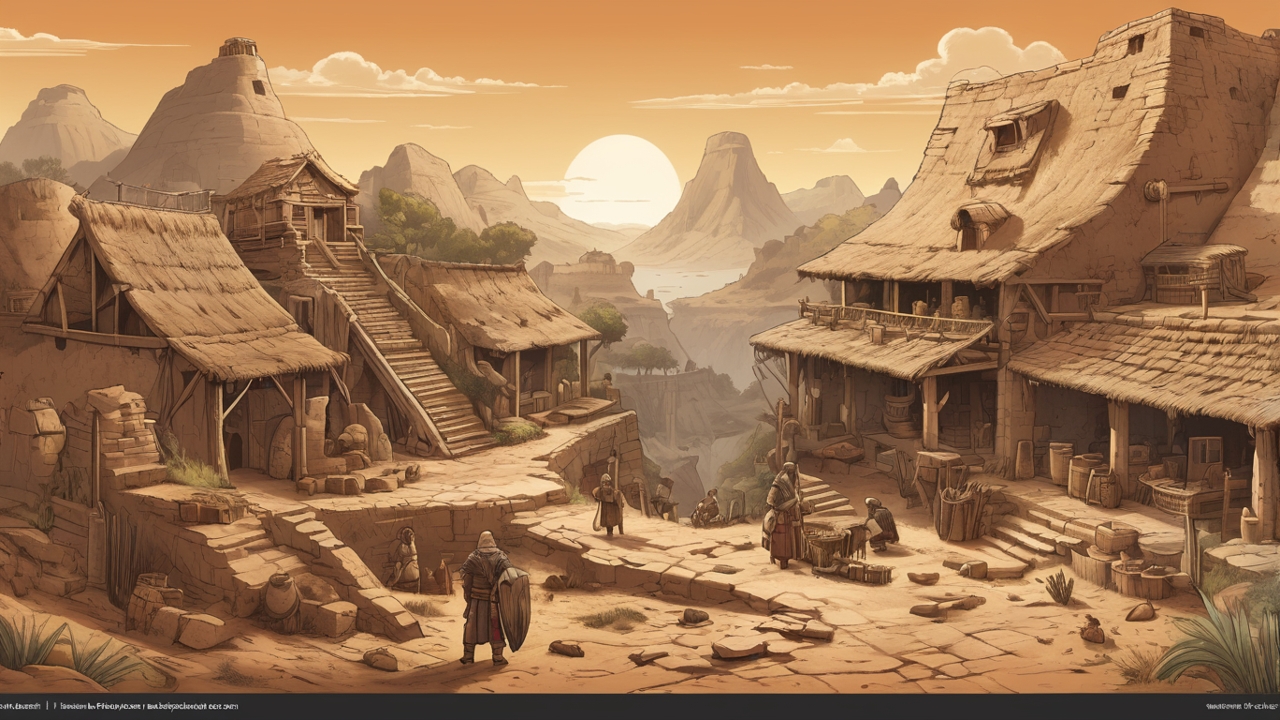
Housing varied by social class. Common people lived in simple houses built from mud bricks, which were cheap and provided good insulation against heat. These homes typically had one or two rooms with few windows (to keep interiors cool in hot climates), flat roofs that served as sleeping areas during hot summer nights, and minimal furniture. The wealthy lived in larger houses or even palaces built from stone or better-quality brick, featuring multiple rooms, courtyards, and decorated walls. Nobody had running water, electricity, or any modern conveniences we take for granted.
Clothing was practical and straightforward. In hot climates like Egypt, people wore linen tunics made from flax plants. In cooler regions, wool from sheep provided warmth. Most people owned only one or two sets of clothes, wearing simple tunics, robes, or loincloths depending on the climate and culture. The wealthy distinguished themselves through finer fabrics, elaborate jewellery, and decorative elements. Fashion existed even in ancient times, with different styles marking different periods and regions.
Family life is centred on survival and work. Extended families often lived together, with multiple generations sharing homes. Children began working at young ages, typically around six or seven years old, learning the skills they’d need as adults. Boys usually learned their fathers’ trades, whether farming, metalworking, or another craft. Girls learned from their mothers, focusing on skills like weaving, cooking, and managing households.
Only children from elite families received formal education, learning to read and write – skills that provided access to prestigious careers as scribes or priests. Life expectancy was shockingly low by modern standards, with most people dying in their thirties or forties, and many children not surviving to adulthood.
Most Bronze Age people were farmers, working their fields with bronze tools that made agriculture more productive than ever before. Specialised craftspeople included bronze smiths (among the most valued members of society), potters who created vessels for storage and cooking, weavers who made cloth, and carpenters who built homes and furniture using bronze tools.
Elite professions included scribes who could read and write, priests who performed religious ceremonies and wielded considerable power, soldiers who protected the kingdom and fought wars, and government officials who administered laws and collected taxes. Merchants travelled long distances trading goods, connecting distant civilisations.
Religion permeated Bronze Age life. People worshipped many gods (polytheism), believing these deities controlled natural phenomena like rain, sun, and harvests, as well as human affairs like war, love, and death. Temples were among the most important and impressive buildings in cities, and priests formed a powerful class. People made offerings to gods seeking favour or protection. Burial practices reflected beliefs in the afterlife, with the wealthy receiving elaborate tombs filled with goods they’d need in the next world, while common people received simple graves.
Despite the lack of modern conveniences, Bronze Age life was significantly better than the Stone Age that preceded it. Better tools made work easier and more productive. Improved farming produced more food, allowing populations to grow. Stronger weapons provided better protection from enemies and wild animals. Beautiful objects and art enriched life beyond mere survival. Writing preserved knowledge and enabled complex administration. Trade brought exotic goods from distant lands, exposing people to new ideas and products.
Bronze Age Facts Conclusion
The Bronze Age represents a crucial chapter in human development, demonstrating how a single technological innovation – the creation of bronze – could transform entire civilisations. This revolutionary alloy made possible better tools, superior weapons, and beautiful art, driving the rise of the first great civilisations in Egypt, Mesopotamia, the Indus Valley, China, Greece, and Crete.
These societies created stunning artwork and invented writing systems that preserved knowledge for future generations, fundamentally changing human culture. Yet even these mighty civilisations proved fragile, as the mysterious Bronze Age Collapse around 1200 BCE showed when multiple societies fell almost simultaneously, plunging regions into centuries of darkness.
Daily life during this era, while significantly improved from the Stone Age, remained harsh by modern standards, with most people working as farmers in simple homes, eating basic diets, and dying young. The Bronze Age teaches us that technological progress drives social change, that civilisations can be interconnected and interdependent, that even powerful societies can collapse under the right stresses, and that each era builds upon the achievements of those that came before.
The innovations and discoveries of the Bronze Age – from metallurgy to writing to complex government – laid foundations that continue influencing our world thousands of years later, reminding us that understanding history helps us appreciate how far humanity has come and how our own civilisation rests on achievements stretching back millennia.
We hope you enjoyed learning more things about Bronze Age as much as we loved teaching you about them. Now that you know how majestic the history is, you can move on to learn about other ones like: Viking Warriors, The Anglo Saxons, Vikings, and Celts.
Why not subscribe to our LearningMole Library for as little as £1.99 per month to access over 3400 fun educational videos.
Maths Circus, an innovative platform we've crafted, presents a captivating realm where children learn mathematics through the exciting theme of a circus. The joy of juggling numbers and solving circus...
Asia Facts for Kids: Asia is the largest continent on Earth, covering around 30% of the world's land and home to about 4.8 billion people. It has 47 United Nations...
Feedback with digital portfolios works best in primary schools when teachers keep comments brief and expect every child to act on them. A voice note of about a minute on...
Singers use their voices as musical instruments to perform songs in theatres, recording studios, choirs and at events. Most of their working day, though, is spent practising, learning music and...







Leave a Reply