Baseball Quotes for Kids: There’s something special about baseball that transcends the game itself. Perhaps it’s the measured pace that allows for reflection between pitches, or the way success and failure alternate so rapidly that resilience becomes essential, or maybe it’s the beautiful balance between individual performance and team interdependence. Whatever the reason, baseball has always been more than a sport—it’s a classroom where young players learn lessons that shape their character long after their playing days end. Baseball quotes capture the wisdom earned on dusty diamonds and grass fields, offering young players words of encouragement, guidance, and inspiration.
For children learning to play baseball, the challenges can feel overwhelming. Hitting a round ball with a round bat is one of the hardest skills in all of sports. Failure happens constantly—even the best hitters fail seven out of ten times.
The mental demands of staying focused through long games, bouncing back from errors, and maintaining confidence through inevitable slumps test young minds as much as young bodies. This is precisely why baseball quotes matter. They provide language for understanding failure, frameworks for approaching challenges, and reminders that every player who ever wore a uniform faced the same struggles.
Quotes About Practice and Hard Work
No baseball quote resonates more universally than “Hard work beats talent when talent doesn’t work hard.” Young players need to understand that natural ability provides a starting point, not a finish line. The kids who dedicate themselves to practice, who take extra swings in the batting cage, who work on their footwork long after official practice ends, inevitably surpass more naturally gifted players who coast on talent alone.
Ted Williams, perhaps the greatest hitter who ever lived, famously said, “Baseball is the only field of endeavour where a man can succeed three times out of ten and be considered a good performer.” This quote teaches young players that success in baseball looks different from success in school or other activities. A .300 batting average means failing seventy per cent of the time—yet that’s excellent performance. Understanding this reality helps kids maintain perspective and resilience when struggles inevitably come.
The wisdom that “Champions are made when no one is watching” speaks directly to the importance of off-season training and voluntary practice. Young players who shoot hoops or play video games during the off-season wonder why teammates who attended winter workouts surpass them come spring. This quote teaches that excellence isn’t built during games or even official practices alone, but through countless hours of deliberate effort when no coaches, parents, or teammates are observing.
Cal Ripken Jr., who played in 2,632 consecutive games, embodied reliability and work ethic. His advice that “You could be a kid for as long as you want when you play baseball” reminds young players that dedication to practice doesn’t mean losing the joy of play. The hard work of improvement and the fun of playing can coexist—in fact, they should.
Quotes About Teamwork
Baseball’s unique structure—individual performance within team context—creates perfect opportunities for teaching collaboration. The reminder that “There’s no ‘I’ in team” might be cliché, but it captures an essential truth. A player might hit a home run, but teammates who reached base before him contributed to the runs scored. A pitcher might throw a shutout, but fielders behind him made plays that preserved it.
Derek Jeter’s philosophy that “There may be people who have more talent than you, but there’s no excuse for anyone to work harder than you do” combines individual responsibility with team context beautifully. Each player owning their personal effort strengthens the collective team. When everyone commits to maximum effort, the team becomes greater than the sum of individual talents.
The concept that “Nine players working as one” captures baseball’s essence. Unlike sports where one superstar can dominate, baseball requires contributions from every position. The best hitter can’t win games if pitchers give up too many runs. The best pitcher can’t win if teammates don’t score. This interdependence teaches children that their role matters regardless of whether they’re the star player or the ninth batter in the lineup.
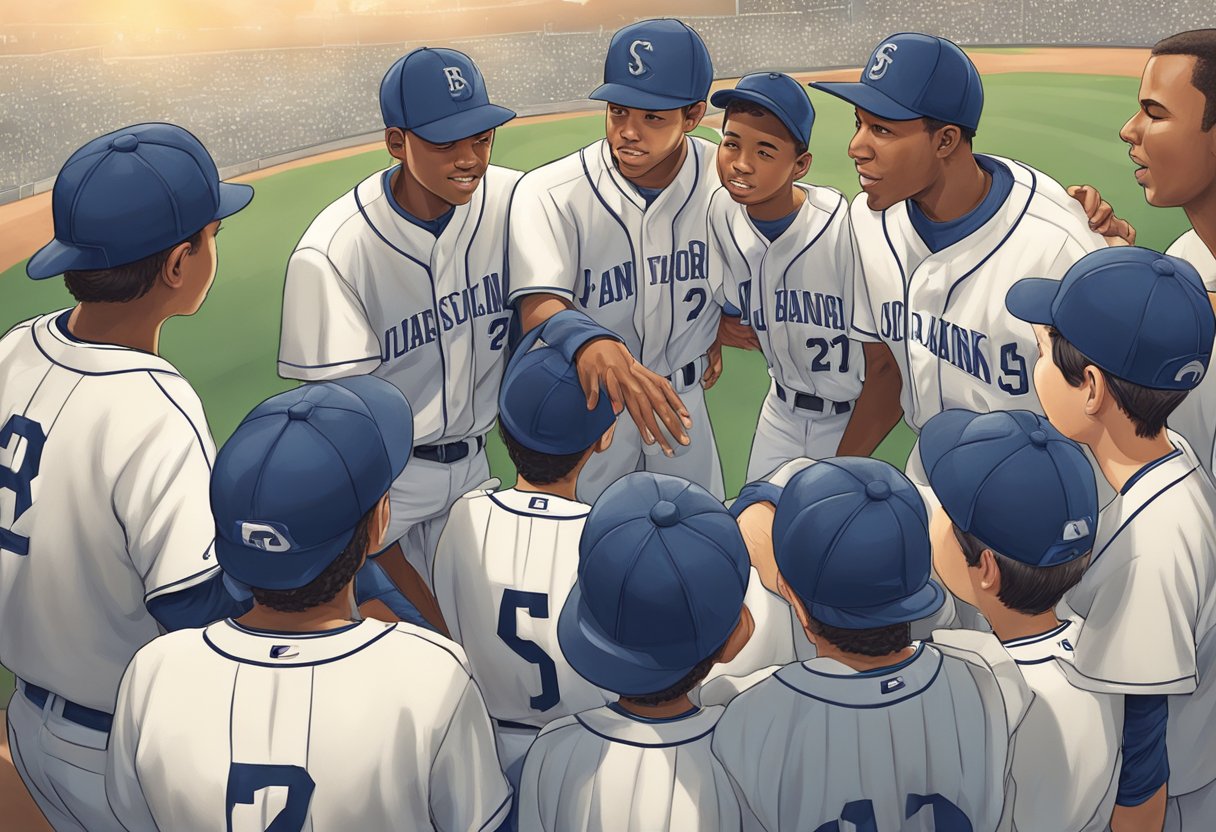
Coaches often remind young players that “Your teammates should be your best friends,” and this goes beyond cliché. The bonds formed through shared struggles—gruelling practices in summer heat, tough losses, comeback victories, and season-long journeys—create friendships that outlast youth baseball careers. Players who genuinely care about each other play harder, communicate better, and enjoy the experience more fully.
Quotes About Perseverance and Not Giving Up
Baseball’s structure naturally teaches persistence. With nine innings providing multiple opportunities for a comeback, the game itself preaches that it’s never over until the final out. The classic encouragement that “It ain’t over ’til it’s over,” attributed to Yogi Berra, has become universal precisely because baseball proves this truth repeatedly. Young players learn that being behind doesn’t mean being beaten.
Mickey Mantle once said, “It’s unbelievable how much you don’t know about the game you’ve been playing all your life.” This humble acknowledgement from one of baseball’s all-time greats teaches young players that there’s always more to learn, always room for improvement, always another level to reach. This perspective keeps kids engaged and growing rather than becoming complacent.
The long baseball season—often spanning several months for youth leagues—teaches perseverance differently than sports with shorter seasons. The wisdom that “It’s a marathon, not a sprint” helps young players understand that one bad game, or even one bad week, doesn’t define their season. Maintaining effort and positive attitude through the inevitable ups and downs requires mental toughness that transfers to school, future careers, and life challenges.
When young players face elimination games or must-win situations, the reminder to “Control what you can control” provides actionable guidance. Players can’t control umpire calls, weather, opponents’ performance, or even their own results entirely. But they can control their effort, attitude, preparation, and response to adversity. This distinction empowers kids to channel anxiety into productive focus.
Quotes About Handling Failure
Perhaps no aspect of baseball matters more for childhood development than learning to handle failure gracefully. Babe Ruth’s famous statistic that he struck out 1,330 times provides comfort to every young player who fans on a big pitch. If the Sultan of Swat struck out that much, failure must be not just acceptable but inevitable for everyone who plays.
The observation that “Every strike brings me closer to the next home run,” also attributed to Babe Ruth, reframes failure as progress rather than setback. Each failed attempt provides information and brings players closer to success. This growth mindset approach helps young players view mistakes as learning opportunities rather than evidence of inadequacy.
Coaches teach that “The best players have the shortest memories,” meaning elite performers quickly forget errors and bad at-bats rather than dwelling on them. A shortstop who makes an error in the second inning must be mentally ready to field the next ball hit to him. This selective memory—remembering lessons learned but forgetting emotional pain—proves crucial for success in baseball and beyond.
The wisdom that “Slumps are temporary, talent is permanent” comforts struggling players. Every hitter goes through periods where balls find gloves instead of gaps, where pitches look unhittable, where nothing seems to work. These slumps feel endless when you’re in them, but they always end. Understanding this helps young players maintain confidence during difficult stretches.
Quotes About Confidence and Mental Toughness
Baseball is often called ninety per cent mental, and while the exact percentage might be debatable, the importance of mindset is not. Yogi Berra’s famous quote, “Baseball is ninety per cent mental, and the other half is physical”, uses intentionally incorrect math to humorously emphasise the mental game’s dominance. Young players who understand this principle invest in building mental toughness alongside physical skills.
The encouragement to “See the ball, hit the ball” simplifies hitting’s complex mechanics into achievable focus. When young hitters overthink their stance, swing path, or mechanics, performance suffers. This quote reminds them to trust their training and focus on the fundamental task: tracking and striking the ball.
Confidence and arrogance differ significantly, and baseball quickly humbles players who confuse the two. The reminder that “Act like you’ve been there before” teaches young players to celebrate success without excessive showboating that disrespects opponents or appears foolish when inevitable failures follow. Quiet confidence that comes from preparation and proven performance earns respect; loud arrogance that exceeds accomplishment invites mockery.
Visualisation techniques help young players build confidence. The advice to “Picture yourself succeeding before you step in the box” gives a concrete mental preparation strategy. Players who visualise line drives up the middle before their at-bat often perform better than those who approach the plate dwelling on previous strikeouts or fearing failure.
Quotes About Sportsmanship and Respecting the Game
Baseball’s unwritten rules and culture of respect distinguish it from many other sports. Players learn to “Respect your opponent, respect the umpires, respect the game” from their first season in youth leagues. This three-part mandate teaches that competition and courtesy coexist, that authority deserves respect even when we disagree with calls, and that the game itself—its history, traditions, and beauty—merits our best behaviour.
Lou Gehrig’s famous farewell speech declared him “the luckiest man on the face of the earth” despite being diagnosed with a fatal disease. This extraordinary gratitude and perspective teach young players to appreciate the privilege of playing baseball. Not everyone has the health, opportunity, or access to play. Those who do should never take it for granted.
Jackie Robinson’s courage in breaking baseball’s colour barrier came with the understanding that he would face abuse and had to respond with exceptional character. His example teaches young players today that sometimes being the best teammate means enduring difficulty with grace, that standing up for what’s right requires courage, and that playing well constitutes the most powerful response to critics.
The principle of “Play hard, play fair, play to win” captures the essence of healthy competition. Playing hard shows respect for opponents by giving them your best effort. Playing fair maintains integrity. Playing to win embraces competition’s purpose without resorting to cheating or poor sportsmanship. Young players who internalise all three elements become complete competitors.
Quotes About Having Fun and Love of the Game
Amid the focus on improvement, competition, and winning, young players must remember why they started playing. The simple reminder that “Baseball is a game, and games are meant to be fun” helps players, parents, and coaches maintain perspective. When the sport becomes a joyless obligation rather than a passionate pursuit, something has gone wrong.
Cal Ripken Jr.’s philosophy that “You could be a kid for as long as you want when you play baseball” celebrates the sport’s ability to preserve childhood wonder even as players mature. Adults who continue playing softball or watching games professionally maintain a connection to the youthful joy that baseball uniquely provides.
The encouragement to “Play every game like it’s your last” might seem to contradict the fun message, but it actually complements it. Playing with urgency and full engagement maximises enjoyment. Going through the motions or taking plays off diminishes the experience for everyone. Maximum effort and maximum joy aren’t opposites—they’re partners.
When young players feel pressure mounting—from parents’ expectations, playoff stakes, or personal ambition—reminding them why they started playing helps reset perspective. The question “Why do you play baseball?” should always have one answer first: “Because I love it.” When love of the game guides participation, everything else falls into place.
Quotes About Fundamentals and Doing the Little Things Right
Baseball’s beauty lies partly in its infinite complexity emerging from simple fundamentals. The advice to “Master the basics before attempting the spectacular” keeps young players grounded. Kids who try no-look catches before they can reliably field routine grounders, or attempt home run swings before they can make consistent contact, build houses on sand. Fundamentals provide the foundation for advanced skills.
The observation that “Defence wins championships” reminds young players that while hitting gets attention, preventing runs matters equally. Teams with solid defence give themselves chances to win even when offensive production lags. Young players who take pride in their defensive positioning, footwork, and throwing accuracy contribute significantly even during batting slumps.
Coaches preach that “Catching the routine play makes you a good player; making the spectacular play makes you a great player.” Most plays in baseball are routine—grounders hit directly to fielders, catchable fly balls, and throws to first base. Players who consistently make these plays provide enormous value. Spectacular diving catches and backhand grabs look impressive but matter less than reliability on standard plays.
The principle that “Take care of the little things and the big things take care of themselves” applies to baseball perfectly. Backing up throws, running hard to first base on walks, knowing the count and situation, communicating with teammates—these unglamorous details add up to winning baseball. Young players who attend to them develop winning habits.
Using Baseball Quotes Effectively
Simply knowing inspirational quotes provides limited value. The real power comes from integrating these messages into daily baseball life. Coaches who post a “Quote of the Week” in the dugout or share relevant quotes during team meetings help players internalise wisdom. Discussing what quotes mean and how they apply to specific situations deepens understanding beyond surface-level familiarity.
Parents can reinforce quotes during car rides to and from games, helping children process experiences through the lens of baseball wisdom. When a child feels discouraged after striking out, reminding them that Babe Ruth struck out constantly but kept swinging provides comfort and perspective. When a child displays poor sportsmanship, discussing quotes about respecting the game creates teaching moments.
Some youth teams create visual quote boards featuring players’ favourite sayings alongside photos from games and practices. This combination of inspiring words and personal memories strengthens both. Players seeing themselves in action while reading quotes about hustle, teamwork, or perseverance make concrete connections between abstract principles and lived experience.
Conclusion
Baseball quotes for kids are far more than motivational slogans printed on dugout walls—they’re distilled wisdom from generations of players who learned life lessons on the diamond. These quotes teach young players how to handle failure with grace, approach practice with dedication, treat teammates with respect, and maintain perspective during both victories and defeats. The child who internalises messages about perseverance, teamwork, and love of the game carries those lessons far beyond the baseball field.
What makes baseball quotes particularly powerful is how directly they translate to life beyond sports. The player who learns that failure is inevitable and temporary becomes an adult who takes risks and bounces back from setbacks. The teammate who puts collective success ahead of personal statistics becomes a coworker who collaborates generously. The kid who respects opponents, umpires, and the game becomes a person who treats others with dignity and honours traditions.
Every time a young player steps onto a baseball field—whether it’s perfectly manicured grass or a dusty sandlot—they enter a space where these timeless lessons come alive. Share these quotes with the young players in your life, discuss their meanings, and watch as words spoken by baseball legends decades ago guide today’s children toward becoming not just better players, but better people. As the saying goes, baseball is more than just a game—it’s a teacher, and its lessons last a lifetime. Now, play ball!
Maths Circus, an innovative platform we've crafted, presents a captivating realm where children learn mathematics through the exciting theme of a circus. The joy of juggling numbers and solving circus...
The 9 times table multiplication has a reputation for being tricky, yet it holds more mathematical magic than any other table in the primary curriculum. Every answer follows two neat...
Article Summary What this article covers: Ten differences between river otters and sea otters, from size, fur and swimming style to diet, tool use and family life, plus which otter...
Article Summary What this article covers: The nine main types of natural disasters, how each one works and how they are measured, which hazards genuinely affect the UK, and how...








Leave a Reply