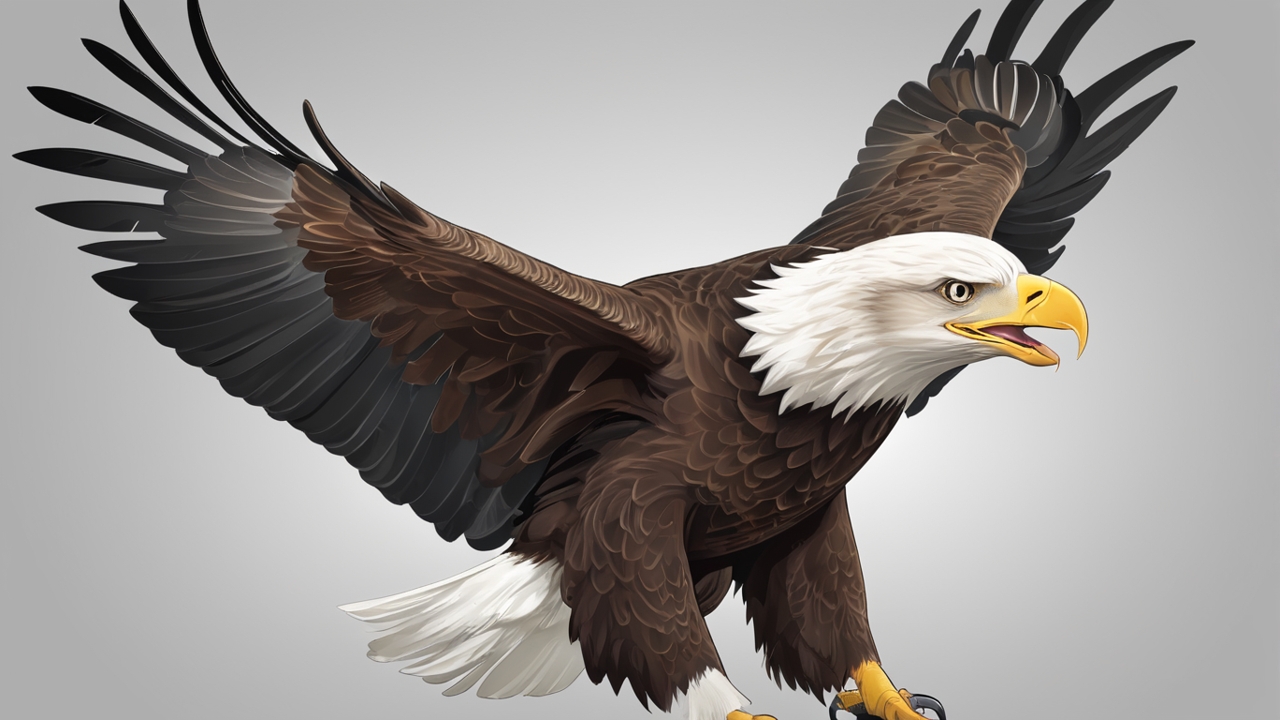
Bald Eagle Facts for Kids: With piercing yellow eyes, a snow-white head, and wings that span nearly eight feet, the bald eagle is one of the most recognisable and majestic birds in the world. As the national symbol of the United States, this powerful raptor represents freedom, strength, and courage. But beyond its symbolic importance, the bald eagle is a fascinating creature with incredible abilities and a remarkable survival story.
Despite their name, bald eagles aren’t actually bald at all! They have a full head of striking white feathers that contrast beautifully with their dark brown bodies. The word “bald” comes from an Old English word meaning “white,” describing their distinctive appearance rather than a lack of feathers.
These magnificent birds of prey once faced the very real threat of extinction. By the 1960s, only a few hundred nesting pairs remained in the lower 48 states. Hunting, habitat loss, and especially the pesticide DDT had devastated their populations. But thanks to determined conservation efforts, legal protections, and the banning of harmful chemicals, bald eagles have made one of the most remarkable comebacks in wildlife history. Today, tens of thousands of bald eagles soar across North American skies once again—a true conservation success story that gives us hope for other endangered species.
In this article, we’ll explore five brilliant facts about bald eagles that showcase their amazing hunting abilities, impressive parenting skills, powerful symbolism, and the inspiring story of their recovery from near-extinction. Whether you’ve seen a bald eagle soaring overhead or only in pictures, these facts will help you appreciate why these birds captivate people around the world.
Fact 1: Bald Eagles Aren’t Actually Bald
The Name Mystery Solved
When you first see a bald eagle, you might wonder why it’s called “bald” when it clearly has a head full of brilliant white feathers. The answer lies in the history of the English language. Hundreds of years ago, the word “balde” (which became our modern “bald”) meant “white” rather than “hairless.” Early European settlers in America saw these impressive birds with white heads and called them “bald eagles” to describe their white-headed appearance, not to suggest they lacked feathers.
This naming makes more sense when you understand that bald eagles’ most distinctive feature is the sharp contrast between their pure white head and tail feathers and their dark chocolate-brown body feathers. From a distance, especially against the sky, that white head can appear almost luminous, making these birds unmistakable.
What Bald Eagles Really Look Like
Adult bald eagles are stunning birds with several distinctive features. Their bodies are covered in dark brown feathers that can appear almost black in certain lighting. The famous white head and tail feathers don’t develop until the birds are about four or five years old—young eagles are entirely brown with mottled white patches, which can make them tricky to identify.
The eagle’s large, hooked yellow beak is perfectly designed for its role as a predator. This powerful tool can tear through fish and other prey with ease. Complementing the yellow beak are piercing yellow eyes that can spot a fish in the water from over a mile away. These eyes have special adaptations, including a nictitating membrane—a transparent third eyelid that protects their eyes while still allowing them to see, especially when diving toward water at high speeds.
Bald eagles’ feet are equipped with massive talons that curve into sharp points. These talons can exert over 400 pounds of pressure per square inch—about ten times stronger than a human hand grip! This incredible strength allows eagles to grasp and hold onto slippery fish or struggling prey.
Impressive Size
Bald eagles are large birds, though their size varies between males and females. Female bald eagles are notably larger than males, a trait called sexual dimorphism that’s common in birds of prey. Females typically weigh between 10-14 pounds, while males weigh 8-10 pounds. This might not sound heavy, but remember that birds need to be relatively light to fly efficiently.
Their wingspan is truly impressive—typically ranging from 6 to 8 feet from wingtip to wingtip. Imagine standing with your arms stretched out; most adult humans have an arm span of about 5-6 feet, so a bald eagle’s wings extend even wider than that! This enormous wingspan allows eagles to soar on air currents for hours with minimal effort, covering vast distances while searching for food.
From beak to tail, bald eagles measure between 28-40 inches in length—about the size of a medium dog. However, much of this length comes from their tail feathers. Despite their large appearance, eagles are surprisingly lightweight due to their hollow bones and efficient body structure designed for flight.
Young Eagles Look Different
If you see a large brown bird soaring overhead, it might actually be a young bald eagle! Juvenile bald eagles don’t have the distinctive white head and tail that make adults so recognisable. Instead, they’re mottled brown all over with varying amounts of white on their undersides and wing linings.
This brown plumage gradually changes over four to five years. Each year during moulting season, young eagles lose old feathers and grow new ones, with progressively more white appearing on their heads and tails. By their fourth or fifth year, they finally display the classic adult colouring that everyone recognises. This gradual transformation means you might see eagles at various stages, with partially white heads or odd patterns—all perfectly normal for eagles going through the maturation process.
Scientists believe this delayed development of adult plumage serves important purposes. The brown colouring may provide better camouflage for younger, less experienced hunters. Additionally, adult eagles may be less aggressive toward brown juveniles than they would be toward other white-headed adults, allowing young eagles to survive in territories occupied by breeding pairs until they’re mature enough to establish their own territories.
Fact 2: Bald Eagles Are Amazing Hunters with a Surprising Diet
Master Fishermen
Bald eagles are primarily fish eaters, which is why they’re almost always found near water—coastal areas, rivers, large lakes, and marshes. They’re spectacular fishermen, using several techniques to catch their slippery prey.
The most dramatic hunting method involves spotting fish from high in the air, then diving down in a controlled descent with their talons extended forward. Just before hitting the water, eagles swing their feet forward and plunge their talons into the fish, often barely getting their feathers wet. Sometimes they do enter the water, and they’re actually capable swimmers, using their wings like oars to paddle to shore with their catch.
Eagles prefer fish weighing 1-3 pounds, though they can carry fish weighing up to about half their own body weight—approximately 4-5 pounds for a large female eagle. When they catch a fish too heavy to carry in flight, eagles have been observed swimming to shore while gripping the fish, unwilling to let go of such a large meal.
Their favourite fish vary by region and season. In the Pacific Northwest, eagles feast on salmon during spawning runs. In other areas, they hunt catfish, carp, herring, and whatever fish species are most abundant and accessible. Shallow water makes fishing easier, so eagles often hunt in areas where fish come near the surface.
Not Just Fish
While fish make up a large portion of their diet, bald eagles are opportunistic predators and scavengers who eat a surprising variety of foods. They hunt waterfowl like ducks and geese, sometimes catching them in flight or snatching them from the water’s surface. Small mammals, including rabbits, squirrels, muskrats, and even young deer, occasionally fall prey to hungry eagles.
Carrion—animals that are already dead—forms an important part of eagles’ diet, especially in winter when live prey may be scarce. Eagles gather at sites where dead fish wash up or where animals killed by cars or harsh weather can be found. This scavenging behaviour is completely natural and helps eagles survive during difficult times. In fact, Benjamin Franklin objected to choosing the bald eagle as America’s national symbol partly because he considered their scavenging habits unworthy of such honour—he preferred the turkey!
One of the most interesting (and somewhat controversial) eagle behaviours is kleptoparasitism—stealing food from other birds. Bald eagles sometimes harass ospreys, other eagles, or even mammals until they drop their catch, which the eagle then swoops down to claim. While this might seem unfair, it’s an efficient hunting strategy that conserves energy. Why spend effort catching fish when you can steal from someone else? In nature, survival often matters more than fairness.
Eating Habits and Adaptations
An adult bald eagle typically eats about half a pound to one pound of food per day, though they can eat much more when food is abundant or go several days without eating when prey is scarce. They can survive for quite a while without food—up to several weeks if necessary—by slowing their metabolism and living off stored body fat.
Eagles tear their food into chunks using their powerful hooked beaks. They don’t have teeth, so they swallow large pieces whole. Their digestive systems are highly efficient, extracting maximum nutrition from their meals. Parts they can’t digest—bones, fur, feathers, and scales—are compacted into pellets that eagles regurgitate. Finding these pellets beneath eagle roosting sites can tell scientists what the eagles have been eating.
The eagle’s talons are marvels of natural engineering. Each foot has four toes with long, curved, razor-sharp talons. The rear talon is particularly large and powerful, used for piercing vital organs of prey. The feet’s rough, textured surface helps grip slippery fish. Eagles can lock their talons in a gripping position, allowing them to hold prey securely even during flight.
Fact 3: Bald Eagles Build Enormous Nests and Are Devoted Parents
Nest Engineering Marvels
Bald eagle nests, called eyries or aeries, are the largest of any North American bird and among the largest bird nests in the world. These massive structures are architectural marvels that would impress any engineer.
A typical bald eagle nest measures 5-6 feet in diameter and 2-4 feet deep when first built. However, eagles reuse and add to their nests year after year, and over time these structures can become truly enormous. The largest recorded bald eagle nest was found in Florida—it measured 9.5 feet wide and 20 feet deep, and was estimated to weigh over two tons! Imagine a nest weighing as much as a small car, built by birds using only sticks, grass, and determination.
Eagles build their nests high in tall, sturdy trees—usually the tallest tree available in the area—or occasionally on cliffs if suitable trees aren’t present. They prefer trees near water since that’s where their food source is located. The nest’s location provides safety from most predators (few animals can reach a nest 50-100 feet up in a tree) and a commanding view of the surrounding territory.
Both male and female eagles participate in building and maintaining the nest. They gather large sticks and branches, sometimes breaking dead branches directly from trees during flight. These sticks form the nest’s strong foundation and outer structure. Inside, they line the nest with softer materials—grass, moss, feathers, and corn stalks—creating a softer surface for eggs and eaglets.
Each year, the pair renovates and adds to their nest before breeding season. This annual addition causes nests to grow steadily larger over the years. Successive generations of eagles have used the same nests for decades, each generation adding its own improvements to the structure its parents built.
Lifelong Partners
Bald eagles typically mate for life, forming pair bonds that can last 20-30 years or more. These partnerships often begin with spectacular courtship displays that are breathtaking to witness. Potential mates perform aerial acrobatics, flying high into the sky and diving, swooping, and chasing each other. The most dramatic display is called “cartwheeling”—the two eagles lock talons mid-air and tumble toward earth in a spinning free-fall, releasing each other only at the last moment before hitting the ground. This test of trust and coordination helps establish the strong bond necessary for successful parenting.
Once paired, eagles often return to the same nesting territory year after year. They’re highly territorial during breeding season, defending their area aggressively against other eagles and potential threats. If one mate dies, the surviving eagle may eventually find a new partner, but many eagles appear to go through a mourning period first.
Raising the Next Generation
In late winter or early spring, depending on location, female eagles lay eggs—usually one to three, though two is most common. Eagle eggs are off-white and about the size of a tennis ball. Both parents share incubation duties, though the female typically spends more time on the eggs. They must keep the eggs warm and turn them regularly to ensure even development. The incubation period lasts about 35 days.
When eaglets finally hatch, they’re tiny, helpless, and covered in gray down. A newly hatched eaglet weighs only 2-3 ounces—about as much as a tennis ball. They’re born with their eyes open but are completely dependent on their parents for warmth, protection, and food.
Both parents are devoted caregivers. They take turns hunting and bringing food back to the nest, tearing it into small pieces for their young. Eagle parents feed their chicks frequently—sometimes every 20-30 minutes during the day. The eaglets grow rapidly, gaining weight quickly on a protein-rich diet of fish and meat.
Young eagles face many challenges in their early weeks. In nests with multiple chicks, sibling rivalry can be intense, with the larger, stronger chick sometimes dominating feeding times. The smaller chick may not survive if food is scarce—a harsh reality of nature that ensures at least one offspring receives adequate nutrition. When food is abundant, both chicks typically survive and thrive.
As eaglets grow, they become more active and curious, exercising their wings in the nest and eventually hopping to nearby branches. This stage is called “branching.” Finally, at 10-12 weeks old, young eagles take their first flights—a momentous and somewhat nerve-wracking occasion as they launch themselves from the nest into open air, their wings often not yet fully coordinated.
Even after fledging, young eagles aren’t immediately independent. Parents continue to feed and supervise them for several more weeks, teaching them hunting techniques and territorial boundaries. This extended parental care gives young eagles the best possible chance of survival. Gradually, the juveniles become more competent hunters and eventually leave their parents’ territory to find their own way in the world.
Fact 4: Bald Eagles Almost Went Extinct, But Made an Amazing Comeback
A Once-Thriving Population in Danger
Before European colonisation of North America, bald eagles thrived across the continent. Estimates suggest that 250,000-500,000 bald eagles lived throughout what is now the United States. They nested in every state except Hawaii and were especially abundant near coastlines and major rivers where fish were plentiful.
However, by the mid-20th century, bald eagles had nearly vanished from most of the United States. By 1963, only 417 nesting pairs remained in the lower 48 states—a shocking decline of over 95% from historical populations. In many states where eagles had once been common, they disappeared entirely. What happened to cause such a catastrophic decline?
Multiple Threats Combined
Several factors combined to devastate bald eagle populations. First, direct persecution played a major role. Many people mistakenly viewed eagles as threats to livestock and fish populations. Some states even offered bounties—payments for killing eagles. Between 1917 and 1952, Alaska alone paid bounties for over 100,000 dead bald eagles. This systematic slaughter devastated populations before people understood eagles’ true ecological role and value.
Habitat loss was another significant factor. As human populations expanded, forests were cleared, wetlands were drained, and coastlines were developed. Eagles need large, undisturbed territories with suitable nesting trees near water. As these habitats disappeared, so did the eagles.
However, the most devastating threat came from an unexpected source: pesticides, particularly DDT (dichloro-diphenyl-trichloroethane). DDT was widely used starting in the 1940s to control mosquitoes and agricultural pests. While it didn’t directly kill adult eagles, it caused an insidious problem that affected reproduction.
DDT accumulated in the environment and moved up the food chain through a process called bioaccumulation. Small fish absorbed DDT from contaminated water. Larger fish ate many small fish, concentrating the DDT in their bodies. Eagles ate the larger fish, concentrating it even further. The chemical interfered with eagles’ ability to metabolise calcium properly, causing them to lay eggs with dangerously thin shells. These fragile eggs broke under the parent’s weight during incubation, making successful reproduction nearly impossible.
By the 1960s, bald eagles were in crisis. In some regions, reproduction had almost completely failed for years. The species teetered on the brink of extinction.
Conservation to the Rescue
Fortunately, people began recognising the crisis and took action. The 1940 Bald Eagle Protection Act made it illegal to kill, harass, or possess bald eagles, their nests, or their eggs. This provided some protection, though enforcement was initially limited, and the law didn’t address habitat loss or pesticides.
A crucial breakthrough occurred in 1962 when scientist Rachel Carson published “Silent Spring,” a groundbreaking book that documented the environmental damage caused by pesticides, including the devastating effects of DDT on birds. Carson’s work raised public awareness and sparked the environmental movement. Her research and advocacy eventually led to the United States banning DDT in 1972—a pivotal moment for bald eagles and many other bird species.
In 1973, the Endangered Species Act provided additional protections, listing the bald eagle as endangered in most states and threatened in others. This law required government agencies to protect eagle habitat and take active steps to promote recovery.
Conservation organisations, government agencies, and concerned citizens launched eagle recovery programs. These efforts included:
Protecting and monitoring nest sites
Captive breeding programs to boost populations
Habitat restoration and protection
Reducing human disturbance in nesting areas
Public education about the’ importance of eagles
Strictly enforcing laws against killing eagles
A Triumphant Return
The combination of legal protection, DDT ban, and active conservation efforts produced remarkable results. Slowly at first, then more rapidly, bald eagle populations began recovering. Eggs with normal, strong shells hatched successfully. Young eagles survived and eventually bred, producing their own offspring. Protected nest sites allowed eagles to raise families without disturbance.
The recovery accelerated through the 1980s and 1990s. By 1995, the bald eagle’s status had been upgraded from endangered to threatened—meaning it was still at risk but was showing improvement. By 2007, bald eagle populations had recovered so successfully that the species was removed from the endangered species list entirely, though it remains protected under the Bald Eagle Protection Act and Migratory Bird Treaty Act.
Today, over 70,000 bald eagles live in the lower 48 states, with hundreds of thousands more in Alaska and Canada. Eagles have returned to nest in states where they hadn’t been seen for decades. The sight of a bald eagle soaring overhead, once rare and precious, has become more common again.
This recovery represents one of conservation’s greatest success stories. It demonstrates that when we recognise environmental problems and take determined action, we can reverse even dire situations. The bald eagle’s comeback gives us hope for other endangered species and reminds us of our responsibility as stewards of the natural world.
Ongoing Vigilance
While no longer endangered, bald eagles still face threats. Lead poisoning from eating animals killed with lead ammunition remains a serious problem. Power lines cause electrocution deaths. Vehicle collisions kill eagles. Climate change may affect prey availability and nesting habitats. Illegal shooting still occurs occasionally.
However, the eagle’s remarkable recovery shows that with continued protection, monitoring, and conservation efforts, these magnificent birds can thrive alongside human communities. Many eagles now nest near cities and suburbs, adapting to human-modified landscapes as long as sufficient food and suitable nesting sites remain available.
Fact 5: Bald Eagles Are Powerful Symbols with Amazing Abilities
America’s National Bird
On June 20, 1782, the Continental Congress chose the bald eagle as the national emblem of the United States, featuring it prominently on the Great Seal. This decision wasn’t without controversy—Benjamin Franklin famously preferred the wild turkey, which he considered more respectable since eagles sometimes scavenged! Despite Franklin’s objections, the eagle’s image of strength, courage, freedom, and longevity made it the perfect symbol for the young nation.
Today, the bald eagle appears on countless official items: dollar bills, quarters, the presidential seal, military insignia, government buildings, and official documents. It’s recognised worldwide as a symbol of the United States. The eagle represents ideals Americans hold dear: independence, freedom, and the courage to defend those values.
Beyond patriotic symbolism, the bald eagle has become an icon for conservation itself. Its near-extinction and dramatic recovery symbolise both the consequences of environmental damage and the possibility of restoration through dedicated effort.
Sacred to Native Americans
Long before European settlers arrived, Native American cultures revered the bald eagle as sacred. Many tribes considered eagles messengers between humans and the Creator, with their ability to fly higher than other birds symbolising their connection to the spiritual realm.
Eagle feathers hold profound spiritual significance in Native American traditions. They’re given as marks of honour, used in religious ceremonies, and incorporated into ceremonial regalia. The possession of eagle feathers by Native Americans for religious and cultural purposes is specifically exempted from laws that otherwise prohibit possessing eagle parts—a recognition of these traditions’ importance.
Different tribes have various legends and beliefs about eagles, but common themes include the eagle as a symbol of wisdom, courage, strength, and spiritual power. This reverence for eagles continues in Native American communities today.
Extraordinary Abilities
Bald eagles possess several remarkable capabilities beyond their symbolic importance:
Incredible Vision: Eagle eyesight is legendary, and deservedly so. Their vision is approximately 4-8 times sharper than human vision. An eagle soaring at 1,000 feet can spot a rabbit moving in a field below. They can see fish beneath the water’s surface from high in the air, even when flying at considerable speeds. Eagles have two foveae (areas of sharp central vision) in each eye, compared to humans’ one, allowing them to focus on objects both directly ahead and to the side simultaneously.
Powerful Flight: Despite their size, eagles are graceful, efficient fliers. They can soar for hours on thermal air currents without flapping their wings, conserving energy while covering vast distances. When actively flying, they can reach speeds of 30-40 mph. During hunting dives, they can achieve speeds over 100 mph. Their broad wings provide lift for soaring, while their tail feathers serve as a rudder for precise manoeuvring.
Surprising Swimming: Few people know that bald eagles can swim! If they catch a fish too heavy to lift into the air, eagles sometimes paddle to shore using their wings as oars in a movement called the “butterfly stroke.” While not their preferred mode of transportation, this ability occasionally saves eagles that would otherwise drown after catching oversized prey.
Impressive Strength: An eagle’s grip strength is phenomenal—their talons can exert over 400 pounds per square inch of pressure, roughly ten times stronger than a human hand. This allows them to capture and hold struggling prey securely. They can carry prey weighing up to half their body weight in flight—imagine carrying a 70-pound object while running!
Long Lives: In the wild, bald eagles typically live 20-30 years, though many die younger due to accidents, disease, or starvation. In captivity, where they’re protected from dangers and receive regular food and veterinary care, eagles can live 40-50 years or more. The oldest known wild bald eagle lived to at least 38 years old and was still raising young!
Bald Eagle Facts Conclusion
Bald eagles are truly remarkable birds that deserve every bit of admiration they receive. From their striking appearance—white heads gleaming against dark bodies—to their impressive hunting prowess and tender parental care, they embody both fierce power and devoted nurturing. Their story arc from near-extinction to thriving populations demonstrates both humanity’s capacity to damage the environment and our ability to heal it when we commit to conservation.
These five brilliant facts reveal just a fraction of what makes bald eagles special. They’re not actually bald but brilliantly white-headed. They’re formidable hunters who can pluck fish from water at high speed. They build enormous nests that they maintain for years and raise their young with devoted care. They recovered from the brink of extinction through determined conservation efforts. And they serve as powerful symbols of freedom, strength, and the possibility of environmental recovery.
Whether you see eagles as national symbols, apex predators, devoted parents, or conservation success stories, there’s no denying their magnificence. The fact that we came so close to losing them forever makes their recovery all the more precious. Every bald eagle soaring overhead represents countless people who worked to protect these birds and their habitats—scientists, conservationists, lawmakers, and concerned citizens who refused to let these magnificent birds disappear.
The next time you see a bald eagle—whether soaring over a lake, perched in a tall tree, or pictured on a coin or bill—take a moment to appreciate not just the bird itself but everything it represents: the wildness we’re fortunate to share our world with, the fragility of nature when threatened by human activities, and the hope that comes from successful conservation efforts.
Bald eagles remind us that we can make a difference. The choices we make—protecting habitats, banning harmful chemicals, enforcing conservation laws, and respecting wildlife—have real consequences. The eagles’ triumphant return from near-extinction proves that with knowledge, determination, and action, we can reverse environmental damage and ensure that future generations will also thrill to the sight of these magnificent birds soaring across American skies.
We hope you enjoyed learning more things about the bald eagle as much as we loved teaching you about them. Now that you know how majestic these animals are, you can move on to learn about other animals like: Birds, Invertebrates and Reptiles.
Why not subscribe to our LearningMole Library for as little as £1.99 per month to access over 3400 fun educational videos.
Maths Circus, an innovative platform we've crafted, presents a captivating realm where children learn mathematics through the exciting theme of a circus. The joy of juggling numbers and solving circus...
Fruit helps protect the body from disease because it delivers fibre, vitamins, minerals and natural plant compounds that support the heart, the gut, blood sugar control and healthy cells. The...
Dark chocolate is one of the few treats that scientists have studied in real depth, and the results are more measured than the headlines suggest. The cocoa bean is rich...
A tour guide leads visitors around a place of interest, such as a castle, a museum, a city centre or a nature reserve, and explains its history and stories in...




Leave a Reply