Coconuts have “nuts” in their name, a hard brown shell and a place on the nut shelf in many supermarkets, but botanists classify it as a drupe, the same group of fruits as peaches, plums and cherries. A coconut is the single-seeded fruit of the coconut palm, Cocos nucifera, and only in loose everyday language does it count as a nut. That makes the coconut a useful puzzle for children studying plants in the UK National Curriculum, because the explanation behind its misleading name leads straight into how seeds are built and how they travel.
This guide comes from LearningMole, the free UK educational platform founded by former primary school teacher Michelle Connolly, and it is written for primary teachers, parents and curious children aged roughly 7 to 11. It covers what a drupe is, why a coconut can float across an ocean and still sprout, what the three “eyes” on the shell are for, and why coconut does not usually count as a nut under UK allergy rules. If your class has already studied how seeds grow into new plants, the coconut is a natural next example because it is one of the largest seeds in the plant kingdom.
Each section opens with the main fact and then explains the science behind it, with classroom activities and curriculum links further down the page. Teachers planning the Year 3 plants unit will find the seed dispersal material most useful, while parents can use the facts and the floating experiment at home with a coconut from the supermarket. You can also read our guide to the plant life cycle for primary pupils alongside this article to place the coconut within the wider topic.
A coconut is a drupe, a fruit with a hard stone around its seed
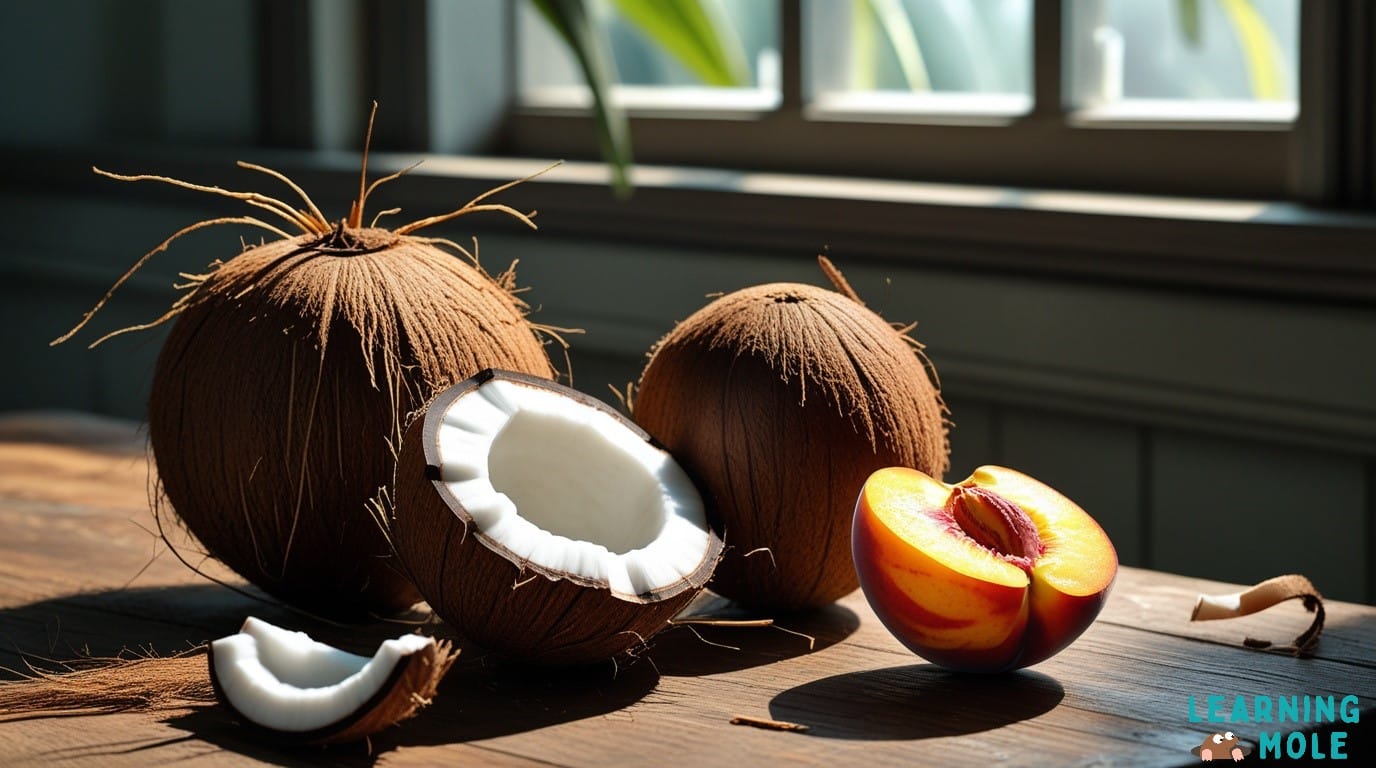
Botanists call a coconut a fibrous drupe, which means a fruit whose single seed is protected by a hard, stony inner layer. Peaches, cherries, olives and mangoes are drupes too, so the coconut belongs to a familiar family, even though it looks nothing like a peach in the fruit bowl.
The three layers of a drupe
Every drupe has three layers wrapped around the seed. The outer skin is the exocarp, the middle layer is the mesocarp and the hard inner layer is the endocarp, which is the “stone” in a cherry or a peach. In a peach, the mesocarp is the soft, juicy part we eat. In a coconut, the mesocarp is a thick mat of dry fibres called coir, and the brown hairy ball sold in UK supermarkets is the endocarp with most of that fibrous husk already stripped away.
Why a coconut can be called a fruit, a seed and a nut
All three words can describe a coconut, depending on who is speaking. A botanist would call the whole thing a fruit because it develops from the flower of the palm, and the white flesh and water inside belong to the seed. Cooks and shoppers often call it a nut because it has a hard shell and is cracked open like one. A true nut, in the botanical sense, is a hard fruit such as a hazelnut or an acorn, where the shell itself is the fruit wall, and it does not split open to release the seed. The table below compares the coconut with other foods that children often group together.
Everyday name
Botanical group
What surrounds the seed
The part people eat
Best use in a lesson
Coconut
Fibrous drupe
Fibrous husk and a hard shell
The seed’s white flesh and water
Showing that a drupe can have a dry middle layer
Peach
Fleshy drupe
Soft, juicy flesh and a hard stone
The fleshy middle layer
Comparing with the coconut layer by layer
Almond
Drupe
A leathery husk and a hard shell
The seed inside the shell
Showing that food labels and botany do not always match
Hazelnut
True nut
A hard shell that is the fruit wall
The seed inside the shell
Defining what a true nut is
Peanut
Legume
A papery pod
The seeds inside the pod
Showing that a “nut” can be a member of the pea family
The fibrous husk works like a lifejacket at sea
A coconut can float in seawater for weeks because its fibrous husk is full of trapped air, which makes the whole fruit lighter than the water around it. This lets the palm spread its seeds along coastlines without help from animals or people.
How water carries seeds to new places
Plants cannot walk, so they rely on wind, animals, water or small explosions to move their seeds away from the parent plant, a process called seed dispersal. Seeds carried by water are dispersed by hydrochory, and the coconut is the best known example. A coconut that falls from a palm on a beach can roll into the surf, drift on ocean currents and wash up on another shore where there is space and light for a new palm to grow. LearningMole’s guide to why some objects sink, and others float explains the idea of density that sits behind this.
How trapped air keeps the coconut afloat
The outer skin of the coconut is waxy and waterproof, and the coir underneath it is a spongy layer more than 2 centimetres thick that holds pockets of air. Together, these layers keep the seed dry and buoyant. A 1941 study by the American zoologist C H. Edmondson suggested that coconuts can still germinate after floating for about 110 days, which is enough time to drift thousands of kilometres. Edmondson tested only a small number of coconuts, and later observers found that seawater can spoil the seed, so the 110-day figure is best taught as an upper limit rather than a typical trip.
“Pupils remember what they have held, shaken and listened to, so a real coconut on the table does more for a seed dispersal lesson than any diagram. When children realise that a fruit can cross an ocean and grow into a tree on the far side, they start asking how every other seed gets about,” says Michelle Connolly, founder of LearningMole and a former primary school teacher with over 15 years of classroom experience.
The three eyes on a coconut are germination pores
The three dark dents at one end of a coconut shell are germination pores, and only one of them is a working exit for the young plant. The other two are plugged with hard tissue that seals the seed inside.
Finding the soft eye
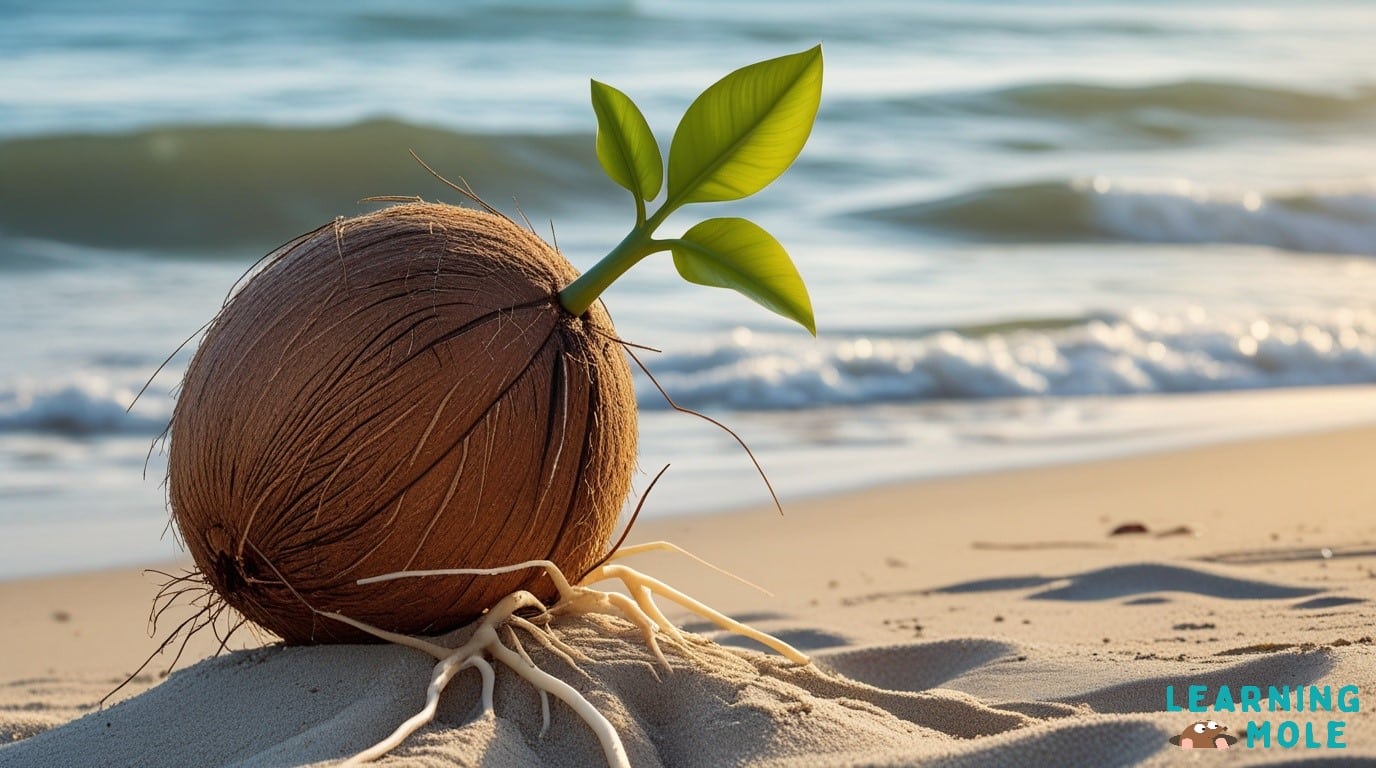
The three pores are a reminder that the coconut flower is made of three joined sections called carpels, which is common in the palm family. Only one section goes on to form the seed. A tiny, cylindrical embryo sits just beneath the soft pore, embedded in the white flesh, and when the coconut germinates, the first shoot and root push out through that soft spot. Botanists who study palms describe the soft eye as weak enough for a paper clip to push through, while the other two feel like solid wood.
Where the name “coco” comes from
The word coconut is usually traced to Portuguese and Spanish sailors in the 1500s, who used the word “coco” for a grinning face or a spooky head. The three eyes and the hairy husk reminded them of a face, and the name stuck. Children enjoy the story, and it lets a teacher show that the “face” is really a set of plant structures with a job to do.
Coconut water is a food store for the young plant
The clear liquid inside a young coconut is liquid endosperm, a store of water and nutrients that feeds the embryo as it develops. The white flesh, often called coconut meat, is solid endosperm, and both are part of the seed.
How the liquid feeds the embryo
A coconut that washes up on a sandy beach may land a long way from fresh water. The liquid sealed inside the shell gives the embryo its own supply while it begins to grow. When the coconut germinates, a spongy growth develops from the base of the embryo and slowly fills the hollow centre, absorbing the stored food. This growth is sometimes sold as “coconut apple” in countries where coconuts are grown.
How coconut water turns into coconut meat
Young green coconuts are full of liquid and have a thin layer of soft, jelly-like flesh. As the fruit ripens, more of the liquid is laid down as firm white flesh on the inside of the shell, so a mature brown coconut has thicker meat and less water. This explains why coconut water is usually sold from young green coconuts, while desiccated coconut and coconut oil are made from the flesh of mature ones.
People use every part of the coconut and its palm
Almost every part of the coconut and its palm has a use, which is why it is often described as the tree of life in the regions where it grows. The flesh and water are eaten and drunk, while the husk, shell and leaves become ropes, bowls, fuel and building materials.
Foods made from the coconut
The table below follows a coconut from the outside in. It shows what each layer does for the plant and how people use it, which makes it a useful reference when pupils label a coconut diagram.
Layer
Botanical name
Job for the plant
How people use it
Best use in a lesson
Smooth outer skin
Exocarp
Keeps water out
Removed before sale
Testing which materials are waterproof
Fibrous husk
Mesocarp
Traps air so the fruit floats
Coir for ropes, mats, brushes and plant pots
Comparing natural and man-made materials
Hard brown shell
Endocarp
Protects the seed
Bowls, buttons and fuel
Investigating the strength of materials
White flesh
Solid endosperm
Stores food for the embryo
Eaten fresh, dried as flakes or pressed for oil
Linking seeds to food
Clear liquid
Liquid endosperm
Supplies water and nutrients
Drank as coconut water
Explaining how a seed survives on a beach
Several familiar foods come from the white flesh. Coconut milk is made by grating the flesh and soaking or squeezing it with water, so it does not occur naturally inside the fruit. Coconut oil is pressed from dried flesh, called copra.
Desiccated coconut and coconut flakes are the flesh shredded and dried in smaller or larger pieces; coconut flour is dried flesh ground into a powder, and coconut butter is the flesh blended into a thick paste. Coconut milk is popular with families who avoid cow’s milk, although it contains far less protein and calcium than dairy milk unless it has been fortified.
Coir, shells and leaves as natural materials
Coir from the husk is strong and resists rot in salt water, so it has been twisted into ropes and fishing nets for centuries and is still used for doormats and garden products. The hard shells become bowls, spoons and musical instruments, or are burned as fuel. The palm’s leaves are woven into roofs, baskets and mats.
This makes the coconut a good case study for Year 1 and Year 2 lessons on everyday materials, because pupils can handle coir and shell and describe how each one feels. The LearningMole article on palm trees and their many uses covers the rest of the plant in more detail.
Coconut palms grow up to 30 metres tall
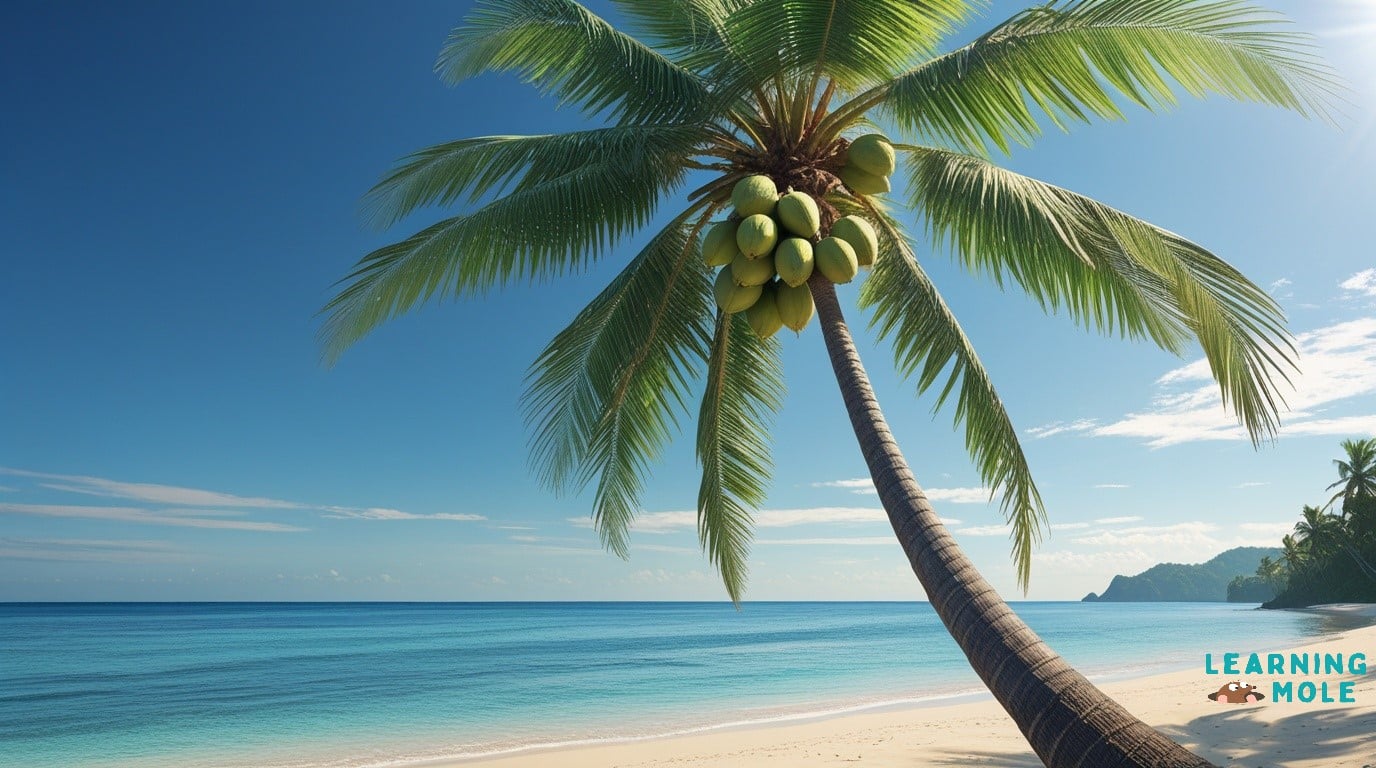
A coconut palm can reach around 30 metres, roughly the height of a ten-storey building, and its fruit grows in clusters just below the crown of leaves. Each ripe coconut has a long way to fall, so its husk protects the seed on landing as well as at sea.
Flexible trunks that bend in the wind
Palms grow on exposed coasts where storms are common. Their trunks are made of bundles of tough fibres rather than the solid wood found in an oak, so they bend with strong winds instead of snapping.
How the husk cushions a falling coconut
The same thick husk that keeps a coconut afloat also absorbs much of the impact when the fruit hits the ground. A ripe coconut with its husk can weigh more than a kilogram, so the cushioning helps the shell and seed survive the drop intact.
Coconut and nut-free school policies
Coconut is not classed as a tree nut in the UK, and allergy to coconut is rare. Anaphylaxis UK, the national charity for people at risk of severe allergic reactions, explains that the coconut belongs to the palm family and is only distantly related to tree nuts, and that people with a tree nut allergy are not generally advised to avoid it.
What allergy charities say about coconut
UK food law lists 14 major allergens that must be highlighted on packaging, and tree nuts and peanuts are on that list while coconut is not. Coconut allergy does exist, although it is rare, and a small number of people react to both coconut and tree nuts. The Anaphylaxis UK coconut factsheet advises anyone unsure about their own diagnosis to ask their GP about a specific coconut allergy test. The almond in the table above is also worth noting here, because it is botanically a drupe like the coconut, yet it is treated as a tree nut for allergy purposes, which shows that allergy rules follow the proteins in a food rather than its botanical label.
Checking your school’s packed lunch policy
Each school sets its own food policy, and some nut-free schools also exclude coconut as an extra precaution, particularly where a pupil has a known coconut allergy. Parents should check their own school’s policy before packing coconut products, and teachers should check the class allergy list and individual healthcare plans before bringing a real coconut into a lesson. For wider guidance on food in school, see our article on teaching children about nutrition and healthy eating.
Coconuts link to several parts of the primary science curriculum
The coconut fits most closely with the Year 3 plants unit in the national curriculum for science in England, which asks pupils to explore the part flowers play in the life cycle of flowering plants, including seed formation and seed dispersal. It also supports earlier and later units, as the table below shows.
Year group
Curriculum area
How the coconut fits
Best use in a lesson
Year 1
Plants and everyday materials
Naming parts of a tree and describing natural materials
Handling coir and shell
Year 2
Plants
How seeds grow into mature plants
Watching a sprouting coconut on video
Year 3
Plants
Seed formation and seed dispersal
The floating investigation below
Year 4
Living things and their habitats
Grouping living things
Sorting fruits into drupes, nuts and legumes
Year 6
Evolution and inheritance
How plants are adapted to their environment
Explaining the husk as a coastal adaptation
Key Stage 1: plants and natural materials
Younger pupils can start by identifying the coconut as part of a tree and comparing its outside with fruit they know, such as an apple or a peach. Handling the husk, shell and flesh gives Year 1 and Year 2 pupils the vocabulary they need to describe materials. Pupils in Northern Ireland can approach the same material through the World Around Us area of learning.
Key Stage 2: seed dispersal and adaptation
Older pupils can compare the coconut with other dispersal methods, such as sycamore seeds carried by the wind and burrs carried on animal fur. The floating investigation works well in Year 3, while the explanation of the husk as a coastal adaptation suits Year 6 work on evolution and inheritance. LearningMole’s collection of hands-on seed planting activities for children can extend the unit once pupils understand how seeds travel.
The coconut lifejacket floating investigation
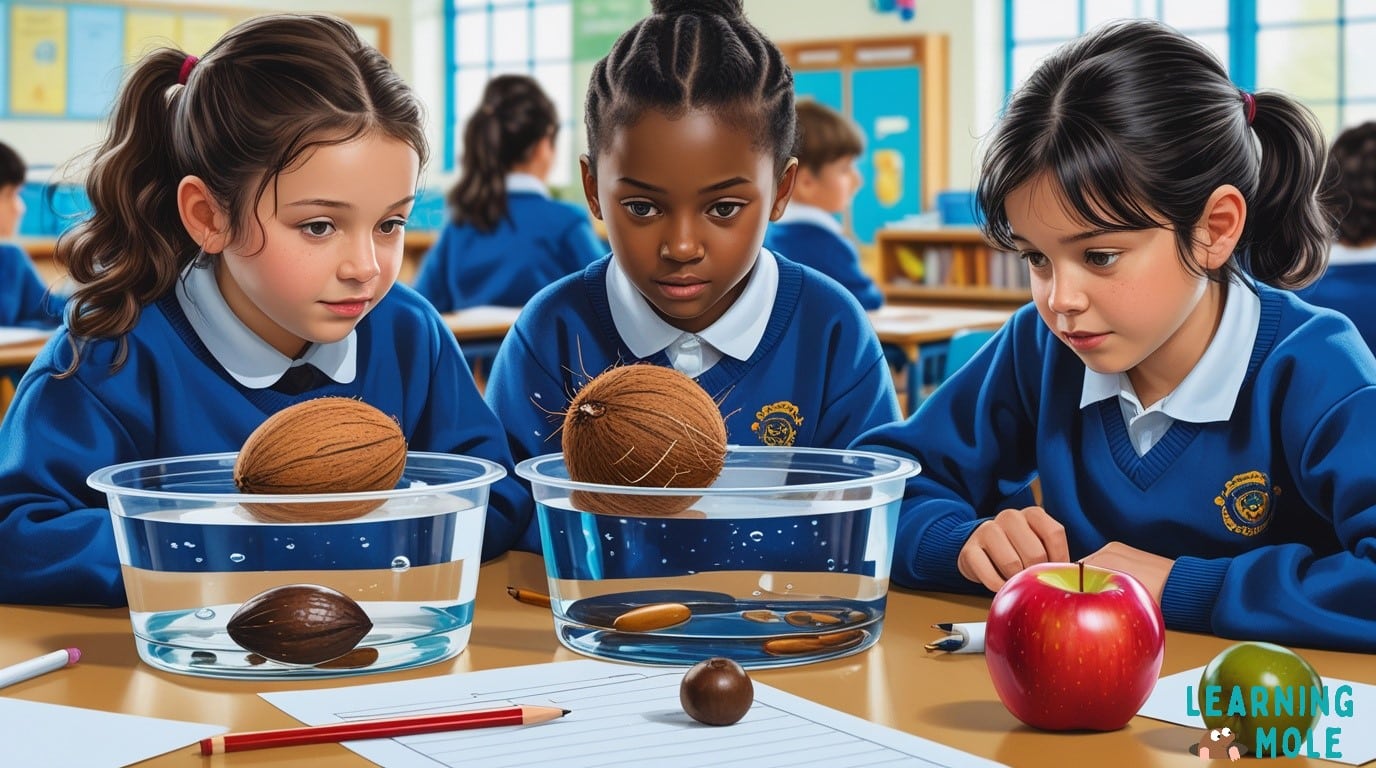
Fill two clear tubs with water and dissolve several spoonfuls of salt in one of them. Pupils predict whether a whole coconut, a piece of coir, an apple, a dried bean and a conker will float in each tub, then test and record their results. Most supermarket coconuts have had their husk removed, so a piece of coir from a garden centre plant liner helps pupils see how the fibres trap air. Pupils should notice that floating depends on trapped air and density rather than size alone, since the heavy coconut floats while a small bean may sink.
The three eyes investigation
Give small groups a brown coconut and ask them to find the three eyes. With an adult holding the coconut steady, pupils press each eye gently with the handle of a teaspoon to find the one that gives way. An adult can then pierce the soft eye with a clean skewer and pour out the coconut water so pupils can see the liquid endosperm. Check the class allergy list before this activity and wash hands afterwards.
Teaching resources and support for coconut and seed lessons
LearningMole provides free, curriculum-aligned videos and teaching resources that help primary teachers and parents bring plant topics to life, from seeds and life cycles to habitats and adaptation. All of our resources are free to use in the classroom and at home, and they are written by educators who understand the UK National Curriculum.
Teachers planning a seed dispersal unit can pair this article with our guide to fruits and their seeds for children and our article on beaches and coastal habitats, which show where coconut palms live and how coastal plants survive. Parents supporting learning at home can try the floating investigation in a washing-up bowl and talk through the results using the vocabulary from this article, such as drupe, husk and germination.
Frequently asked questions about coconuts
Is a coconut a fruit, a nut or a seed?
A coconut is a fruit, specifically a fibrous drupe, and the white flesh and water inside it belong to its single large seed. In everyday language, it is also called a nut because of its hard shell. Botanists do not classify it as a true nut because a true nut, such as a hazelnut, has a shell that is the fruit wall itself, with no fibrous layer around it.
Can a child with a tree nut allergy eat coconut at school?
Most children with a tree nut allergy can eat coconut safely, according to Anaphylaxis UK, which explains that coconut is only distantly related to tree nuts. Coconut is not one of the 14 major allergens that UK food labels must highlight. Some schools still exclude coconut from packed lunches as a precaution, so parents should check their own school’s policy and follow medical advice for their child.
What is the liquid inside a coconut called?
The liquid inside a coconut is called liquid endosperm, and most people know it as coconut water. It is a store of water and nutrients that feeds the embryo while the seed begins to grow. As the coconut ripens, much of this liquid becomes the firm white flesh lining the shell, which is why young green coconuts contain more water than mature brown ones.
When do children learn about seed dispersal in UK schools?
Seed dispersal is part of the Year 3 plants unit in the national curriculum for science in England, so most children meet it at around age 7 or 8. Younger pupils learn how seeds grow into plants in Year 2, and older pupils return to plant adaptation in Year 6. The coconut is a useful example at each stage because its dispersal method is easy to see and test, and LearningMole’s free plant resources follow the same year-by-year order.
Why do coconuts have three eyes?
The three eyes are germination pores left by the three carpels that make up the coconut flower. Only one of them is soft enough for the young shoot to push through, and the embryo sits just beneath it. The other two are sealed with hard tissue that protects the seed.
How long can a coconut float in the sea and still grow?
A coconut may still germinate after floating for up to about 110 days, according to a small study from 1941, which is long enough to travel thousands of kilometres. In practice, seawater often spoils the seed sooner, so most successful journeys are probably shorter hops between nearby islands and coasts. The empty husk itself can stay afloat for much longer.
Where do coconuts come from?
Coconuts grow on coconut palms along tropical coasts in Asia, the Pacific, Africa and the Americas. Scientists still debate exactly where the coconut first grew, but genetic studies point to separate early populations in the Pacific and in the Indian Ocean region. The coconut spread partly by floating and partly with people who carried it on long sea voyages.
Using the coconut to start your next plant topic
The coconut earns its place in a primary science lesson because a single fruit covers so much of the plants curriculum. Its three layers show children what a drupe is, its husk shows how a seed can travel by water, its eyes show where a new plant emerges and its water shows how a seed carries food for the journey. Each of these ideas can be seen and touched with a coconut from the supermarket, which makes the topic accessible for teachers and parents alike.
The question of whether coconuts are really nuts also gives children a first taste of how scientists classify living things. Everyday names are useful in the kitchen, but botanists group plants by how their flowers and fruits are built, and allergy specialists group foods by the proteins they contain. Helping pupils see that one object can be described in different ways for different purposes is a skill they will use across science, from sorting animals in Year 4 to explaining adaptation in Year 6.
A good next step is to run the floating investigation with your class or at home, then compare the coconut with wind-dispersed seeds such as sycamore and dandelion. LearningMole’s free plant and seed resources, including our guide to seeds for children and the videos on the LearningMole YouTube channel, give you ready-made material to continue the topic, all aligned with the UK National Curriculum and free to use in the classroom.
Maths Circus, an innovative platform we've crafted, presents a captivating realm where children learn mathematics through the exciting theme of a circus. The joy of juggling numbers and solving circus...
The 9 times table multiplication has a reputation for being tricky, yet it holds more mathematical magic than any other table in the primary curriculum. Every answer follows two neat...
Article Summary What this article covers: Ten differences between river otters and sea otters, from size, fur and swimming style to diet, tool use and family life, plus which otter...
Article Summary What this article covers: The nine main types of natural disasters, how each one works and how they are measured, which hazards genuinely affect the UK, and how...







Leave a Reply