Teaching apostrophes at KS2 works best with a mix of clear explanations, hands-on activities and regular practice. Children aged 7 to 11 need to get their heads around both possession and contraction rules.
Many teachers find it tricky to explain this punctuation mark, but the right resources can really make a difference. Good apostrophes teaching materials for KS2 include PowerPoints, worksheets, interactive games and display posters, all covering contraction and possessive apostrophes in ways kids actually understand.
Michelle Connolly, founder of LearningMole and a former primary teacher with over 15 years’ experience, says, “apostrophes cause more confusion than almost any other punctuation mark, but breaking them down into simple rules and practising with real examples helps children grasp the concept much faster.”
This UK educational platform shares curriculum-aligned resources that help teachers make grammar lessons more interesting and accessible for everyone.
Getting your Year 3 to Year 6 pupils to master apostrophes takes time and a variety of approaches. The best punctuation activities for KS2 mix direct teaching with games, loop cards and guided practice. That way, you tackle common mistakes before they become habits.
Key Takeaways
Effective apostrophe teaching at KS2 uses PowerPoints, games and worksheets that cover both possession and contraction rules.
Children need regular practice and clear examples to get when and how to use apostrophes.
Tackling common mistakes early through guided activities stops confusion as pupils move through Key Stage 2.
What Are Apostrophes?
Apostrophes are punctuation marks with three main jobs in English writing: showing possession, indicating contractions, and sometimes forming plurals. Lots of pupils get muddled about where to put them.
Definition and Purpose
An apostrophe is a small mark, a bit like a floating comma. You’ll use it in three main ways in your KS2 classroom.
First up: possession. When something belongs to someone or something, you add an apostrophe. For one owner, the apostrophe goes before the ‘s’ (the dog’s collar). For more than one, it goes after the ‘s’ (the dogs’ collars).
Second: contractions. When you squash two words into one, the apostrophe shows where letters have gone missing. Things like ‘can’t’ (cannot), ‘didn’t’ (did not), and ‘we’re’ (we are). Teaching apostrophes for contraction and possession helps pupils get both ideas.
The third use is for making plurals of lowercase letters, though you probably won’t see this much. You might write ‘mind your p’s and q’s’ just to keep things clear.
Common Misconceptions
Your pupils will probably make a few common mistakes with apostrophes. The biggest one? Adding apostrophes to regular plurals. Words like ‘apples’, ‘cats’, or ‘books’ don’t need apostrophes just because there’s more than one.
Another classic mix-up is with ‘its’ and ‘it’s’. ‘Its’ shows possession (the cat licked its paw), while ‘it’s’ is a contraction for ‘it is’ or ‘it has’. This one throws a lot of learners off because most possession uses an apostrophe.
Kids also get stuck on names ending in ‘s’. You can write ‘James’s book’ or ‘James’ book’, and the National Curriculum says both are fine. Just pick one and stick to it in your classroom.
A lot of children put apostrophes in the wrong place for plural possession. So you’ll see ‘the girl’s bags’ for more than one girl, when it should be ‘the girls’ bags’.
Teaching Apostrophes for Possession
Apostrophes for possession show ownership or belonging. They work differently for singular and plural owners.
Understanding where to put the apostrophe helps students write accurately.
Singular Possession Explained
Singular possession means one person or thing owns something. You add an apostrophe and an ‘s’ to the owner.
The rule is straightforward: owner + ‘s + thing owned. For example, “the cat’s toy” means the toy belongs to one cat.
This works for all singular nouns, even names like “James’s book” or “the teacher’s desk”.
Kids often mix up possessive apostrophes with plurals. “Dogs” means more than one dog, but “dog’s” means one dog owns something. Teaching singular possession works best if you start with familiar objects and names.
Try writing long phrases first, then shortening them. “The ball that belongs to the boy” becomes “the boy’s ball”. This shows that the apostrophe stands in for “that belongs to”.
Plural Possession in Detail
Plural possession means more than one person or thing owns something. The apostrophe’s position depends on how the plural noun ends.
For regular plurals ending in ‘s’, add just an apostrophe after the ‘s’. “The girls’ classroom” means the classroom belongs to several girls.
Irregular plurals are different. Words like “children” or “women” don’t end in ‘s’, so you add ‘s after the apostrophe. You get “the children’s books” or “the men’s coats”.
Resources for possessive apostrophes often include activities where students turn longer sentences into shorter ones using the right apostrophe. This helps them spot the difference between “the toys belonging to the cats” (cats’ toys) and “the toys belonging to the cat” (cat’s toys).
Apostrophes for Contractions
Contractions join two words into one by removing certain letters and popping in an apostrophe. The apostrophe shows exactly where the letters have gone.
How Contractions Work
Contractions squash two words together by dropping letters from the second word. “Do not” becomes “don’t” and “I am” becomes “I’m”. The apostrophe goes right where the missing letters would sit.
Year 3 and Year 4 pupils usually start learning apostrophes for contractions as part of the National Curriculum. Teachers often notice that children pick up this idea more quickly than possessive apostrophes because the rule is simple.
“Won’t” is a bit odd since it looks nothing like “will not”. English is full of these little quirks.
Using the Apostrophe to Show Omission
Using apostrophes for contractions means putting the apostrophe where letters have dropped out. “Should not” becomes “shouldn’t“, with the apostrophe taking the place of the second “o”. “I have” becomes “I’ve”, with the apostrophe replacing “ha”.
Apostrophes for contraction follow just one rule. The apostrophe always marks the missing letters, not just the join.
Pupils get mixed up with “it’s” (it is) and “its” (belonging to it). “It’s” always means “it is” or “it has”. If you can swap in “it is”, use the apostrophe.
LearningMole has free video tutorials that show how to spot missing letters in contractions. These visuals help Year 5 and Year 6 children really get the hang of it.
Teaching Plural Apostrophes
Plural apostrophes have their own rules, depending on whether the plural noun ends in ‘s’ or not. The most common slip-up is adding apostrophes to regular plurals that don’t actually own anything.
Plural Apostrophes Rules
When you teach plural apostrophes, you’ll want to cover two main rules. For regular plurals ending in ‘s’, just add an apostrophe after the ‘s’ to show possession. “The cats’ toys” means the toys belong to several cats.
For irregular plurals that don’t end in ‘s’, add apostrophe and ‘s’, just like with singular nouns. So you get “the children’s books” and “the women’s coats”.
Regular plurals: the dogs’ kennels, the teachers’ staffroom
Irregular plurals: the mice’s nest, the people’s choice
The difference is whether the plural word already ends in ‘s’.
Common Errors with Plurals
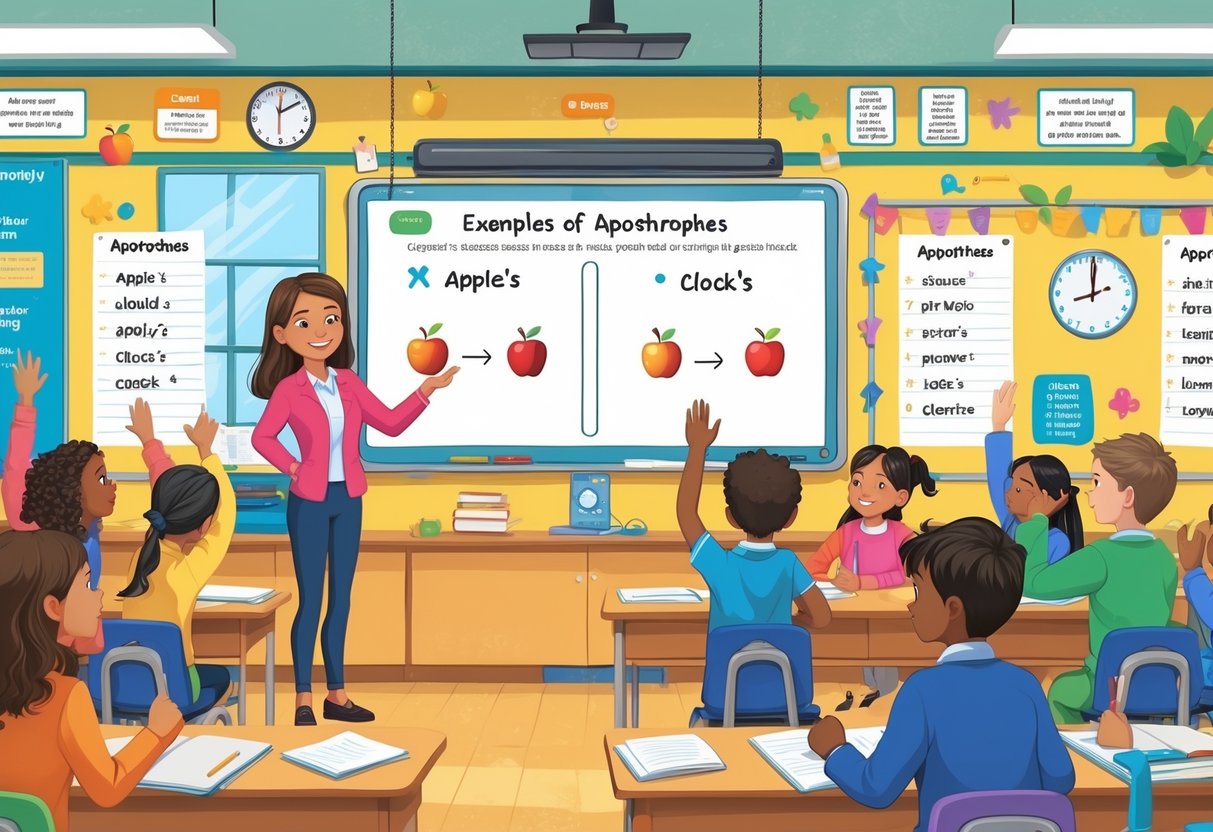
Students often add apostrophes to regular plurals with no possession. “Apple’s for sale” instead of “apples for sale” pops up a lot. The apostrophe only belongs when something is owned, like “the apples’ colour”.
Another common error is writing “the childrens’ toys” instead of “the children’s toys”. They forget that irregular plurals need the apostrophe before the ‘s’.
You can help students by asking two things. Does the word show ownership? Does the plural already end in ‘s’? These questions usually point them in the right direction.
Effective Apostrophe Activities
Apostrophe worksheets give structured practice for contraction and possession. Interactive games let children use these punctuation skills in a way that feels fun and a bit less formal.
Apostrophe Worksheets
Apostrophe worksheets give your pupils targeted practice with both omission and possession.
Start with simple contractions such as ‘do not’ becoming ‘don’t’. Move on to possession with singular nouns.
Your Year 4 pupils need to see that ‘the girl’s bag’ means one girl owns the bag, while ‘the girls’ bags’ means several girls own bags.
Look for worksheets that include common mistakes children make.
Many pupils add apostrophes to plural nouns by mistake or get stuck with irregular plurals like ‘children’s’ and ‘women’s’. Worksheets that point out these errors help your class avoid them in their writing.
Choose resources that fit your pupils’ current understanding.
Some worksheets focus just on contractions, which work well for younger learners. Others combine both types of apostrophes for more confident writers.
Apostrophes Game
Interactive games make apostrophe practice more enjoyable for your class.
An apostrophes game where children sort words into contraction and possession categories lets them see the difference in context.
Include examples that show common errors, like its versus it’s, which the National Curriculum expects Year 5 and 6 pupils to master.
LearningMole offers free video resources that show apostrophe rules through visual examples. This really helps children who struggle with written explanations.
Review and Reinforcement Strategies
Regular quick quizzes help you spot which children need extra support.
A test practice resource with different levels lets you match questions to each pupil’s understanding.
Use a mix of written exercises and verbal checks throughout the week.
Ask children to explain why they’ve placed an apostrophe in a particular spot. This shows if they truly understand the rule or are just guessing.
Display an apostrophe checklist in your classroom with questions like “Am I showing ownership?” or “Am I joining two words together?”
Children can use this when editing their writing across all subjects, not just English lessons.
Addressing Common Apostrophe Mistakes
https://www.youtube.com/watch?v=ji-FLfVbYi0
Students often struggle with apostrophes in two main areas: putting them in the wrong place within words and mixing up contractions with possessive pronouns.
You can adapt apostrophe lessons by offering different types of support for each ability level. Try making three versions of worksheets: one with sentence starters and visual prompts for those who need extra help, one with standard practice, and one with complex sentences for confident learners.
Use colour coding to help visual learners spot the difference between possession and contraction. Red cards can show contractions, and blue cards can show possession. This approach helps make grammar rules feel more concrete.
Let students work in pairs, matching stronger students with those who need support. Rotate these pairs often so everyone gets a chance to learn from different partners. You could use loop cards and games that let students pick their own level of challenge.
Physical activities suit kinesthetic learners. Give students apostrophe cards to place between letters on big word cards set up around the classroom.
Encouraging Independent Learning
Set up an apostrophe reference station in your classroom. Posters with clear rules, examples, and common mistakes help, and a laminated checklist lets students review their writing before handing it in.
LearningMole has free grammar videos that students can watch on their own or at home. These short videos back up what you teach in class.
Try self-marking digital activities using interactive whiteboards or tablets. Immediate feedback helps students learn from their mistakes right away. You might also set up a peer review system where students check each other’s apostrophe use using a simple rubric with tick boxes for possession, contraction, and correct placement.
Frequently Asked Questions
Teachers often look for apostrophe resources that actually work in their classrooms. Here are answers to some of the most common questions about teaching this punctuation mark to KS2 pupils.
Where can I find free worksheets on apostrophes suitable for KS2 pupils?
You can get free apostrophe worksheets from Twinkl. The resource pack includes games, loop cards, and PowerPoint presentations by teachers. It covers apostrophes for possession, contractions, and plural forms from Years 3 to 6.
BBC Bitesize has free online articles that explain how to use apostrophes for contraction and possession. These work well for independent learning or homework.
Classroom Secrets offers differentiated test practice across four levels. You can match worksheets to your pupils’ current understanding.
How can I teach possessive apostrophes effectively to Year 5 students?
Start with the basic rule. Add an apostrophe before the ‘s’ for singular nouns to show possession, like “the cat’s mat.” Once pupils understand this, move on to plural possessives where the apostrophe comes after the ‘s’, such as “the cats’ mat.”
Use real examples from your classroom. Mention things like “the teacher’s desk” or “the pupils’ coats” to show the difference between singular and plural possession.
Interactive games help Year 5 students practise these skills without pressure. Wordwall has apostrophe activities, including group sorts and quizzes, and these work for both whole-class and small-group teaching.
Are there any downloadable resources to explain apostrophes for contraction and possession?
The Apostrophes Resource Pack from Twinkl has materials covering both contraction and possession. Download the folder, unzip the files, and print what you need for your lessons.
Teacher of English has a SPaG resource with a 20-slide PowerPoint that explains omission and possession rules. The pack also includes common mistakes, an interactive game, and worksheets.
These packs let you prepare lessons ahead of time and use materials across different year groups. Many resources include answer sheets to make marking faster.
Could you recommend any comprehensive apostrophe worksheets that come with answers for KS2 educators?
LearningMole provides curriculum-aligned resources for KS2 English. Their punctuation teaching materials come with clear explanations, and the platform includes both free and subscription content made with input from experienced primary teachers.
The differentiated worksheet pack from Classroom Secrets includes answers and works for all KS2 year groups. The multiple-choice format makes these worksheets handy for assessment.
Choose resources that separate possession and contraction worksheets at first. Pupils can master one idea before moving on to both.
What’s a good way to introduce the concept of apostrophes in a KS2 classroom setting?
Begin with contractions. Pupils already use these in daily speech. Show how “do not” becomes “don’t” and “cannot” becomes “can’t”, pointing out that the apostrophe marks where letters have been removed.
Teaching resources with high street signs can show that even adults get apostrophes wrong. This helps pupils feel less anxious about mistakes.
Put up visual displays showing the three main uses: possession, contraction, and making plurals of lowercase letters. Keep these posters on your classroom wall for students to check during their writing.
Can you suggest any interactive apostrophes teaching activities for KS2 students?
Punctuation activities for KS2 usually work best when you mix games, worksheets, and hands-on tasks. This way, learning about apostrophes feels a lot more fun and a bit less like a chore.
Try using loop cards. Pupils each get a card and search for the classmate with the matching apostrophe rule or example. They end up talking about where the apostrophe should go, which really helps it stick.
Check out the Year 6 English lesson on apostrophes and speech punctuation for revision activities you can tweak for your own class. Group sorting activities let pupils separate examples of possessive apostrophes from apostrophes used in contractions.
Maths Circus, an innovative platform we've crafted, presents a captivating realm where children learn mathematics through the exciting theme of a circus. The joy of juggling numbers and solving circus...
The 9 times table multiplication has a reputation for being tricky, yet it holds more mathematical magic than any other table in the primary curriculum. Every answer follows two neat...
Article Summary What this article covers: Ten differences between river otters and sea otters, from size, fur and swimming style to diet, tool use and family life, plus which otter...
Article Summary What this article covers: The nine main types of natural disasters, how each one works and how they are measured, which hazards genuinely affect the UK, and how...






Leave a Reply