Apollo turns up more often than almost any other god in a Key Stage 2 Ancient Greece topic, and he is usually the one children find hardest to pin down. Zeus has his thunderbolt. Poseidon has the sea. Apollo has music, poetry, archery, prophecy, healing, disease and light, all at once. Ask a Year 4 class what he was the god of and you will get six different answers, and most of them will be right.
That range is the point. Apollo sat at the centre of Greek daily life in a way that a single-job god never could, and understanding him gives children a way into Greek religion, Greek politics and Greek storytelling at the same time. This guide sets out who Apollo was, retells five of his best-known myths in language suited to Years 3 to 6, and shows where his name still surfaces in British life today.
If you are planning a unit and want ready-made material alongside it, you can browse our teaching resources for curriculum-linked history and literacy support. LearningMole is a UK educational platform producing curriculum-aligned videos and materials for children aged 4 to 11, and everything on the site is free to use.
The National Curriculum asks Key Stage 2 pupils to study Ancient Greece, Greek life and achievements, and the influence of Greece on the western world. Apollo answers all three parts of that requirement. The Greeks did not treat him as a character in a storybook. They consulted him before going to war, blamed him for outbreaks of illness, and competed in games held in his honour, which makes him a useful way of showing children the difference between a myth and a living religion.
Apollo KS2 Fact File: Domains, Symbols and Family
Apollo was one of the twelve Olympian gods, the son of Zeus and the Titaness Leto, and the twin brother of Artemis. His Roman name stayed the same, which is unusual among the major gods and worth pointing out to children who have already met Zeus as Jupiter.
At a Glance: Who Was Apollo?
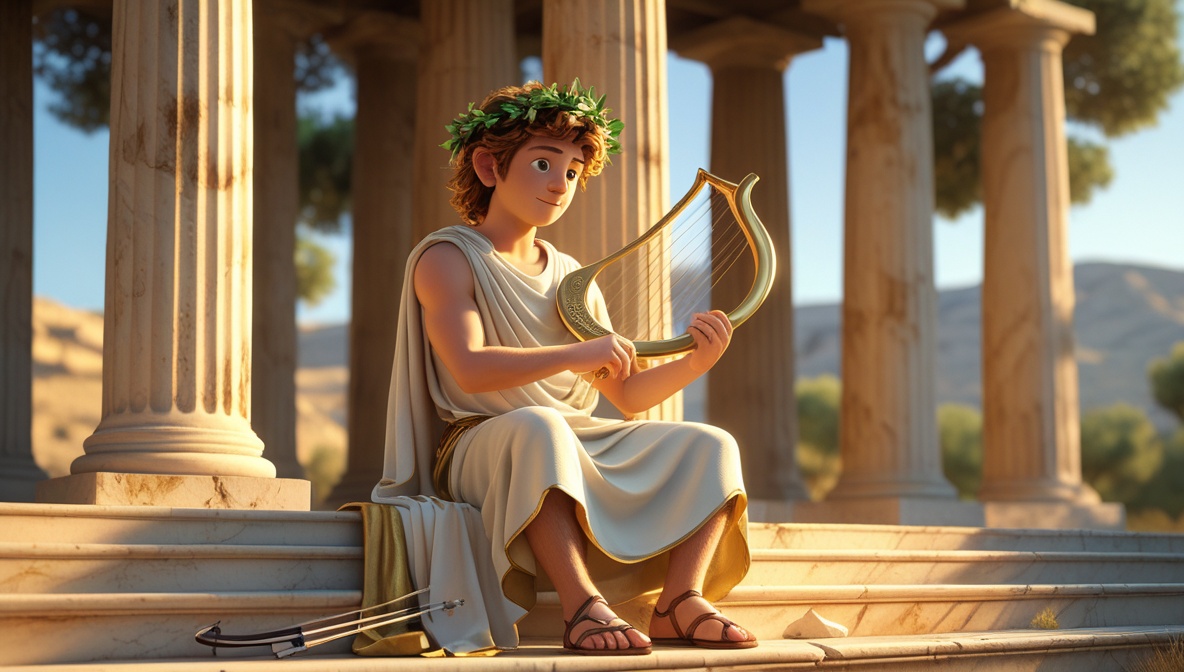
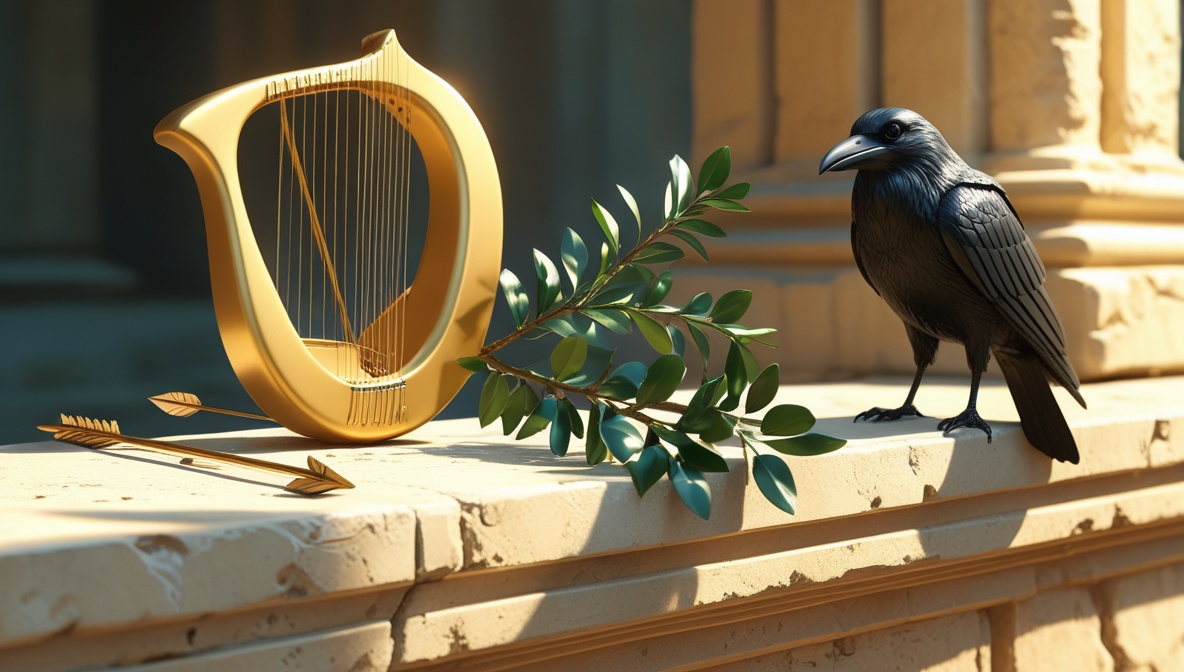
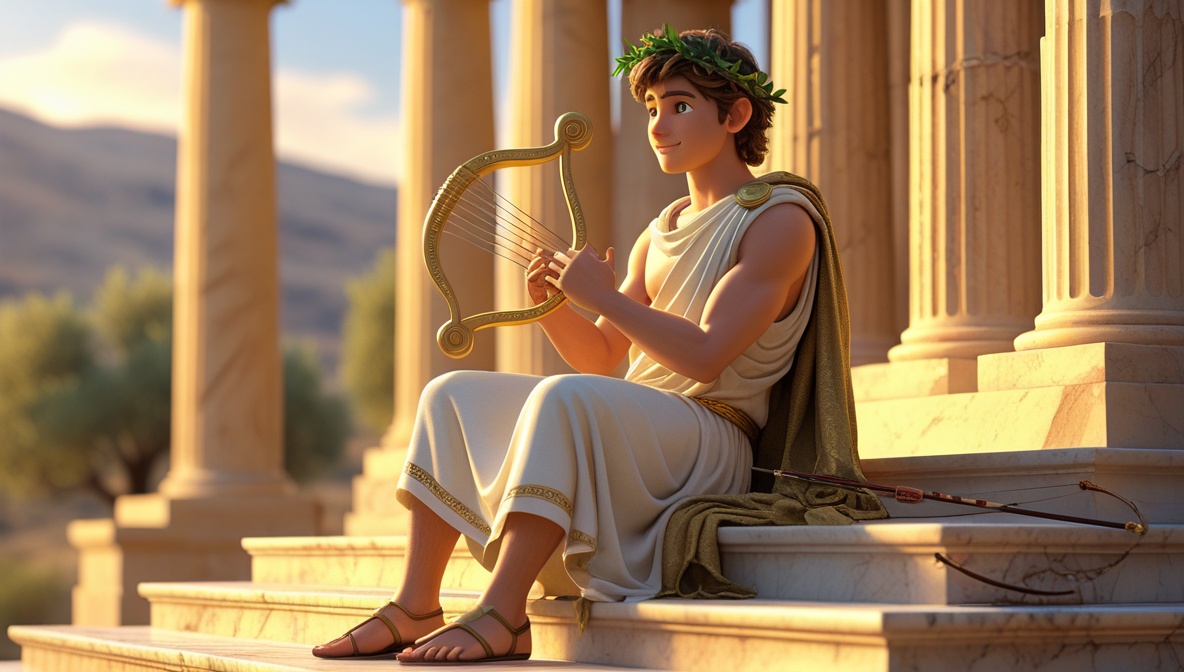
He was worshipped as the god of music and poetry, of archery, of prophecy, of healing, and of light. The Greeks also believed he sent plague, firing arrows of sickness into a city that had offended him, so he was both the cause and the cure. That double role confuses children at first and requires a few minutes of discussion. Apollo is often shown in art holding a golden lyre or a silver bow, and later Greek and Roman writers linked him with the sun, although the older sun god was the Titan Helios.
Three words are worth teaching directly as historical vocabulary before you start the myths: pantheon (the full group of gods a people worshipped), oracle (a holy place where a god answered questions, or the priest who gave the answer), and sanctuary (a protected sacred site). Children who hold these terms confidently will write far more precisely about Greek religion. The LearningMole guide to the ancient Greek gods covers the wider pantheon if you want to place Apollo alongside his relatives first.
Sacred Symbols, Plants and Animals
Attribute
Greek detail
What it meant to the Greeks
Where you can still see it
Areas of power
Music, archery, prophecy, healing, light, plague
A god who governed both order and sudden disaster
The word “Apollonian” for calm, ordered beauty
Main symbols
Golden lyre, silver bow and arrows
Harmony and precision, the two things Greeks admired most in art and warfare
Lyre shapes on classical buildings and orchestral crests
Sacred plant
The laurel (bay) tree
Victory, honour and poetic skill
The laurel wreath, and the title Poet Laureate
Sacred animals
Raven, wolf, dolphin
Prophecy, wildness and safe passage at sea
Dolphin carvings on Greek temple ruins
Roman name
Apollo (unchanged), sometimes Phoebus Apollo
Light and brightness
NASA’s Apollo missions to the Moon
Chief sanctuary
Delphi, on the slopes of Mount Parnassus
The place Greeks believed was the centre of the world
The archaeological site visited by tourists today
Why Was Apollo Central to Ancient Greek Life?
Because Greek city-states made real political decisions on his say-so. This is the single point that separates a solid KS2 history lesson from a set of bedtime stories, and it is the one most fact-file websites skip entirely.
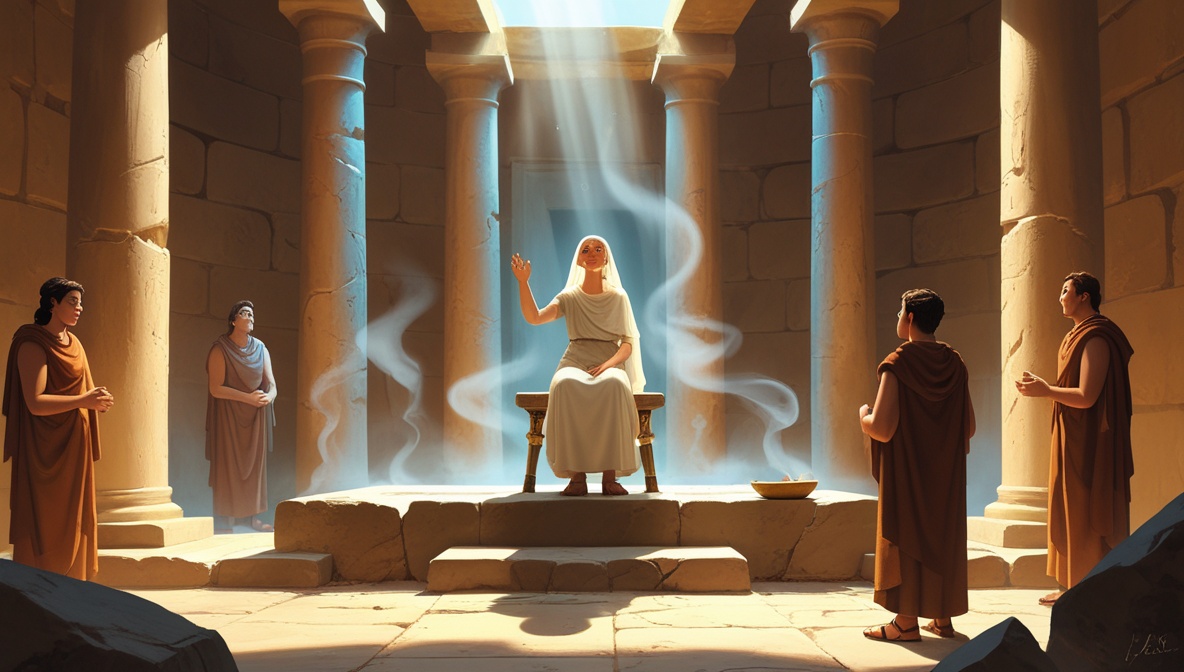
At Delphi, a priestess called the Pythia sat in Apollo’s temple and answered questions put to her by visitors. Ordinary farmers asked about marriages and harvests. Kings and city leaders asked far bigger questions. Athens and Sparta both sent messengers to Delphi before major wars, and the answers they received, usually riddling and open to more than one reading, shaped what they did next.
The historian Herodotus records that when Athens faced the Persian invasion, the advice from Delphi spoke of a wooden wall, and the Athenians argued bitterly over whether that meant a fence around the Acropolis or their fleet of ships. They chose the ships.
Apollo also had festivals and games attached to his name. The Pythian Games at Delphi ran every four years and, unlike the Olympics, included competitions in music and poetry as well as athletics. Sick people travelled to his sanctuaries hoping to be cured. Children find it striking that a god of music was also the god you prayed to when your village fell ill.
Worth saying plainly to a class: the Greeks were not being silly. They had a settled, organised religion with buildings, priests, calendars and taxes, and Apollo was one of its most important figures. Treating Greek belief as a set of superstitions gets in the way of understanding how the society actually worked.
Five Apollo Myths Retold for KS2
These five stories cover the myths Key Stage 2 pupils are most likely to meet, and each one carries a theme you can pull straight into English lessons. Read them aloud first, then use the matrix at the end of this section for planning.
1. The Birth on Delos
Leto was expecting twins, and Hera, the wife of Zeus, was furious about it. She declared that no land anywhere should give Leto a place to rest. Leto walked and walked, turned away from every shore, until she came to Delos, a small rocky island that drifted on the sea and so was not properly land at all. Delos took her in. Artemis was born first, and then Apollo, and the story says the whole island burst into gold at the moment of his birth. Grateful, the twins fixed Delos in place so it would never drift again.
Lesson for the Greeks: perseverance, and the idea that kindness offered by the smallest and poorest is repaid. Delos became one of the holiest sites in the Greek world, which is a neat example of a myth explaining why a real place mattered.
2. Apollo and Python: Slaying the Serpent and Founding Delphi
A monstrous serpent called Python guarded a cleft in the rock at the foot of Mount Parnassus. Python had hunted Leto while she wandered, and Apollo, still very young, took his silver bow and went after it. He tracked the serpent to its cave and killed it. On that spot he founded his temple, and the priestess who spoke his answers there took the name Pythia in memory of the creature. The Pythian Games were held nearby to mark the victory.
Lesson for the Greeks: even a god must answer for violence. Some versions have Zeus sending Apollo away from Olympus for a period of service afterwards, which teaches children that consequences apply to everyone in a story, not just the villain.
Geography link: Mount Parnassus is a real limestone mountain in central Greece, and the Delphi site sits on a steep terrace above a deep valley. A map task comparing Delos, Delphi and Athens works well here.
3. The Cattle Thief: When Apollo Met Baby Hermes
This one gets laughs every time. Hermes was born in the morning, climbed out of his cradle by lunchtime, and by nightfall had stolen fifty of Apollo’s cattle, walking them backwards so their hoofprints pointed the wrong way. When Apollo tracked him down, Hermes was tucked up in his blankets pretending to be a helpless newborn. Apollo hauled him to Zeus, who laughed and told Hermes to hand the cattle back. Then Hermes produced something he had made from a tortoise shell and some strings: the first lyre. Apollo heard one note, forgot about the cattle entirely, and traded the whole herd for the instrument.
Lesson for the Greeks: cleverness can beat strength, and a fair exchange settles a quarrel better than a punishment. The dialogue between a furious older brother and a baby who will not stop lying is excellent modelling material for Year 5 and 6 speech punctuation.
4. Apollo and Daphne: The Origin of the Laurel Wreath
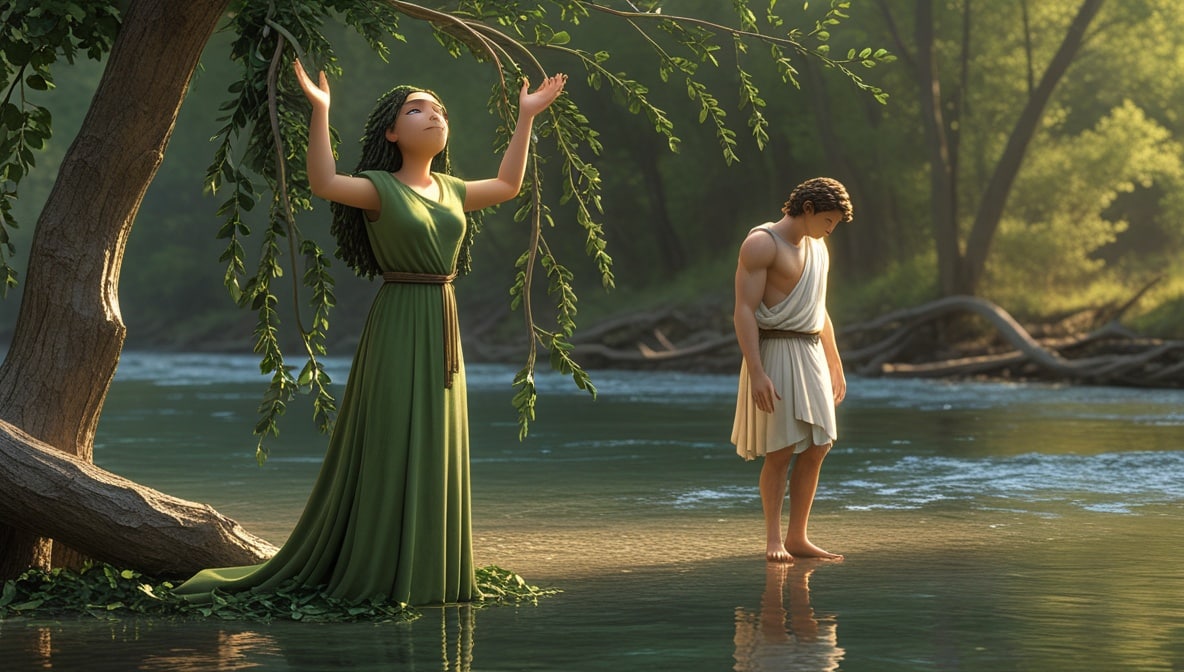
Apollo, fresh from killing Python, mocked the young god Eros for carrying a bow he was too small to use properly. Eros answered with two arrows. The golden one struck Apollo and filled him with longing. The lead one struck a river nymph named Daphne and filled her with a determination to stay free, unmarried and among her trees. Apollo followed her; Daphne ran, and ran, and finally called out to her father, the river god Peneus, for help. He answered by turning her into a laurel tree. Apollo, grieving, declared the laurel his own sacred plant and said its leaves would crown every victor and every great poet from then on.
Lesson for the Greeks: pride invites trouble, and Daphne’s wish to stay free and close to the natural world is respected by the story rather than punished by it. Frame the myth around Eros’s trickery and Apollo’s boastfulness, and keep the focus on the transformation and on where laurel wreaths come from. That connection is the payoff: Roman generals wore laurel, Olympic victors wore laurel, and Britain’s Poet Laureate carries the same word today.
5. King Midas and the Musical Contest
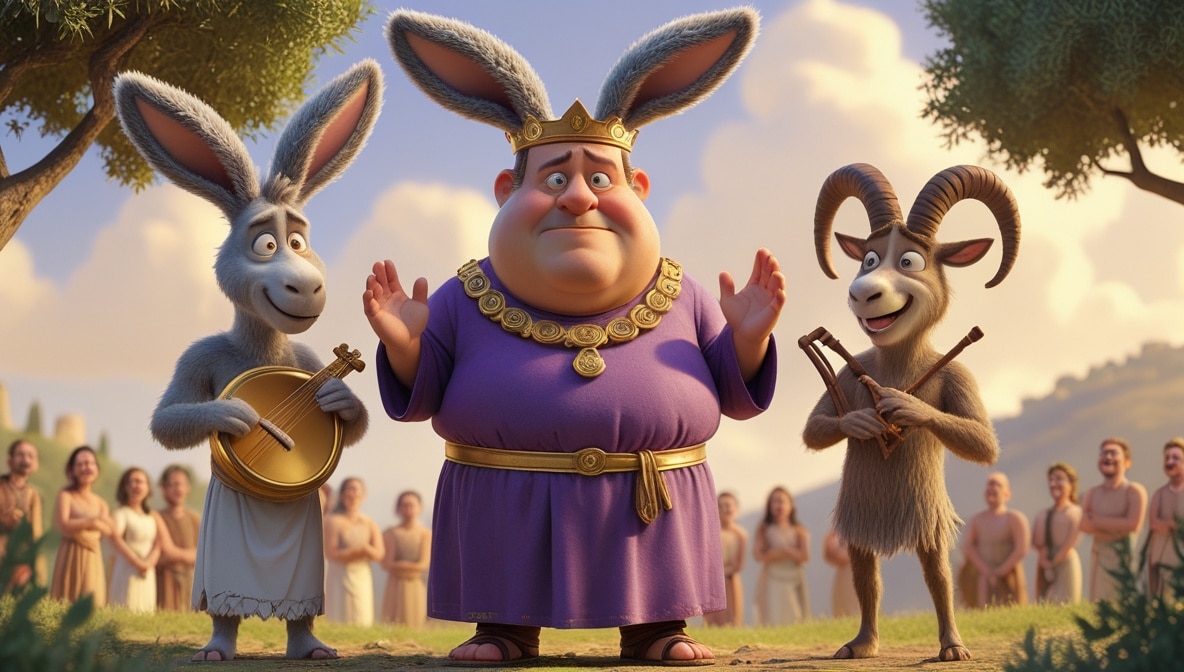
Pan, the goat-legged god of shepherds, claimed his reed pipes made better music than Apollo’s lyre. A contest was arranged, judged by Tmolus, the god of the mountain. Pan played a rough, cheerful tune. Apollo played the lyre and sang, and the trees stopped rustling to listen. Tmolus declared Apollo the winner, and everyone agreed except King Midas, who announced loudly that Pan should have won. Apollo touched the king’s head, and Midas’s ears stretched out long, grey and furry. Donkey’s ears. Midas spent the rest of his life in a tall hat.
Lesson for the Greeks: speak carelessly about people more powerful than you and expect consequences. It is also a story about the difference between having an opinion and having judgement, which is a genuinely useful distinction for Year 6 debate work.
“In Key Stage 2 writing, children often produce heroes who are good at everything and never put a foot wrong. Apollo fixes that. He is brilliant and generous one moment and proud and reckless the next, so children can finally see what a complicated character looks like on the page, and then write one themselves.”
Michelle Connolly, LearningMole founder, has over 15 years of experience as a primary school teacher.
KS2 Myth Matrix: Themes and Curriculum Hooks
Myth
Core theme
KS2 curriculum hook
The Birth on Delos
Perseverance; kindness repaid
Setting description; sequencing a journey on a map
Apollo and Python
Courage and consequence
Diary entry from Apollo during his exile
Apollo and Hermes
Cleverness over strength
Dialogue and speech punctuation; character contrast
Apollo and Daphne
Pride; respect for the natural world
Origin-story writing; explaining a symbol
Midas and the Contest
Fairness and foolish boasting
Persuasive debate: who should have won?
Apollo’s Modern Legacy: From Ancient Greece to Today
Apollo’s name and symbols survive in British life far more visibly than most Greek gods, which makes him the obvious choice when the curriculum asks about Greek influence on the Western world.
The Apollo space programme. When NASA needed a name for the project that would carry astronauts beyond Earth orbit, it chose the god of light and of the chariot that crossed the sky. Apollo 11 landed on the Moon on 20 July 1969. Six missions landed in total, and twelve people walked on the lunar surface, the last of them on Apollo 17 in December 1972. Between them, they brought back roughly 382 kilograms of rock, dust and core samples, which showed that Moon rock is chemically related to Earth rock and supported the theory that the Moon formed after a very large object struck the early Earth.
The snake on the ambulance. Look at the side of a UK ambulance or the badge of a medical organisation, and you will usually find a staff with a single snake coiled round it. That is the Rod of Asclepius. Asclepius was Apollo’s son, a healer so skilled that the Greeks worshipped him too. A useful correction for children and teachers alike: the two-snake staff with wings often used in films is the caduceus, and it belonged to Hermes, god of messengers and thieves. Different god, different meaning.
The Poet Laureate. The word “laureate” comes from the laurel that Daphne became. Britain’s Poet Laureate holds a role created in the seventeenth century, and the title carries Apollo’s sacred tree inside it every time it is used. Olympic wreaths, the laurel on some coins and crests, and the phrase “resting on your laurels” all trace back to the same story.
KS2 Classroom and Home Learning Activities
Two activities that work with minimal preparation and cover History, English and Art.
The Delphic Oracle Dilemma Desk. Put children in pairs. One is a Greek citizen arriving at Delphi with a genuine historical problem: should Athens build more warships, should our city send help to an ally, should we plant early this year? The other is the Pythia, who must answer in a short riddle that could be read two ways. Afterwards, discuss what happened when the answers were misread. This is the quickest way to show a class why the Oracle held real political power rather than being a piece of decoration.
Design a Modern Laurel Wreath. Pupils choose someone they think deserves honouring: a scientist, an author, a nurse, a local athlete. They then design a crown using symbols that fit that person’s achievement instead of laurel leaves, and write a short label explaining each choice. It ties the Daphne myth to a piece of Art and Design work and gives children a reason to think about what a symbol actually does.
At home, parents can extend the topic without any special materials. Retelling one myth at bedtime and asking a child to spot who behaved badly and why is a reading comprehension exercise in everything but name. LearningMole’s Ancient Greeks resources for children cover daily life, clothing and schooling if a child wants to keep going.
Teaching Resources and Support
LearningMole provides free, curriculum-aligned videos and written material covering Ancient Greece for Key Stage 2, including short animations on Greek gods, Greek worship and daily life in the Greek world. The videos work well as a starter before a reading lesson or as revision at the end of a unit, and they give visual and auditory learners a route into a topic that is otherwise heavily text-based.
For teachers, the Ancient Greece material sits alongside wider history and literacy support across the site, all of it mapped to the National Curriculum and written by people who have taught these lessons. LearningMole was founded by a former primary school teacher, and the Key Stage 2 material reflects what actually works in a classroom rather than what reads well on a planning document. For parents and home educators, the same videos work without any preparation at all. Every resource on LearningMole is free, and you can also watch the full collection on our YouTube channel.
Apollo was the god of music and poetry, archery, prophecy, healing and light. The Greeks also believed he sent plague when angered, so he was worshipped both as a bringer of illness and as its cure. This combination is unusual among the Olympians and is one reason he appeared in so many different parts of Greek life.
Why did Apollo chase Daphne, and why is this story taught in schools?
Apollo had mocked Eros for being too small to use a bow properly. Eros retaliated with two arrows: a golden one that filled Apollo with longing, and a lead one that made Daphne determined to stay free and live among her trees. Apollo pursued her, and Daphne asked her father, the river god Peneus, to save her. He turned her into a laurel tree. Schools teach it because it explains the origin of the laurel wreath, a symbol still used for victory and for poetry, and because it gives children a clear example of pride bringing trouble on the person who shows it.
Did Apollo invent the lyre?
No. His younger brother Hermes made the first lyre from a tortoise shell on the day he was born. Apollo traded fifty cattle for it and became so associated with the instrument that many people assume it was his invention.
Is Apollo suitable for Key Stage 1, or is he strictly a KS2 topic?
Key Stage 1 children can happily learn that Apollo was a Greek god of music who played a lyre and carried a bow, and a simple version of the Hermes and the cattle story works well with Year 1 and 2. The fuller material sits in Key Stage 2. Ancient Greece appears in the National Curriculum at KS2, and the themes in Apollo’s myths- prophecy, exile, unreturned love and the misuse of power, need the reading maturity of Years 3 to 6 to be discussed properly.
What is the difference between Apollo in Greek and Roman mythology?
Very little in name, which makes him unusual. Most Olympians were renamed by the Romans, but Apollo kept his Greek name. Roman writers leaned harder on his connection to the sun and treated him as a protector of the state, particularly under the emperor Augustus.
What was the Oracle at Delphi?
The Oracle was the answer given by Apollo through his priestess, the Pythia, at his temple in Delphi. Visitors asked a question, and she replied with words that were usually short and ambiguous. Greek leaders consulted the Oracle before wars, colonisations and major building projects, which is why Delphi became one of the wealthiest and most influential sites in the Greek world.
Where can I find lesson material for teaching Apollo and Greek myths?
LearningMole holds free Ancient Greece videos and supporting material aimed at Years 3 to 6, covering the Greek gods, Greek worship and daily life. All of it is mapped to the National Curriculum and available without payment, and the videos can also be watched on the LearningMole YouTube channel.
Bringing Apollo into Your Ancient Greece Topic
Apollo rewards a longer look than most fact files give him. His stories are short enough to read aloud in a single session, varied enough to cover comedy, tragedy and adventure in one unit, and connected tightly enough to real Greek places that children can put a pin in a map for every myth they read. Delos, Delphi, Mount Parnassus: these are not invented settings.
The strongest teaching angle is usually his inconsistency. Children arrive expecting gods to be straightforwardly good or straightforwardly wicked, and Apollo is neither. He grieves for Daphne and honours her for the rest of time. He also gives a king donkey’s ears for disagreeing with a music judge. Sitting with that contradiction is good practice for the inference work the KS2 English curriculum asks for, and it produces far better creative writing than a hero who wins everything.
Once children have met Apollo properly, the rest of the Greek pantheon becomes easier to teach, because they already understand the important thing: the Greeks believed these figures were real, present and capable of interfering in an ordinary afternoon. Everything else, the temples, the festivals, the ships sent to Delphi for advice, follows from that. Free Ancient Greece videos and teaching material for Years 3 to 6 are available across the LearningMole site whenever you want to take the topic further.
Maths Circus, an innovative platform we've crafted, presents a captivating realm where children learn mathematics through the exciting theme of a circus. The joy of juggling numbers and solving circus...
Mexican traditions blend the customs of ancient Mesoamerican peoples, such as the Aztecs and the Maya, with Catholic festivals brought by Spanish settlers in the sixteenth century. The result is...
The moose (Alces alces) is the largest member of the deer family alive today, and a fully grown bull can stand about 2 metres tall at the shoulder, which makes...






Leave a Reply