What this article covers: Ten practical activities for teaching global issues in schools, from news analysis and United Nations simulations to trade games, storytelling and community action projects, with guidance on age-appropriate discussion, curriculum links in the UK and assessing global learning.
Who this is for: Primary and KS3 teachers planning lessons on climate change, poverty, human rights, trade and global citizenship, and parents and carers who want to talk about world events with their children at home.
Key takeaway: Teaching global issues works best through active, age-appropriate activities that connect world problems to pupils’ own lives, present balanced viewpoints and end with something pupils can do, so that learning builds understanding and hope.
Expert view: ‘When children understand global challenges, they develop empathy and problem-solving skills that extend far beyond the classroom walls.’ Michelle Connolly, Founder of LearningMole and former teacher with over 15 years of classroom experience
Quick facts:
The 17 Sustainable Development Goals, agreed by all United Nations member states in 2015, give teachers a ready-made framework for global issues such as poverty, hunger, climate and equality.
Global issues link to KS2 geography, PSHE and citizenship in England, and to global citizenship themes in the curricula of Wales, Scotland and Northern Ireland.
Schools in England must present balanced views when political issues are discussed, so the best global issues activities explore more than one perspective.
Teaching global issues in the classroom helps pupils understand important world problems while building their critical thinking skills. Climate change, poverty, migration, conflict and inequality can feel distant and abstract to children, but the right activities turn them into lessons pupils remember, and help young people grow into informed, caring citizens of an interconnected world. In the UK, global issues sit naturally within geography, PSHE, citizenship and English, so they can be taught without adding a new subject to the National Curriculum.
Bringing global perspectives into your teaching does not require a complete curriculum overhaul. Simple activities like role-play, current events discussions and exchanges with schools in other countries can make global issues relevant and engaging for pupils of all ages. This guide sets out ten activities for teaching global issues in primary schools and at KS3, with tips on keeping discussions balanced and age-appropriate. For an overview of the issues themselves, LearningMole’s guide to global issues for primary students explains each topic in child-friendly language.
Why teaching global issues matters
Teaching global issues prepares pupils for an interconnected world and develops skills they need for life, including critical thinking, empathy and the confidence to act. It also helps children make sense of news and events they already hear about at home and online.
Building global awareness and citizenship
When you teach global issues, you help pupils see beyond their immediate surroundings and understand their place in the wider world. This awareness is the foundation of global citizenship, which means recognising that people in different countries share responsibilities and that local actions can have global effects.
Pupils who explore global topics often show more interest in cultural diversity, human rights and fairness, environmental sustainability and international cooperation. The classroom becomes a starting point for future citizens who understand how their choices connect to people and places far away.
Developing critical thinking and empathy
Global issues rarely have simple solutions, which makes them ideal for developing analytical skills. When you guide discussions on topics such as climate change or inequality, you teach pupils to weigh evidence, consider several viewpoints and form their own reasoned opinions.
This approach builds empathy as well as critical thinking. Pupils learn to consider how the same issue affects communities differently and develop compassion for people whose experiences differ from their own. Activities that examine global challenges help pupils question assumptions, analyse information carefully, consider what is fair and build arguments based on evidence.
The 10 activities at a glance
The table summarises the ten activities in this guide, so teachers can choose one that fits their class, time and topic. Every activity can be adapted for younger or older pupils.
Activity
Best for
Time
Global issues it suits
Main skills
1. Global news time
Year 3 to KS3
10 to 15 minutes
Any current issue
Media literacy, discussion
2. United Nations simulation
Year 5 to KS3
Two or three lessons
Climate change, refugees, health
Debate, research, diplomacy
3. Global trade game
Year 4 to KS3
One lesson
Trade, poverty, fair trade
Economics, negotiation
4. Rights detectives
Year 2 to KS3
One lesson
Children’s rights, equality
Reasoning, empathy
5. Personal stories and guest speakers
KS1 to KS3
30 to 60 minutes
Migration, culture, conflict
Listening, empathy
6. Living museum of history
Year 4 to KS3
Two lessons
Migration, empire, conflict
Research, perspective-taking
7. Product journey
Year 3 to KS3
One lesson
Globalisation, trade, environment
Mapping, systems thinking
8. Cultural perspectives
KS1 to KS2
20 to 30 minutes
Culture and diversity
Respect, comparison
9. Sustainable Development Goals action project
Year 4 to KS3
Half a term
Any of the 17 goals
Teamwork, problem-solving
10. Virtual exchange and field trips
KS2 to KS3
One lesson upwards
Any issue
Communication, curiosity
Activities using current events
Current events connect classroom learning with the real world and show pupils that global issues are happening now. Short, regular news activities build media literacy and confidence in discussing complex topics.
1. Global news time
Global news time is a short, regular slot where pupils share and analyse a news story about a global issue. Set aside 10 to 15 minutes at the start of certain lessons, choose age-appropriate articles from reliable sources, or ask pupils to bring stories they have found.
Teach pupils to separate facts from opinions, spot bias and judge whether a source is reliable. This simple framework works for most age groups:
Who created this news, and who is affected by it?
What facts are presented, and what opinions?
Why was this story published, and why should we care?
How might people in different places see this issue?
Older pupils can compare how two news outlets cover the same event, which shows how framing and perspective shape reporting. Use think-pair-share so quieter pupils have time to prepare before speaking, and try discussion starters such as ‘How might this event affect people in different parts of the world?’ and ‘What could help solve this problem?’ A classroom news board, where pupils pin up global stories that interest them, keeps global awareness visible all year.
Role-play and simulation activities
Role-play helps pupils understand global issues by stepping into other people’s shoes. Simulations turn abstract systems, such as international decision-making or world trade, into experiences pupils can feel and discuss.
2. United Nations simulation
A United Nations simulation is a mini General Assembly in which pupils represent different countries and debate a global issue, such as climate change or helping refugees. Assign each pupil or pair a country to research, including its position on the issue, its economy and its neighbours. Give younger pupils a simple briefing card for their country.
Set clear debate rules that suit the age group. A simple structure might be a two-minute opening statement from each country, a five-minute discussion and a one-minute closing statement, followed by a vote on a resolution. Role cards with sentence starters, such as ‘Our country believes…’ and ‘We would agree if…’, help every pupil take part. The activity can run over several lessons and works especially well with upper KS2 and KS3 classes.
3. Global trade game
The global trade game shows pupils how countries depend on each other for resources and goods. Divide the class into country groups and give each group different resources, such as coloured paper, scissors, rulers and glue, along with a list of shapes they need to make and sell.
Make some groups resource-rich and others resource-poor. The game runs in four phases: groups assess their resources, trade with other groups, produce their shapes and then reflect on the results. Add events such as a trade barrier or a flood that destroys one group’s supplies to show how world events affect supply chains and why some goods become expensive or scarce.
Afterwards, discuss which groups did well and why, and whether the outcome was fair. You can extend the activity by introducing fair trade, sustainability and workers’ rights, which link well to Fairtrade Fortnight each spring.
4. Rights detectives
Rights detectives is a primary-friendly way to explore justice and fairness around the world. Pupils study a simplified version of the United Nations Convention on the Rights of the Child, which the UK ratified in 1991, and match each right to pictures or short scenarios from different countries.
Older pupils can work with the Universal Declaration of Human Rights, adopted by the United Nations in 1948, and hold a mock tribunal in which groups argue different sides of a case about fairness. A resource distribution activity, where sweets or counters are shared out unequally and pupils discuss what is fair, makes inequality concrete for younger children.
Choose cases that suit your pupils’ age. Younger pupils can focus on fairness in everyday contexts such as school, food and play, while older pupils can tackle more complex questions about equality and justice.
Storytelling and empathy activities
Storytelling builds empathy by connecting global issues to real people. Personal stories and historical narratives help pupils understand that statistics and headlines describe the lives of individuals and families.
5. Personal stories and guest speakers
Personal stories create an immediate emotional connection with global issues. Invite guest speakers with experience of other countries, such as parents, community members or charity volunteers, to share their stories in person or by video call, and give pupils time to prepare questions in advance.
‘When children understand global challenges, they develop empathy and problem-solving skills that extend far beyond the classroom walls,’ says Michelle Connolly, Founder of LearningMole and former teacher with over 15 years of classroom experience.
Other ways to bring personal stories into the classroom include story exchanges with partner schools in other countries, interviews with family members who have lived abroad and reading circles built around age-appropriate books written by or about young people from different parts of the world. These activities help pupils recognise a shared humanity while appreciating cultural differences.
6. Living museum of history
Historical narratives give context to today’s global challenges, showing how past events shape issues such as migration, conflict and inequality. In a living museum, pupils research a historical event, then take on the role of a person affected by it and present their story to visitors from another class.
Include several perspectives on the same event. When studying the British Empire, for example, pupils can present the views of people in Britain and of people in the countries that were colonised. Historical fiction and first-hand accounts help pupils see the people behind the dates, and combining research with role-play develops both critical thinking and empathy.
Activities on global communities and interconnectedness
Activities about global communities help pupils understand how people around the world are connected through culture, trade and the environment. They work well with younger pupils, because they start from familiar things such as food, clothes and celebrations.
7. Product journey
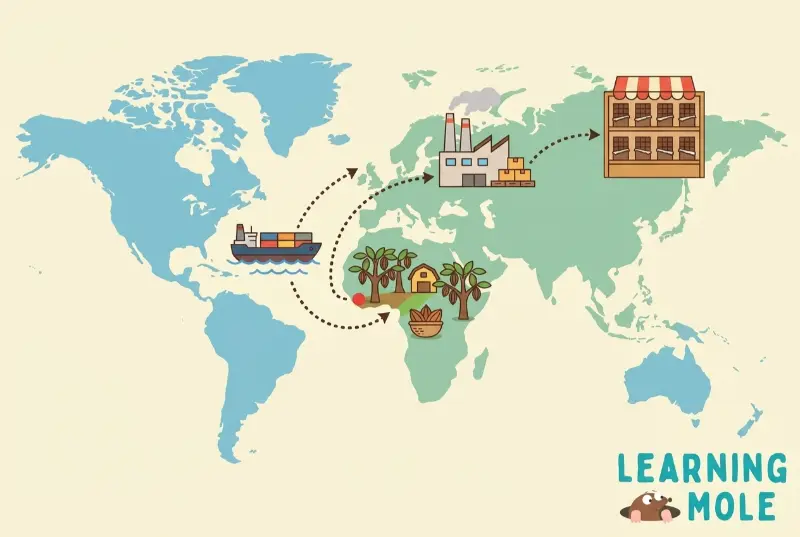
The product journey activity traces an everyday item back to where it came from, showing pupils how globalisation affects what we eat, wear and use. A chocolate bar is a good starting point: cocoa beans are grown mainly in West Africa, then shipped, processed and packaged in other countries before reaching UK shops.
Pupils plot each stage on a world map, then discuss who is involved at each step and who earns money from the chocolate. Clothing labels and smartphones work well as follow-up investigations. The table helps pupils think about the local and global sides of globalisation.
Area
Local impact
Global connection
Food
A wide variety of food in UK shops
Farming and trade around the world
Technology
Phones, tablets and computers at home and school
Materials and factories in many countries
Clothing
Affordable clothes on the high street
Cotton farms and garment workers abroad
Environment
Local weather, flooding and air quality
Climate change and global emissions
8. Cultural perspectives
The cultural perspectives activity helps pupils recognise and respect differences between cultures while finding common ground. Choose an everyday situation, such as greeting someone, sharing a meal or celebrating a birthday, then compare how it is done in different cultures and discuss the reasons behind the differences.
Pupils can extend this into a class cultural museum, where they bring in or draw items that represent their own family’s heritage and explain what they mean. Short role-plays of greetings and customs help younger pupils practise respect for different cultural norms. LearningMole’s guide to cultural traditions around the world offers more ideas for exploring culture with children.
Taking action on global issues
Pupils learn most from global issues when they can do something about them. Action projects turn concern into positive steps and show pupils that young people can make a difference.
9. Sustainable Development Goals action project
The Sustainable Development Goals action project asks pupils to choose one of the 17 global goals, research how it affects their local area and plan a small action. The goals cover issues such as ending poverty and hunger, quality education, clean water, climate action and life on land and below water, so every class can find one that interests them.
Work in small groups, with each group researching its goal, presenting what it found and proposing an action. Actions might include a school recycling scheme, a food bank collection, a campaign to reduce car journeys to school or a letter to a local councillor. Linking a local action to a global goal helps pupils see that small steps add up, and gives the topic a hopeful ending. LearningMole’s resources on pollution are a good starting point for groups that choose an environmental goal.
10. Virtual exchange and field trips
Technology lets pupils connect with peers and places around the world without leaving the classroom. Through a school partnership or online exchange, pupils can work with a class in another country on a shared project, comparing daily life and discussing a global issue such as climate change or access to education. Shared digital walls and video calls make this practical even for primary classes.
Virtual field trips bring distant places into the classroom. Many museums, including the British Museum, the Louvre and the Smithsonian’s National Museum of Natural History, offer online tours of their collections, and 360-degree videos can show pupils rainforests, cities or coastlines affected by environmental change. Before each trip, give pupils context and guiding questions, such as comparing water access in different communities, and afterwards ask them to reflect on what they learned.
Teaching global issues to different age groups
Global issues can be taught at every age, as long as the topic and approach match pupils’ understanding and maturity. Younger children need concrete, hopeful examples close to their own lives, while older pupils can handle complexity, competing viewpoints and more difficult subjects.
Age group
Suitable topics
Approach
KS1 (ages 5 to 7)
Families and homes around the world, caring for the environment, fairness
Stories, pictures, simple comparisons and kind actions
Lower KS2 (ages 7 to 9)
Food and where it comes from, recycling, children’s rights
Product journeys, rights detectives, simple research
Upper KS2 (ages 9 to 11)
Climate change, trade, migration, the Sustainable Development Goals
Simulations, debates, action projects
KS3 (ages 11 to 14)
Conflict, inequality, human rights, global governance
United Nations simulations, source analysis, extended research
Pupils aged 11 to 14 are beginning to think more abstractly and can engage with complex issues when they are presented carefully. Connect topics to their personal experiences, use current events as discussion starters and always balance problems with examples of solutions and progress.
Keeping discussions balanced and age-appropriate
Some global issues are sensitive or political, so teachers need to handle discussions with care. In England, schools have a legal duty to make sure that, when political issues are brought to pupils’ attention, they are offered a balanced presentation of opposing views, and the Department for Education’s guidance on political impartiality explains how to do this in practice.
Agree ground rules for discussion with your class, such as listening respectfully and challenging ideas, not people. Present several perspectives, use reliable sources and let pupils reach their own conclusions. Be aware that some pupils may have personal experience of issues such as conflict, migration or poverty, so check with pastoral staff before teaching sensitive topics and give pupils a way to step back if they need to.
Integrating global issues into the curriculum
You do not need separate global studies lessons to teach global awareness. Global perspectives can strengthen lessons across many subjects, and they link to curriculum requirements across the UK.
In England, KS2 geography covers human geography, including trade links and the distribution of natural resources such as food, energy, minerals and water, while citizenship is part of the National Curriculum at KS3 and PSHE covers respectful relationships and the wider world. In Wales, one of the four purposes of the curriculum is for learners to become ethical, informed citizens of Wales and the world. Scotland’s Curriculum for Excellence includes learning for sustainability, and Northern Ireland’s curriculum includes local and global citizenship.
Across subjects, global issues fit naturally into everyday teaching:
In English, pupils can read literature from different cultures, analyse news articles and write persuasive letters about international issues.
In science, pupils can investigate climate change, compare water quality and explore renewable energy.
In maths, pupils can analyse statistics on global development, calculate carbon footprints and compare data between countries.
In geography, pupils can map trade routes, compare places and study how environmental change affects communities.
LearningMole’s geography resources support many of these links, and the global issues collection brings together further articles on world topics for children. Choosing one cross-curricular link per term is a manageable way to build global learning into an existing scheme of work.
Assessing and reflecting on global learning
Assessing global learning means looking at pupils’ understanding, skills and attitudes, not only what facts they remember. Reflection helps pupils notice how their thinking has changed and deepens their understanding of global issues.
Feedback and tracking progress
Assessment for global learning should go beyond traditional tests. Digital or paper portfolios let pupils collect their work on global issues across a term, peer feedback sessions encourage pupils to evaluate each other’s arguments, and visual progress maps show how understanding grows. Rubrics that assess both factual knowledge and the ability to explain different viewpoints help teachers judge how well pupils grasp complex topics.
Encouraging self-assessment
Self-assessment helps pupils take ownership of their learning. Reflection journals, where pupils write regularly about their changing views, work well with older pupils. Before-and-after mind maps, created at the start and end of a unit, show younger pupils how much they have learned. ‘I used to think… Now I think…’ statements are a quick way for pupils of any age to describe a shift in their understanding.
Teaching resources and support
LearningMole provides free and subscription-based educational videos and teaching materials that support teaching global issues in primary schools, including geography, the environment, cultures around the world and citizenship. With over 3,300 free resources aligned to the UK National Curriculum, LearningMole serves teachers and parents across the UK and beyond.
For the classroom, LearningMole’s resources give teachers clear, child-friendly explanations of global topics to use before activities such as the trade game or a United Nations simulation, saving time on lesson preparation. For home learning, parents and carers can use the same resources to answer children’s questions about world events in a calm, age-appropriate way. You can also find out more about LearningMole and the educators behind the resources.
Frequently asked questions
What are global issues for kids?
Global issues are problems that affect people in many countries and need countries to work together to solve them. Examples suitable for children include climate change, pollution, poverty, hunger, access to clean water and education, children’s rights and helping people who have had to leave their homes.
How do you teach global issues in primary school?
Start with concrete, hopeful examples close to children’s lives, such as where food comes from or how to reduce waste. Use stories, pictures, role-play and simple comparisons, present more than one viewpoint and end each topic with a positive action pupils can take.
What are good global issues topics for students?
Good global issues topics for students include climate change, plastic pollution, fair trade, access to clean water, children’s rights, migration and the 17 Sustainable Development Goals. Younger pupils do best with topics they can connect to everyday life, while older pupils can explore conflict, inequality and global decision-making.
What are the best activities for teaching global issues?
Some of the most effective activities are regular news discussions, United Nations simulations, trade games, personal stories from guest speakers, product journey investigations and action projects based on the Sustainable Development Goals. The best activities are active, balanced and finish with something pupils can do.
How do I teach sensitive global issues without upsetting children?
Choose topics and sources that suit pupils’ age, focus on solutions and on people who are helping, and set clear ground rules for respectful discussion. Check with pastoral staff before teaching topics such as conflict or migration, as some pupils may have personal experience of them.
Do I have to stay politically neutral when teaching global issues?
Teachers in England must offer a balanced presentation of opposing views when political issues are discussed, and should not promote their own political views to pupils. Presenting several perspectives and letting pupils reach their own reasoned conclusions meets this duty and also builds critical thinking.
How does teaching global issues link to the UK curriculum?
In England, global issues link to KS2 geography, KS3 citizenship, PSHE, science and English. In Wales, the curriculum aims for learners to become ethical, informed citizens of Wales and the world, while Scotland includes learning for sustainability and Northern Ireland includes local and global citizenship.
How can parents talk about global issues at home?
Parents and carers can talk about the news together, cook food from different countries, read books set around the world and take small actions such as recycling or donating to a food bank. Keeping conversations calm and hopeful, and answering questions honestly, helps children feel informed without becoming worried.
Explore LearningMole’s global issues resources
LearningMole provides curriculum-aligned videos and teaching materials for children aged 4 to 11, covering geography, science, PSHE, English and more across Key Stage 1 and Key Stage 2. Whether you are planning a global citizenship unit, preparing a United Nations simulation or helping your child understand the news, our resource library has ready-made materials that save planning time.
Explore our teaching resources or see our subscription plans for full access to our geography and world topics videos, activities and printable classroom resources. New content is added to the library regularly, so it is worth checking back when you plan your next topic.
Maths Circus, an innovative platform we've crafted, presents a captivating realm where children learn mathematics through the exciting theme of a circus. The joy of juggling numbers and solving circus...
Imagine looking up from a Dorset beach 190 million years ago and seeing a creature with leathery wings gliding over the waves. Many children would call it a flying dinosaur,...
Article Summary What this article covers: Twenty-eight polar animals sorted properly by pole, with 21 from the Arctic, 5 from the Antarctic and 2 found at both, along with the...
Article Summary What this article covers: Five active learning strategies for home education (inquiry-based learning, Socratic questioning, gamification, the concrete-pictorial-abstract approach and teaching back), with zero-preparation ideas for busy parents,...




Leave a Reply