20 Great Facts about The Egyptian Pyramids
Table of Contents
The Egyptian pyramids are among the most visited and most studied structures on Earth, yet they still hold secrets that archaeologists are only now beginning to unravel. Built over 4,500 years ago without modern machinery, GPS, or power tools, these monuments were constructed with a precision that continues to puzzle engineers today.

For children studying ancient history, the pyramids are more than a fascinating subject: they are a window into one of the world’s greatest civilisations, and they sit firmly within the KS2 History curriculum under the study of the earliest civilisations.
LearningMole, the UK educational platform founded by former primary teacher Michelle Connolly, has put together this in-depth guide to bring pyramid facts to life for children aged 7 to 11. Whether you are a teacher planning a KS2 ancient Egypt unit, a parent supporting homework, or a curious child eager to learn everything about these incredible structures, this article goes well beyond the basics.
You will find curriculum-aligned facts, classroom activities, a scale comparison with UK landmarks, and the very latest archaeological discoveries, including a hidden corridor found inside the Great Pyramid as recently as 2023.
We have expanded the original five facts into twenty carefully verified facts, organised into clear sections so children can dip in and teachers can plan around them. Each fact connects to something bigger: the engineering of the ancient world, the beliefs that shaped Egyptian society, and the ongoing detective work that modern science continues to carry out on these astonishing structures. By the end of this guide, your class will understand not just what the pyramids are, but why they matter.
More Than Just Stone: Why the Egyptian Pyramids Still Matter Today

The pyramids were built during the Old Kingdom period of ancient Egypt, roughly 2700 to 2200 BCE, when pharaohs were considered divine rulers and their safe passage to the afterlife was a matter of national importance. The Great Pyramid of Giza, built for Pharaoh Khufu around 2560 BCE, is the only surviving structure from the Seven Wonders of the Ancient World. That alone makes it worth studying.
In the KS2 History curriculum, ancient Egypt is studied within the earliest civilisations, and the pyramids are the most tangible evidence of what those civilisations achieved. Understanding the pyramids helps children grasp concepts that span history, science, maths, and art: how ancient people organised labour at scale, how they used geometry to achieve near-perfect alignment, and how their beliefs about death and the afterlife shaped everything they built.
What makes the pyramids particularly valuable for classroom teaching is that new discoveries are still being made. Archaeology is not just about the past. The 2023 discovery of a hidden corridor inside the Great Pyramid, revealed by cosmic-ray imaging technology, is a reminder that these structures are still revealing their secrets.
20 Amazing Facts about the Egyptian Pyramids
These facts are organised from construction and scale through to internal design, purpose, and modern discoveries. Teachers will find curriculum connections flagged throughout.
1. The Great Pyramid Was the World’s Tallest Structure for About 3,800 Years
When it was completed around 2560 BCE, the Great Pyramid of Giza stood 146 metres tall. It held the record as the tallest human-made structure on Earth until Lincoln Cathedral in England surpassed it around 1311 CE. That is nearly four millennia of unchallenged height. Today, after centuries of erosion and the loss of its outer casing stones, it stands at approximately 138 metres.
2. They Were Not Built by Slaves
For centuries, popular accounts suggested the pyramids were built by enslaved people. Archaeological evidence gathered since the 1990s tells a different story. Excavations at Giza revealed workers’ villages complete with bakeries, breweries, and medical facilities.
The workers ate well: records show diets rich in beef, sheep, and goat meat, which was an exceptionally high-protein diet for the ancient world. These were skilled, organised labourers, many of whom received medical care for injuries sustained on site. This is one of the most important fact corrections in modern Egyptology, and it gives children a more accurate picture of ancient Egyptian society.
3. A Hidden Corridor Was Discovered Inside the Great Pyramid in 2023
In March 2023, the ScanPyramids project announced the discovery of a previously unknown corridor inside the Great Pyramid of Giza. The corridor is approximately nine metres long and two metres wide, located just below the north face of the pyramid.
It was found using a technique called muon tomography, which uses cosmic-ray particles that pass through dense stone the way X-rays pass through the human body. Scientists can detect voids and chambers without disturbing the pyramid at all. The corridor’s exact purpose is still being studied, but its discovery confirms there is still much to learn about these structures even after thousands of years of investigation.
4. The Pyramids Are Aligned Almost Perfectly to True North
The Great Pyramid of Giza is aligned to true north with an accuracy of just 0.05 degrees. This is an extraordinary achievement for a civilisation without compasses or modern surveying equipment. Researchers believe the ancient Egyptians used the night sky to achieve this, tracking the rotation of stars around the celestial north pole. This alignment connects KS2 Science (the Earth and the solar system) with KS2 History, making it a useful cross-curricular discussion point.
5. They Once Shone Like Mirrors in the Desert Sun
When first completed, the pyramids were clad in polished white limestone quarried near modern Cairo. This casing reflected the sun so intensely that the pyramids would have been visible from many miles away, gleaming across the desert. Some pyramids had golden capstones (called pyramidions) that caught the sunlight. The outer casing was gradually removed over centuries and used in other construction projects, which is why the stepped core stone we see today looks so different from the original smooth surface.
6. The Great Pyramid Contains Around 2.3 Million Stone Blocks
Each block in the Great Pyramid weighs an average of 2.5 tonnes, roughly the same as a large family car. Some granite blocks used in the internal chambers weigh up to 80 tonnes. Laid end to end, the blocks would circle the Earth’s equator nearly twice. The base of the pyramid covers approximately 5.3 hectares, larger than ten football pitches.
7. The ‘Wet Sand’ Theory May Explain How They Moved the Blocks
One of the longest-running puzzles in archaeology is how the ancient Egyptians moved such enormous stone blocks across desert terrain. A 2014 study published in the journal Physical Review Letters found strong evidence in ancient Egyptian paintings and physical testing: workers poured water on sand in front of sledges carrying heavy loads. Wet sand reduces friction by up to 40%, making it far easier to pull massive weights. This has direct links to the KS2 Science curriculum topic of forces and friction, making it an excellent cross-curricular teaching moment.
8. The Pyramids Required Enormous Logistical Organisation
Estimates suggest around 20,000 to 30,000 workers were involved in building the Great Pyramid at any one time, not the 100,000 sometimes quoted in older sources. Feeding, housing, and coordinating this workforce required sophisticated management systems. Workers were organised into named gangs and crews with assigned shifts. Records found on papyrus at Wadi al-Jarf, dating to around 2560 BCE, describe workers transporting limestone by boat along a canal. These documents are the oldest papyri ever discovered and give direct, first-hand insight into pyramid construction.
9. Pyramid Building Evolved Over Time
The very first pyramid was the Step Pyramid of Djoser at Saqqara, built around 2670 BCE. Its architect, Imhotep, stacked six rectangular stone platforms called mastabas on top of each other to create a stepped form. Less than a century later, Pharaoh Snefru built the Bent Pyramid at Dahshur, which starts at a steep angle and then changes to a shallower angle partway up, suggesting builders adjusted the design mid-construction. His Red Pyramid, built nearby, was the first true smooth-sided pyramid and paved the way for the Giza monuments.
10. The Interior Has Three Main Chambers
Inside the Great Pyramid, a network of corridors leads to three distinct chambers. The lowest chamber, carved into the bedrock, may have been an original burial plan that was abandoned. The Queen’s Chamber sits higher up, though it almost certainly never housed a queen. The King’s Chamber, built from red Aswan granite and located at the heart of the pyramid, contains a large empty sarcophagus. Above the King’s Chamber are five ‘relieving chambers’ designed to distribute the enormous weight of the stones above and protect the burial space below.
11. The Pyramids Were Designed to Protect the Pharaoh’s Journey to the Afterlife
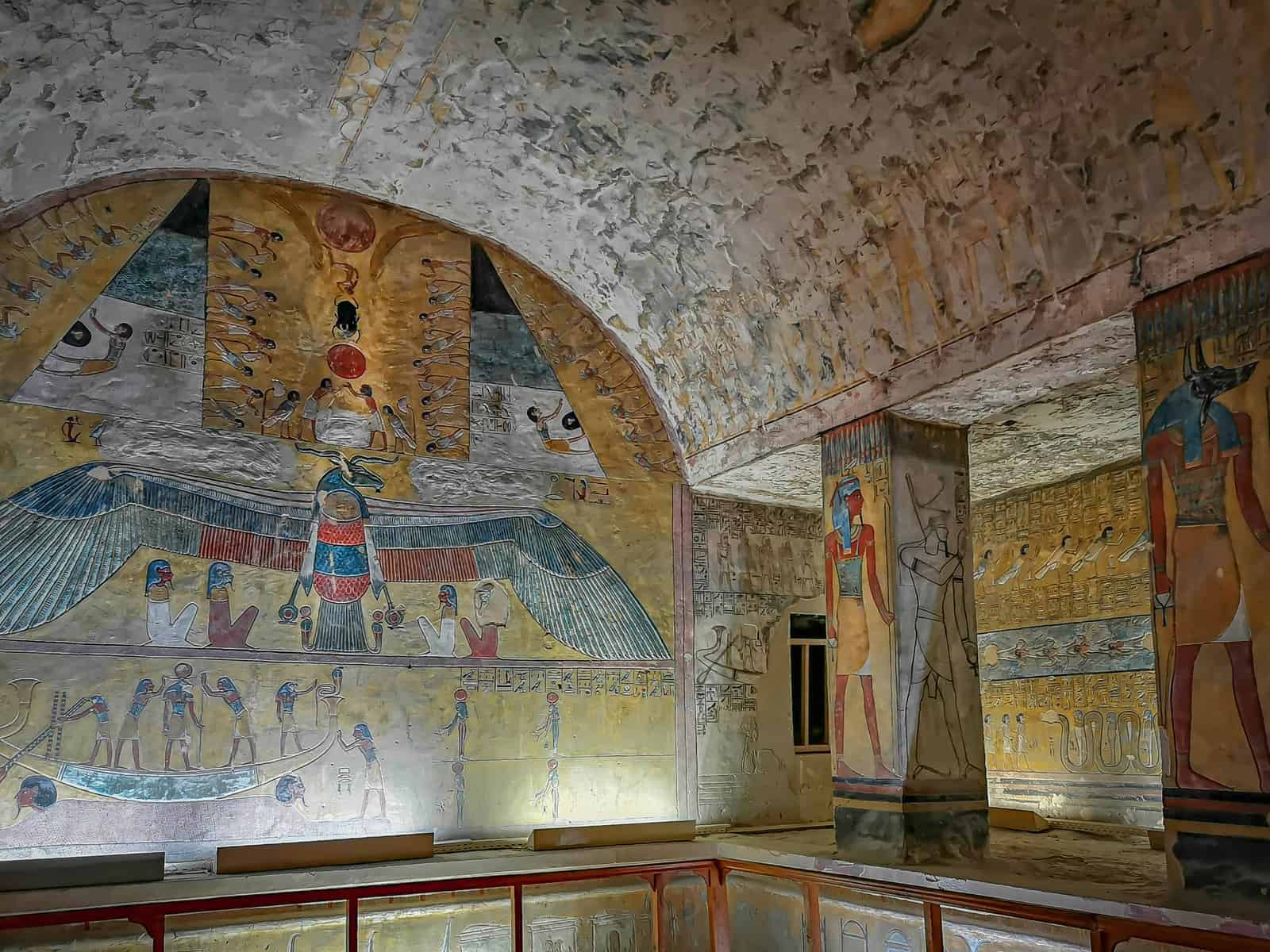
Ancient Egyptians believed the pharaoh’s spirit, known as the ka, needed a safe physical body to return to. The pyramid shape itself held meaning: it may have represented the Benben stone, the sacred mound of creation from Egyptian mythology, or the rays of the sun breaking through clouds. Early pyramid texts, inscribed on the interior walls of later Old Kingdom pyramids, contain spells and prayers to guide the pharaoh safely through the afterlife. The tomb was filled with everything the pharaoh would need in the next life: food, wine, furniture, jewellery, and even model servants called shabtis.
12. Pharaohs Were Sometimes Buried with Pets and Servants
The contents of royal tombs varied by period. In the very earliest dynasties, servants and animals were occasionally buried alongside the pharaoh. By the Old Kingdom, this practice had been largely replaced by the use of shabtis: small carved figurines intended to carry out labour on behalf of the deceased in the afterlife. The tombs were packed with provisions: archaeologists have found wine jars, bread, dried fruit, tools, cosmetics, and elaborate jewellery in pyramid complexes across Egypt.
13. The Pyramid Was Once Protected by Massive Stone Plugs
After the pharaoh’s body and burial goods were placed inside, the entrance passages were blocked with enormous granite plugs. Some of these plugs weighed as much as 20 tonnes. Robbers did eventually breach many pyramids by digging around the plugs rather than through them. By the New Kingdom period (around 1550 to 1070 BCE), pharaohs had largely abandoned pyramid building in favour of hidden rock-cut tombs in the Valley of the Kings, specifically to avoid tomb robbery.
14. The Pyramids Were Once Topped with Gold
The pyramidion, the capstone placed at the very top of a pyramid, was often made from granite coated with gold or electrum (a natural alloy of gold and silver). No intact pyramidion from the Giza pyramids has survived, but examples from other pyramids are preserved in the Egyptian Museum in Cairo. When sunlight struck the golden tip, it would have been visible from a great distance across the flat desert landscape.
15. The Great Sphinx Stands Guard at Giza
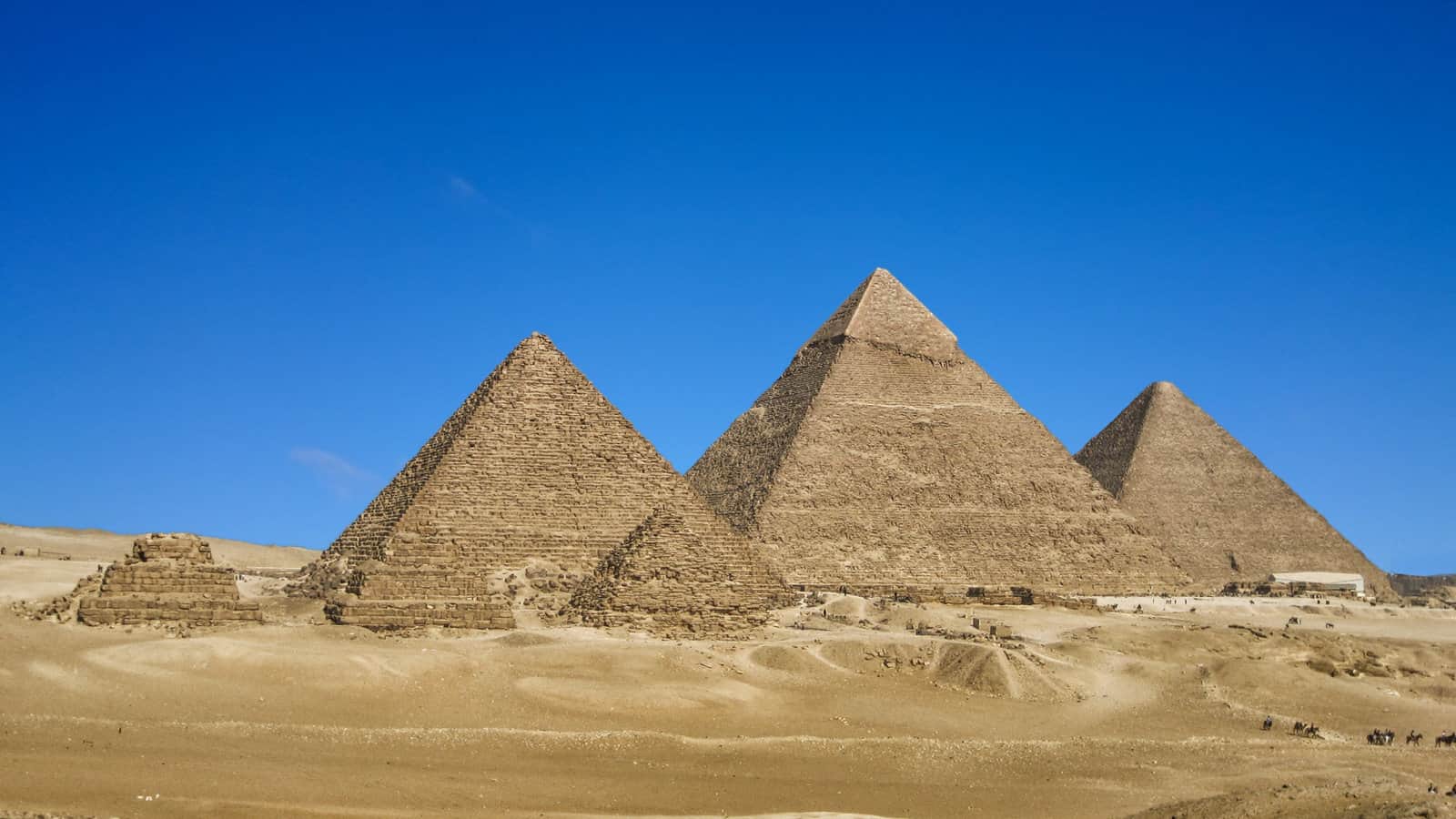
The Great Sphinx is a massive carved limestone statue with a human head and a lion’s body. It stands approximately 20 metres tall and 73 metres long, and it was likely carved during the reign of Pharaoh Khafre, the builder of the second pyramid at Giza. The Sphinx faces due east, towards the rising sun. A small temple sits between its paws. The Sphinx has weathered badly over thousands of years, and extensive restoration work has been carried out in modern times.
16. There Are Over 130 Pyramids in Egypt
The three pyramids at Giza are by far the most famous, but they represent only a fraction of Egypt’s pyramid heritage. Over 130 pyramids have been identified across Egypt, ranging from the massive Giza monuments to smaller, poorly preserved structures in the Sudanese region known as Nubia. Many remain partially buried under desert sand. New pyramid structures continue to be identified through satellite imaging and ground-penetrating radar, suggesting the total number may increase as technology improves.
17. Temperatures Inside the Pyramids Remain Constant
Despite Egypt’s extreme desert heat, the interior of the Great Pyramid stays at a relatively steady temperature of around 20 degrees Celsius year-round. This is partly a function of the pyramid’s enormous mass: the stone absorbs and releases heat very slowly, buffering the interior against outside temperature changes. This consistent temperature was likely beneficial for the preservation of burial goods over thousands of years.
18. The Pyramids Have Their Own Mathematical Relationships
The ratio of the Great Pyramid’s base perimeter to its height is very close to 2 times pi (roughly 6.28), a relationship that has fascinated mathematicians for centuries. Whether this was intentional or a coincidence of the construction method is debated. What is not debated is the extraordinary precision of the base: it is level to within just two centimetres across its entire 230-metre span. For KS2 Maths, the pyramid’s geometry provides a genuine real-world context for exploring area, perimeter, and scale.
19. Pyramid Building Took Decades
The Great Pyramid is believed to have taken approximately 20 to 30 years to build. Given that Khufu’s reign lasted around 23 years, this means construction was likely underway from the very beginning of his rule. Organising, quarrying, transporting, and placing an estimated 2.3 million stone blocks in that timeframe required placing roughly 800 blocks per day, or one block every two minutes during a ten-hour working day. This calculation alone makes for a compelling classroom discussion about ancient mathematics and logistics.
20. Scientists Are Still Discovering New Things About the Pyramids
The ScanPyramids project, which began in 2015, uses multiple non-invasive technologies, including infrared thermography, 3D modelling, and muon tomography, to study the pyramids without disturbing them. The 2023 corridor discovery made headlines worldwide and was peer-reviewed in the journal Nature Communications.
Archaeology has moved well beyond shovels and brushes: today’s Egyptologists work alongside physicists, engineers, and data scientists. This makes ancient Egypt an excellent context for discussing careers in science and technology with KS2 children.
Construction Secrets: How Were the Egyptian Pyramids Built?

No single theory fully explains how the ancient Egyptians constructed the pyramids, and that uncertainty is itself an important lesson: science and history are ongoing processes, not fixed answers. The most widely supported explanation for moving the massive stone blocks involves wooden sledges pulled across wet sand, reducing friction enough for teams of workers to drag loads that would otherwise be immovable. Experiments replicating this technique have shown it to be genuinely effective.
For lifting blocks to higher levels, most researchers favour some form of straight or spiral ramp built as the pyramid rose. Internal ramp theories, supported by features visible inside certain pyramids, suggest builders may have used ramps within the structure itself rather than external ones. Each theory has evidence in its favour, and the debate continues. For teachers, framing this as an open scientific question works well in KS2 Science lessons on forces and materials.
The logistical complexity is staggering. Limestone was quarried just south of Giza. Harder granite, used for internal chambers and some casing, was transported by boat from Aswan, roughly 800 kilometres to the south. A papyrus diary found at Wadi al-Jarf, dated to around 2560 BCE, describes a team of workers who delivered 40 limestone loads in a single day along a Nile canal route. This document, the oldest known papyrus, provides direct primary source evidence of how pyramid construction actually worked.
The Three Giants of Giza: A Comparison

| Pyramid | Pharaoh | Original Height | Base Length | Key Feature |
|---|---|---|---|---|
| Great Pyramid (Khufu) | Khufu / Cheops | 146 m (481 ft) | 230 m | Only surviving Seven Wonder of the Ancient World |
| Pyramid of Khafre | Khafre | 136 m (446 ft) | 215 m | Still retains some original limestone casing at the apex |
| Pyramid of Menkaure | Menkaure | 65 m (213 ft) | 105 m | Only surviving Seven Wonders of the Ancient World |
How Big Were They Really? The Great Pyramid vs. UK Landmarks
| Structure | Height | Age | UK Comparison |
|---|---|---|---|
| Great Pyramid of Giza | 146 m (original) | ~4,600 years old | Taller than The Shard (310 m) halved; 1.5x St Paul’s Cathedral |
| The Shard, London | 310 m | Built 2012 | Twice the height of the Great Pyramid |
| Blackpool Tower | 158 m | Built 1894 | Just 12 m taller than the original pyramid |
| St Paul’s Cathedral | 111 m | Built 1710 | Original pyramid was 35 m taller |
| Nelson’s Column (incl. statue) | 51.6 m | Built 1843 | The original pyramid was 35 m taller |
Inside the Great Pyramid: A Journey Through Time

Entering the Great Pyramid today, visitors walk through the Descending Passage, a narrow corridor that leads down into the bedrock. A separate Ascending Passage leads up to the Grand Gallery, a soaring corbelled corridor nearly nine metres tall and 47 metres long. At the top of the Grand Gallery lies the King’s Chamber, built entirely of polished red granite from Aswan.
The chamber contains an empty sarcophagus, its lid long gone. Above the chamber are five relieving chambers discovered in the 19th century, designed to spread the enormous weight of the pyramid away from the burial space below.
The so-called Queen’s Chamber sits lower in the pyramid and may have served as a ritual space rather than an actual burial chamber. Two small shafts lead from both the King’s and Queen’s Chambers towards the exterior, pointing towards specific stars. Egyptologists believe these may have been aligned with stars significant in Egyptian religion, specifically Orion’s Belt (associated with Osiris) and the star Thuban, the north pole star in Khufu’s time.
The 2023 corridor discovery sits just below the north face, directly above the main entrance. Researchers from ScanPyramids believe it may have been built to redistribute weight above the entrance corridor. Its presence suggests that the pyramid’s internal architecture is still not fully understood, and that further discoveries may await.
Teaching Resources and Support: Ancient Egypt in the Classroom

Ancient Egypt is a popular KS2 History topic precisely because it combines storytelling, science, maths, and art in a single subject. The pyramids sit within the National Curriculum objective for KS2 History: ‘The achievements of the earliest civilisations: an overview of where and when the first civilisations appeared and a depth study of one of the following: Ancient Sumer, the Indus Valley, Ancient Egypt, the Shang Dynasty of Ancient China.’
Classroom Activities by Year Group
Year 3/4: ‘Build a Pyramid’ scale drawing exercise. Children calculate the relative dimensions of the Great Pyramid using simple ratios, then draw it to scale on squared paper. This supports KS2 Maths: geometry and ratio.
Year 4/5: ‘The Worker’s Menu.’ Children research the diet of pyramid workers (beef, fish, bread, onions, garlic) using the archaeological evidence from Giza’s workers’ village. They then design a weekly meal plan for a crew leader, justifying their choices using historical evidence. This supports KS2 History skills: using sources and making inferences.
Year 5/6: ‘Shadow Maths.’ Using the same technique attributed to the Greek mathematician Thales, children measure the height of a school building or tree using its shadow and the shadow of a metre stick. This cross-curricular activity connects KS2 Maths (ratio and proportion) with KS2 History (ancient mathematics).
Supporting Home Learning
Parents supporting children studying ancient Egypt will find that connecting facts to an everyday scale works well. Ask children: how many times taller than our house is the Great Pyramid? How far is 800 kilometres on a map of the UK (roughly London to Inverness)? How long would it take to carry a two-tonne stone by hand?
LearningMole’s video resources on ancient Egypt bring these topics to life through visual explanation, making abstract facts concrete for primary-aged learners. The platform’s curriculum-aligned content supports KS2 History and is designed for both classroom use and home learning, with clear explanations suitable for children aged 7 to 11.
“Children are naturally curious about scale and mystery, and the pyramids offer both in abundance. When a class realises that the builders placed one stone block every two minutes for twenty years, the maths stops being abstract and becomes a genuine human story.” Michelle Connolly, Founder of LearningMole and former teacher with over 15 years of classroom experience
Frequently Asked Questions

How many pyramids are there in Egypt?
Over 130 pyramids have been identified in Egypt, though some sources cite figures between 118 and 138 depending on what counts as a pyramid structure. Many are in poor condition or partially buried under desert sand. Satellite imaging continues to identify new pyramid structures, so the total may increase. The most famous are the three on the Giza plateau, but significant pyramids also exist at Saqqara, Dahshur, Abusir, and further south in Nubia.
Who really built the Egyptian pyramids?
The pyramids were built by organised teams of skilled workers, not enslaved people. Archaeological evidence from workers’ villages at Giza includes bakeries, breweries, fish-processing areas, and a medical facility where healed bone fractures indicate workers received treatment for injuries. Workers were likely recruited from across Egypt on rotating shifts, possibly as a form of tax or civic service. Papyrus records from the period describe named work gangs with assigned supervisors and rations.
What is inside the Great Pyramid of Giza?
The Great Pyramid contains three main chambers connected by passages. The King’s Chamber, built from Aswan granite, houses an empty sarcophagus and is topped by five relieving chambers. The Queen’s Chamber sits lower and may have served a ritual purpose. The Subterranean Chamber, carved into the bedrock, was possibly an abandoned original design. In 2023, the ScanPyramids project discovered a previously unknown corridor nine metres long near the north face of the pyramid, suggesting the internal layout is not yet fully mapped.
Why were the pyramids built in a pyramid shape?
Several explanations have been proposed and none is definitively settled. The shape may represent the Benben stone, the primordial mound from which life emerged in Egyptian creation mythology. It may also represent a solidified ray of sunlight, connecting the pharaoh to Ra, the sun god. Practically, a pyramid shape distributes enormous weight efficiently to the ground, which is why the form worked structurally. The pointed apex also directed the pharaoh’s spirit towards the heavens.
How long did it take to build a pyramid?
The Great Pyramid of Giza took an estimated 20 to 30 years to build, roughly matching the length of Pharaoh Khufu’s reign. To complete the structure in this time, workers would have needed to place approximately 800 blocks per day. Smaller pyramids could be completed more quickly, but even modest pyramid complexes represented decades of coordinated labour. Construction typically began as soon as a new pharaoh took the throne.
Are these pyramid facts suitable for KS2 homework and assignments?
Yes. All 20 facts in this article are based on current archaeological evidence and are aligned with the KS2 History curriculum’s coverage of the earliest civilisations. The facts avoid outdated claims such as the slave-builder myth and include the most recent discoveries, including the 2023 corridor find. Teachers and parents can use these facts confidently for Year 4, Year 5, and Year 6 homework tasks, school projects, and lesson planning.
How can I teach about pyramid construction using science topics?
Pyramid construction connects naturally to KS2 Science topics on forces and friction. The wet-sand transport method, in which workers poured water in front of sledge runners to reduce friction, can be replicated at small scale in a classroom. Children can test how much easier it is to drag a weighted block across dry versus wet sand. The use of ramps to raise blocks connects to KS2 work on simple machines and forces. Muon tomography, used to discover the 2023 corridor, provides a context for discussing radiation and modern physics with older KS2 children.
How do the Egyptian pyramids link to the UK National Curriculum?
Egyptian pyramids appear directly in the KS2 History programme of study under ‘The achievements of the earliest civilisations.’ Beyond history, the pyramids support KS2 Maths (geometry, ratio, scale, and calculation), KS2 Science (forces, friction, materials, and the solar system), KS2 Art and Design (studying Egyptian art conventions and architectural design), and KS2 Computing (through discussions of modern scanning technology used in archaeology). LearningMole provides curriculum-aligned resources covering all these connections.
Conclusion
The Egyptian pyramids are one of those rare topics that genuinely grow with the children who study them. A Year 3 child might be captivated by the sheer size of the structures and the gold-tipped capstones shining in the desert sun. A Year 6 pupil can engage with the muon tomography that found a hidden corridor in 2023, or wrestle with the mathematics of placing 800 stone blocks per day for two decades. This depth is why the pyramids remain such a reliable and rewarding KS2 History topic.
What these 20 facts make clear is that the pyramids were not built by a mysterious or superhuman civilisation. They were built by an organised, well-fed, medically cared-for workforce using ingenious practical solutions to very difficult engineering problems. That story, of human ingenuity working within real constraints, is arguably more remarkable than any ancient mystery. It also gives children a more accurate and respectful understanding of what ancient Egyptians actually achieved.
LearningMole provides a range of curriculum-aligned resources to support your KS2 ancient Egypt teaching, including video content, activities for different year groups, and guides for parents supporting home learning. Whether you are planning a full unit on the earliest civilisations or looking for a single lesson to complement what children are already studying, the resources at LearningMole are designed by experienced educators to make complex history accessible, accurate, and engaging for primary-aged learners.


Leave a Reply